A garage door opener light bulb does more than simply illuminate your garage. The right bulb needs to work reliably with the opener, handle vibration from the motor and door movement, tolerate garage temperatures, and avoid interfering with the opener’s remote-control signal.
Choosing a normal household bulb without checking compatibility can lead to flickering, short bulb life, poor brightness, or even remote-control problems. Fortunately, selecting and replacing a garage door opener light bulb is usually straightforward once you know what to look for.
This guide explains how to choose the right bulb, whether LED or incandescent is better, how to replace the bulb, and how to troubleshoot common garage door opener lighting problems.
What Is a Garage Door Opener Light Bulb?
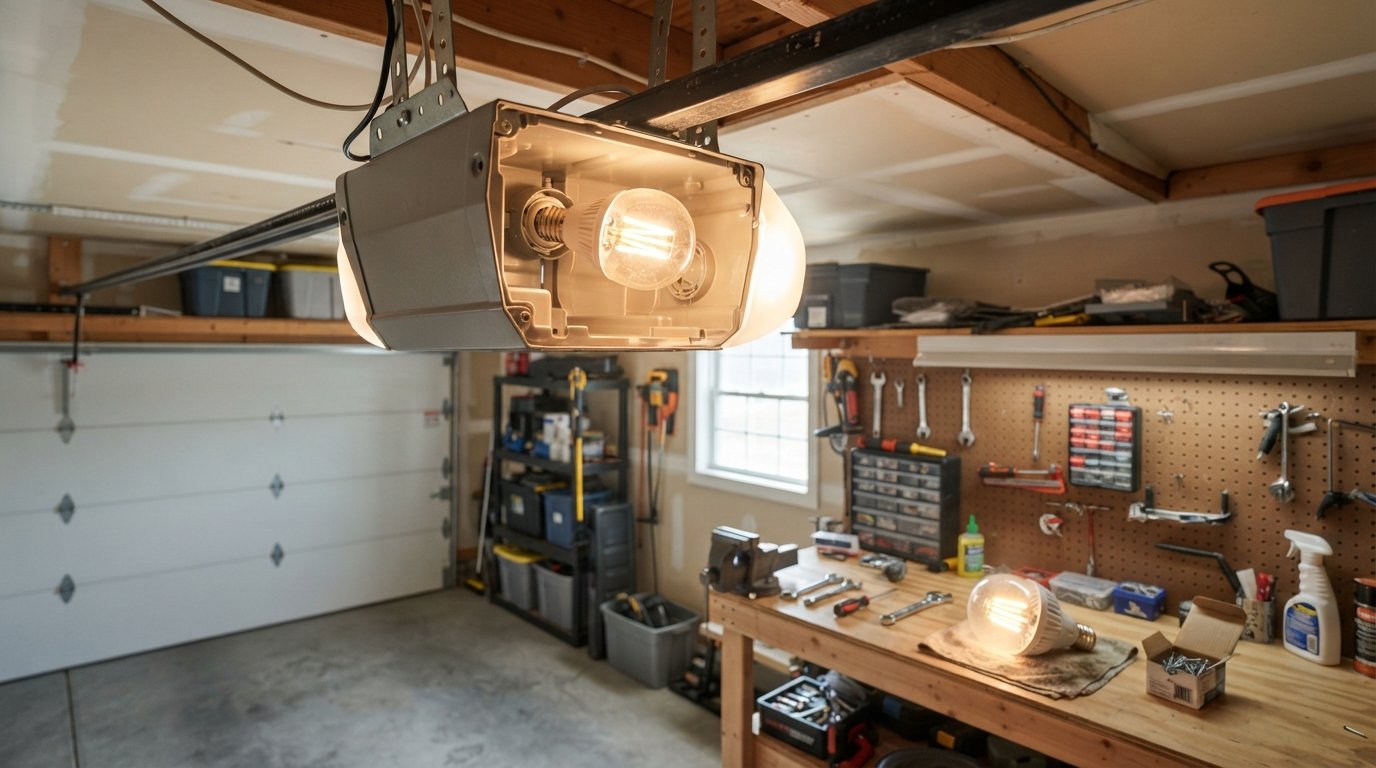
A garage door opener light bulb is the bulb installed inside or near a motorized garage door opener. The opener typically turns the light on automatically when you activate the door or use the wall control.
The light provides temporary illumination around the garage door and opener area, making it easier to enter or leave the garage safely at night.
Unlike an ordinary lamp, a garage door opener places the bulb in an environment with:
- Motor vibration
- Frequent on/off cycles
- Temperature changes
- Dust and humidity
- Limited ventilation
- Potential radio-frequency interference
For these reasons, bulb compatibility matters.
Why You Need a Special Garage Door Opener Light Bulb
Not every household light bulb is ideal for a garage door opener.
The opener’s manufacturer may specify particular requirements for bulb type, wattage, size, and construction. Some openers also have limitations involving LED bulbs because certain LEDs can interfere with radio-frequency signals used by garage door remotes.
Vibration Resistance
Garage door openers operate motors, gears, chains, belts, or other moving components. This creates vibration that can shorten the life of bulbs that are not designed for demanding environments.
A vibration-resistant bulb can be a better choice than a standard decorative household bulb.
Temperature Resistance
Garages can become very hot or cold depending on the climate and whether the space is insulated.
A suitable garage door opener bulb should be designed to operate within the temperatures commonly experienced in the garage.
Radio-Frequency Compatibility
Some LED bulbs can produce electromagnetic or radio-frequency interference.
In certain garage door opener systems, this interference can reduce the operating range of the remote control.
This does not mean all LED bulbs cause problems. Many bulbs are specifically designed to minimize interference.
What Is the Best Bulb for a Garage Door Opener?
The best garage door opener light bulb depends on the opener manufacturer’s requirements and the conditions in your garage.
When choosing one, consider:
- Bulb base
- Maximum permitted wattage
- Brightness
- Bulb size
- LED or incandescent technology
- Vibration resistance
- Temperature rating
- Radio-frequency interference
- Expected lifespan
A garage-door-opener-rated LED bulb is often a practical choice because it can provide long life and lower energy consumption while being designed for this type of application.
However, always check your opener’s manual before installing a replacement.
LED vs. Incandescent Garage Door Opener Bulbs
One of the most common questions is whether an LED or incandescent bulb is better for a garage door opener.
LED Garage Door Opener Bulbs
LED bulbs are popular because they generally use less electricity and last much longer than traditional incandescent bulbs.
Potential advantages include:
- Lower energy consumption
- Long service life
- Lower operating temperature
- Good brightness
- Frequent on/off operation compatibility
- Availability in garage-door-opener-rated designs
However, not every LED bulb is suitable for every opener.
The most important consideration is radio-frequency interference.
Incandescent Garage Door Opener Bulbs
Incandescent bulbs have traditionally been used in many garage door openers.
Their advantages include:
- Simple compatibility
- No LED-related radio interference
- Familiar replacement process
- Usually inexpensive
Their disadvantages include higher energy consumption and shorter lifespan compared with LED technology.
Which Should You Choose?
If your garage door opener supports LED bulbs, a properly rated LED designed for garage door openers can be an excellent option.
If an LED bulb causes remote-control problems, replacing it with a compatible low-interference LED or an approved incandescent bulb may solve the issue.
How to Choose the Right Garage Door Opener Light Bulb
Before buying a replacement, check several important specifications.
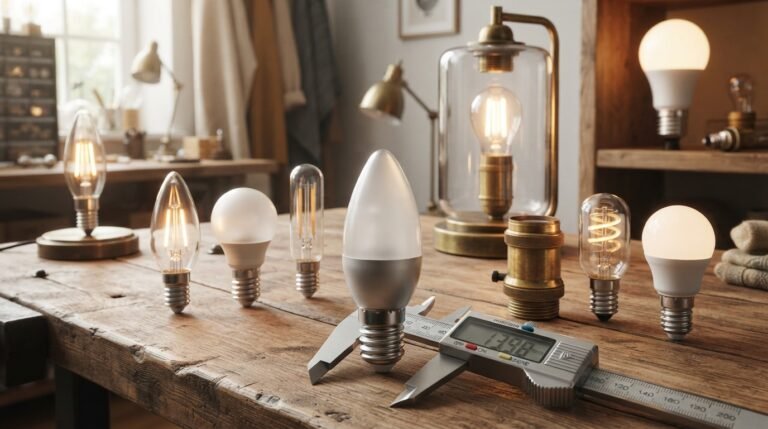
Check the Bulb Base
The bulb must physically fit the opener’s socket.
Many garage door openers use common screw-in bulb bases, but you should confirm the exact base type for your model rather than assuming.
A bulb with the wrong base will not install correctly.
Check the Maximum Wattage
Look at the opener’s manual or the labeling near the light socket.
Never install a bulb that exceeds the opener’s specified maximum wattage.
The maximum wattage is an important safety and compatibility requirement.
Check the Bulb Size
Even if the base fits, a bulb can be physically too large for the opener’s light housing.
Check:
- Overall bulb length
- Diameter
- Shape
- Clearance around the socket
- Light-cover clearance
Check Brightness
Brightness is generally measured in lumens, not watts.
Watts describe energy consumption, while lumens describe the amount of visible light produced.
For example, a lower-wattage LED can produce substantial brightness while consuming much less electricity than an incandescent bulb.
Look for Vibration Resistance
A garage door opener bulb should ideally be able to withstand the vibration produced during normal operation.
A bulb specifically marketed for garage doors or vibration-prone applications can be preferable to a delicate decorative bulb.
Check Temperature Rating
If your garage becomes extremely hot or cold, pay attention to the bulb’s operating-temperature specifications.
A bulb that performs well inside a climate-controlled room may not perform equally well in an unheated or uninsulated garage.
Garage Door Opener LED Bulb and Remote Interference
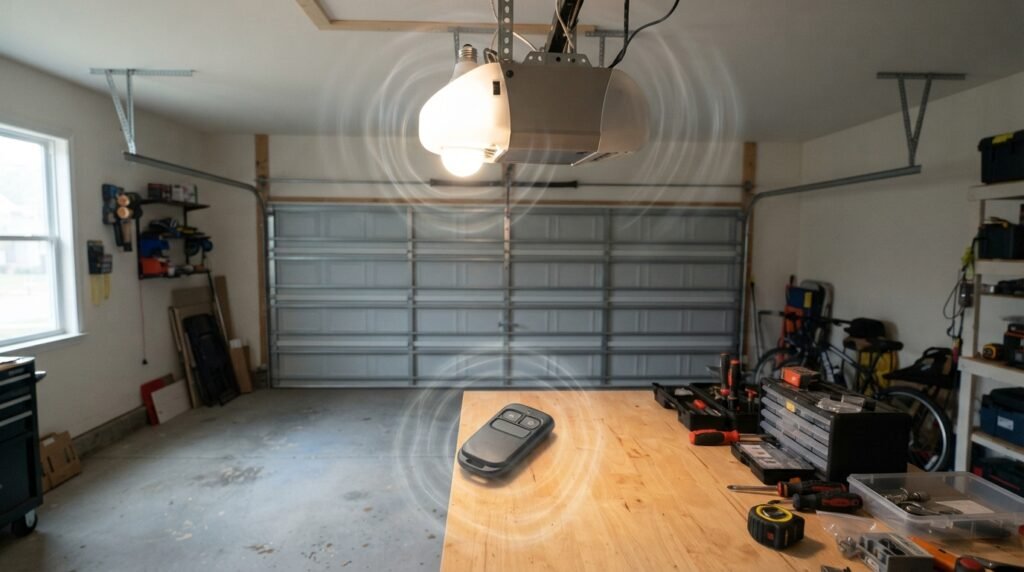
One of the most important issues with some LED bulbs is interference with garage door opener remotes.
Why Can an LED Bulb Affect a Garage Door Opener?
Some electronic LED drivers can generate electromagnetic or radio-frequency noise.
If that noise overlaps with or disrupts the communication used by the opener’s remote-control system, the remote may work only from a shorter distance or may become unreliable.
Symptoms of LED Interference
You may notice:
- Remote works only when you are close to the garage
- Remote range suddenly decreases after replacing the bulb
- Wireless keypad becomes unreliable
- Wall control works normally but remotes struggle
- Opener works inconsistently after a new bulb is installed
The bulb is not necessarily the only possible cause, but it is worth testing.
How to Fix LED Interference
If the problem began immediately after installing an LED bulb:
- Remove the new LED bulb.
- Test the garage door remote again.
- If the remote range improves, the bulb may be causing interference.
- Replace it with a garage-door-opener-rated, low-interference LED.
- Test the remote from several distances.
This simple test can help identify whether the bulb is contributing to the problem.
How to Replace a Garage Door Opener Light Bulb
Replacing the bulb is usually simple, but safety should come first.
Step 1: Turn Off the Opener
Disconnect the garage door opener from power before replacing the bulb whenever practical.
This reduces the risk of electrical contact while working around the socket.
Step 2: Let the Existing Bulb Cool
If the light was recently operating, allow it to cool.
Incandescent bulbs can become very hot.
Step 3: Remove the Light Cover
Some garage door openers have a plastic light lens or cover.
Depending on the model, it may:
- Slide out
- Snap off
- Open using clips
- Be held by screws
Do not force the cover if it does not move easily. Check the opener’s instructions.
Step 4: Remove the Old Bulb
Unscrew the old bulb carefully.
If it is broken or stuck, avoid touching exposed electrical components and follow appropriate electrical safety procedures.
Step 5: Install the New Bulb
Install a bulb that matches the opener’s specifications.
Do not overtighten it.
Step 6: Reinstall the Light Cover
Secure the light cover properly before operating the opener.
Step 7: Restore Power and Test
Reconnect the opener and activate the light.
Check that:
- The bulb turns on
- The bulb remains stable
- The cover is secure
- The opener operates normally
- The remote still works from its normal distance
Garage Door Opener Light Bulb Not Working
If the new bulb does not turn on, the bulb itself may not be the problem.
Check the Bulb
First, make sure the bulb is properly installed.
If possible, test the bulb in a compatible socket.
Check the Socket
Inspect the socket for:
- Damage
- Corrosion
- Burn marks
- Loose contacts
Do not touch electrical contacts while the opener is connected to power.
Check the Light Cover and Wiring
If the socket appears normal but the light still does not work, the issue may involve the opener’s wiring, control board, switch, or light circuit.
Check the Opener’s Manual
Some garage door openers have specific light-control settings or diagnostic procedures.
If the light stopped working without warning, the opener itself may require service.
Garage Door Opener Light Bulb Keeps Burning Out
A bulb that repeatedly burns out can indicate an underlying issue.
Possible causes include:
- Excessive vibration
- Incorrect bulb type
- Excessive heat
- Incorrect wattage
- Loose socket
- Electrical problems
- Poor-quality bulb
- Frequent operating cycles
Use a Vibration-Resistant Bulb
If vibration is shortening bulb life, use a bulb specifically designed for garage door openers or other vibration-prone environments.
Check the Socket
A damaged or loose socket can cause inconsistent electrical contact and shorten bulb life.
If the socket is visibly damaged, professional repair may be appropriate.
Garage Door Opener Light Is Flickering
Flickering can have several causes.
A loose bulb is one of the simplest possibilities.
Other causes can include:
- Poor electrical contact
- Incompatible LED bulb
- Damaged socket
- Power problems
- Internal opener electronics
Try a known-compatible replacement bulb first.
If the problem continues, investigate the opener rather than repeatedly replacing bulbs.
Garage Door Opener Light Is Too Dim
If the light works but does not illuminate the garage adequately, check the bulb’s lumen output.
A higher-wattage bulb is not automatically the answer because the opener may have a maximum wattage limit.
Instead, look for a compatible bulb that provides more lumens within the opener’s specifications.
You can also improve garage lighting by installing dedicated ceiling or wall fixtures instead of relying entirely on the opener’s built-in light.
Garage Door Opener Light Stays On
If the light remains on continuously, possible causes include:
- Light-control settings
- Wall-control settings
- Motion or security features
- Faulty controls
- Internal opener problems
Check the opener’s manual for its light timer and control settings.
If the light remains on despite normal settings, the opener may need further diagnosis.
Can You Use a Smart Bulb in a Garage Door Opener?
A smart bulb may physically fit some garage door opener sockets, but that does not necessarily mean it is a good choice.
Smart bulbs contain additional electronics and may not be designed for:
- Garage door opener vibration
- Temperature extremes
- Frequent automatic switching
- Compatibility with the opener’s lighting circuit
They may also behave differently when the opener controls power automatically.
For most garage door opener applications, a conventional compatible bulb designed for the environment is the simpler option.
Chamberlain Garage Door Opener Light Bulb
Chamberlain manufactures a wide range of garage door openers, and bulb requirements can vary between models.
Before buying a replacement for a Chamberlain opener, check the exact model number and its documentation.
Pay attention to:
- Approved bulb type
- Maximum wattage
- Base type
- Bulb dimensions
- LED compatibility
- Environmental requirements
Do not assume that a bulb compatible with one Chamberlain opener will automatically be correct for every Chamberlain model.
LiftMaster Garage Door Opener Light Bulb
LiftMaster openers can also have model-specific lighting requirements.
If you have a LiftMaster garage door opener, identify the exact model before purchasing a replacement bulb.
A proper replacement should match the manufacturer’s electrical and physical specifications.
If the opener is experiencing lighting or remote-control problems after switching to an LED bulb, test with a compatible bulb designed to minimize interference.
Genie Garage Door Opener Light Bulb
Genie garage door openers also use different models and configurations.
Check your opener’s documentation before selecting a bulb.
The correct replacement depends on factors such as the socket, maximum wattage, bulb size, and model-specific recommendations.
Garage Door Opener Light Bulb Buying Checklist
Before purchasing a replacement bulb, use this checklist:
- Confirm the garage door opener model.
- Check the recommended bulb type.
- Confirm the socket/base.
- Check maximum wattage.
- Compare lumen output.
- Check physical dimensions.
- Consider vibration resistance.
- Consider garage temperature.
- Look for low-interference LED technology if using LED.
- Make sure the bulb fits under the light cover.
- Choose a reputable manufacturer.
- Keep the original bulb or packaging for comparison.
Common Mistakes to Avoid
Choosing Only by Wattage
A bulb with the correct wattage can still be physically incompatible or poorly suited to the opener.
Consider the complete specification.
Buying the Cheapest LED Bulb
Low-cost LEDs may not provide the performance required in a garage door opener.
In particular, poor-quality electronics can potentially contribute to radio interference.
Ignoring Bulb Dimensions
A bulb can have the correct base but still be too large for the opener’s light housing.
Exceeding the Maximum Wattage
Never exceed the manufacturer’s specified wattage.
Assuming Every LED Is Compatible
LED technology varies considerably. A normal household LED is not automatically the best choice for a garage door opener.
How Long Does a Garage Door Opener Light Bulb Last?
Bulb lifespan depends on the bulb type, quality, operating conditions, vibration, temperature, and how frequently the opener activates the light.
LED bulbs generally have a significantly longer rated lifespan than traditional incandescent bulbs.
However, the real-world lifespan of a garage door opener bulb can be affected by the demanding environment.
If bulbs fail unusually often, investigate the opener rather than simply replacing them repeatedly.
Can a Garage Door Opener Use a Regular Light Bulb?
Sometimes, but it depends on the opener.
A regular bulb may work if it meets the opener manufacturer’s requirements for:
- Socket
- Wattage
- Size
- Electrical characteristics
- Environmental conditions
However, a bulb specifically designed for garage door openers can provide better vibration resistance and, in the case of LED products, may be designed to reduce radio interference.
Frequently Asked Questions
1. What type of bulb is best for a garage door opener?
A compatible LED bulb designed for garage door openers is often a practical choice because of its efficiency and long lifespan. However, the opener’s manufacturer specifications should always take priority.
2. Can I use an LED bulb in my garage door opener?
Many garage door openers can use LED bulbs, but compatibility varies. Choose an LED that meets the opener’s requirements and is designed to minimize radio-frequency interference.
3. Why does my garage door remote stop working after installing an LED bulb?
Some LED bulbs can produce electromagnetic or radio-frequency interference that affects the opener’s remote-control range. Removing the bulb and testing the remote can help determine whether the bulb is responsible.
4. What wattage bulb should I use in a garage door opener?
Use the wattage specified by your garage door opener manufacturer. Do not exceed the maximum rating printed in the manual or on the opener.
5. Are garage door opener bulbs different from regular bulbs?
They can be. Garage-door-opener-rated bulbs may be designed to withstand vibration, temperature changes, and the operating conditions of an opener. Some LED versions are also designed to reduce radio interference.
6. Why does my garage door opener bulb keep burning out?
Frequent bulb failure can result from vibration, heat, incorrect bulb selection, electrical problems, or a damaged socket. A vibration-resistant bulb may help, but persistent failures should be investigated.
7. Can I use a smart bulb in my garage door opener?
A smart bulb may physically fit, but it is not necessarily recommended. Smart bulbs contain additional electronics and may not be designed for the opener’s switching behavior and environmental conditions.
8. Why is my garage door opener light flickering?
Possible causes include a loose bulb, poor socket contact, incompatible LED electronics, wiring issues, or a problem inside the opener.
9. Can I use a higher-lumen bulb?
You can use a brighter bulb only if it remains within the opener’s physical and electrical requirements. Check the manufacturer’s specifications rather than choosing solely by brightness.
10. How do I know which garage door opener bulb I need?
Find the opener’s model number and check its manual or manufacturer’s specifications. Confirm the bulb base, maximum wattage, dimensions, type, and LED compatibility before purchasing.
Final Thoughts
Choosing the right garage door opener light bulb is about more than finding a bulb that fits the socket. You should consider the opener’s maximum wattage, socket type, bulb dimensions, brightness, vibration, garage temperature, and compatibility with the opener’s remote-control system.For many modern systems, a properly rated LED bulb can provide excellent efficiency and long service life. However, if a new LED causes remote-control problems, choose a low-interference garage-door-opener-rated bulb or another type approved for your specific opener.
The safest approach is simple: identify your garage door opener model first, check the manufacturer’s bulb requirements, and then choose a compatible bulb based on those specifications.That approach can help prevent flickering, premature bulb failure, remote interference, and compatibility problems while keeping your garage properly illuminated.
Related Post
- Infrared Bulb Heater Bathroom – Complete Guide to Heat Lamps, Safety, Wattage & Installation!
- Lamp Bulb Drawing – Easy Step-by-Step Guide to Drawing a Lamp and Light Bulb!
- Light Bulb Base Types – Complete Guide to Bulb Bases, Sizes & Socket Types!
About the Author