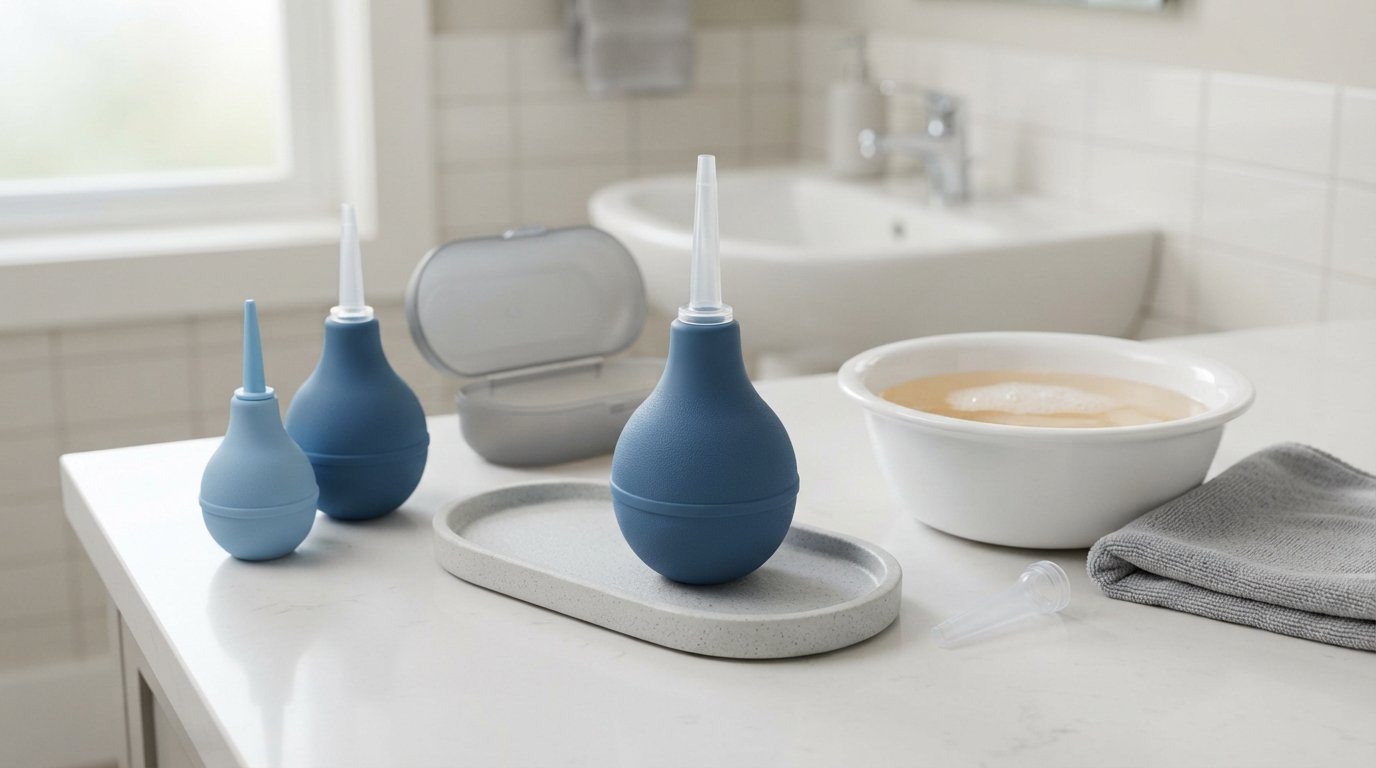
An enema bulb is a small, squeezable device designed to hold and deliver a limited amount of fluid through a nozzle. Depending on the product and its intended purpose, enema bulbs may be used for bowel care, certain medical applications, or personal cleansing.
Modern enema bulbs are available in several designs, including silicone and PVC bulbs, detachable nozzles, anti-backflow systems, reusable kits and different capacities. Current commercial products range from relatively small bulbs to larger systems and multi-nozzle kits.
However, an enema bulb is not simply a hygiene accessory. Enemas can cause complications when used incorrectly or too frequently. Medical sources warn about problems including tissue injury, infection, dehydration, electrolyte disturbances and, in rare cases, perforation.
This guide explains what an enema bulb is, the main types available, what to consider when choosing one, how reusable designs differ, and the safety issues you should understand before using one.
What Is an Enema Bulb?
An enema bulb is a hand-operated fluid-delivery device consisting generally of:
- A squeezable bulb or reservoir
- A nozzle or tip
- A connection between the bulb and nozzle
The bulb is filled with the intended fluid and squeezed to deliver it through the attached nozzle.
Commercial products vary considerably. BOENMED, for example, lists reusable bulb kits ranging from 89 mL to 347 mL, while its Enemator model has a 294 mL bulb.
The exact purpose and appropriate fluid depend on the particular product and medical situation.
What Is an Enema Bulb Used For?
An enema bulb can have different intended uses depending on its design and instructions.
Common categories include:
Bowel care
Some enemas are used for occasional constipation or bowel management.
Medical enemas may be recommended for specific situations, but they are not necessarily appropriate for every episode of constipation.
Personal cleansing
Some products are marketed for limited personal cleansing.
These products are often sold as reusable anal-douche or cleansing bulbs rather than pharmaceutical enema treatments.
Medical procedures
Enemas can also form part of certain medical preparations or treatments.
In those situations, the product and solution should be used according to the instructions given by a healthcare professional or the product manufacturer.
Important distinction
An enema bulb is a device, not automatically a medication.
The bulb itself doesn’t determine whether an enema is medically appropriate. The fluid, purpose, person’s health, frequency of use and product instructions all matter.
How Does an Enema Bulb Work?
An enema bulb uses manual pressure.
The basic design is simple:
- The bulb holds fluid.
- The nozzle provides a pathway for the fluid.
- Squeezing the bulb creates pressure.
- The fluid exits through the nozzle.
Some newer products add features such as:
- Multiple nozzle openings
- Anti-backflow mechanisms
- One-way valves
- Detachable nozzles
- Flexible tips
- Textured grips
For example, BOENMED’s 420 mL douche bulb includes an anti-backflow design and interchangeable nozzles.
The more complicated the design becomes, the more important proper cleaning and following the manufacturer’s instructions become.
Enema Bulb vs Enema Bag
An enema bulb and an enema bag are not the same device.
| Feature | Enema Bulb | Enema Bag |
|---|---|---|
| Design | Handheld squeezable reservoir | Hanging/flexible reservoir |
| Typical size | Smaller | Often substantially larger |
| Pressure | Controlled manually by squeezing | Influenced by height/flow system |
| Portability | High | Usually less compact |
| Components | Bulb + nozzle | Bag + tubing + nozzle |
| Typical use | Small-volume delivery/cleansing | Larger-volume systems or specific bowel-care uses |
Current retail listings show both bulb-style products and larger bag systems in the same general category.
The choice should depend on the intended application rather than simply selecting the largest reservoir.
Enema Bulb vs Enema Bottle
An enema bottle is another type of fluid-delivery container.
A bulb is usually:
- Squeezable
- Compact
- Handheld
- Reusable in some designs
A bottle may be:
- Pre-filled
- Disposable
- Squeezable
- Designed specifically for a medication or laxative
These products shouldn’t automatically be considered interchangeable.
A pharmaceutical enema, for example, may contain a specific active ingredient and have strict dosing instructions.
Types of Enema Bulbs
The market contains several different designs.
Silicone Enema Bulbs
Silicone bulbs are popular in consumer products because they can be flexible and easy to grip.
Current Walmart listings include silicone enema bulbs with anti-backflow designs and multi-opening tips.
PVC Enema Bulbs
PVC is another common material.
BOENMED currently lists multiple PVC bulb models with different capacities and nozzle materials.
Reusable Enema Bulbs
Reusable bulbs are designed to be emptied, cleaned and used again according to the manufacturer’s instructions.
A detachable nozzle can make cleaning easier.
BOENMED specifically describes separate bulb/nozzle construction intended to facilitate post-use cleaning.
Disposable Enema Products
Some enema products are designed for one-time use.
These can be different from reusable personal-cleansing bulbs and may contain a pre-measured solution.
Always follow the labeling for the particular product.
Anti-Backflow Enema Bulbs
Some modern designs include a valve intended to reduce reverse flow.
Retail listings currently highlight anti-backflow designs as a product feature.
This can be useful from a product-design perspective, but it does not eliminate the need for proper hygiene.
What Size Enema Bulb Should You Choose?
Enema bulbs are available in different capacities.
BOENMED lists models at:
- 89 mL
- 143 mL
- 224 mL
- 275 mL
- 347 mL
and its Enemator is listed at 294 mL.
A larger capacity is not automatically better.
The appropriate volume depends on:
- Intended purpose
- Product instructions
- Medical recommendations, when applicable
- Individual circumstances
Avoid choosing a product simply because it holds the most fluid.
For pharmaceutical enemas, use the exact dose specified on the product label rather than trying to increase the amount yourself.
What Should You Look for in an Enema Bulb?
If you’re evaluating products, consider these characteristics.
1. Appropriate capacity
Choose a capacity appropriate for the product’s intended application.
2. Material
Look at whether the bulb uses silicone, PVC or another material and follow the manufacturer’s cleaning instructions.
3. Nozzle design
A nozzle should be designed for its stated application and should be smooth and free from damage.
4. Secure connection
A secure bulb-to-nozzle connection can help prevent leaks.
BOENMED specifically describes threaded and secure-seal connections on several of its products.
5. Easy cleaning
Detachable components can make thorough cleaning easier.
6. Grip
A textured or ergonomic exterior can make the bulb easier to control.
7. Anti-backflow features
These may be useful depending on the intended use.
8. Clear instructions
A product should provide clear instructions for its intended application, cleaning and storage.
Is Silicone or PVC Better for an Enema Bulb?
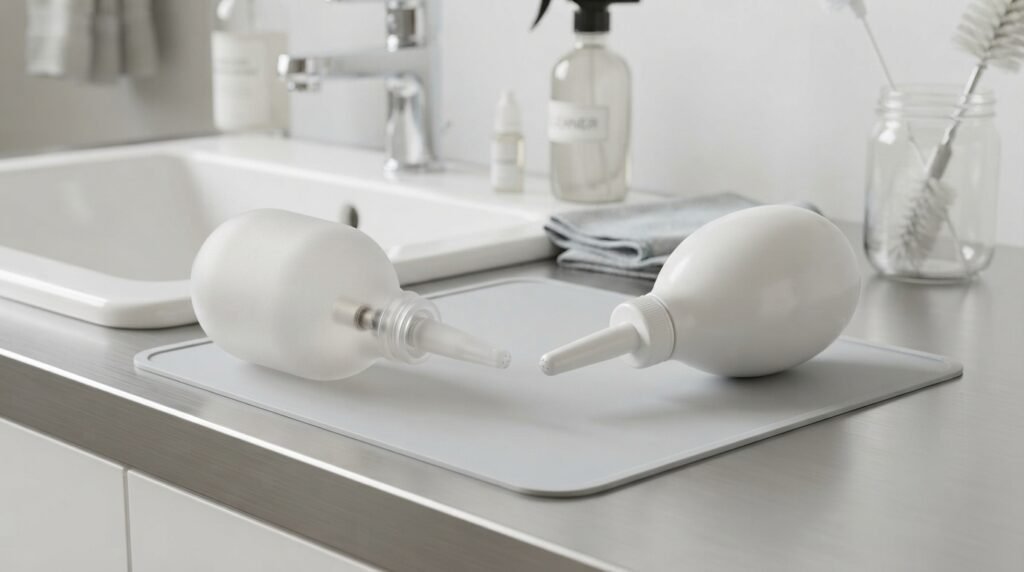
There isn’t one material that is universally best for every user or application.
Silicone
Potential advantages include:
- Flexible feel
- Soft construction
- Easy-to-grip designs
- Availability in consumer personal-care products
PVC
Potential advantages include:
- Common availability
- Different firmness levels
- Multiple medical-device designs
- Often lower-cost construction
The material is only one consideration. The nozzle, connection, cleaning requirements and manufacturer’s instructions are equally important.
Why Does the Nozzle Matter?
The nozzle is the part that comes into contact with sensitive tissue, so its design matters.
Look for a product whose nozzle is:
- Appropriate for the intended use
- Smooth
- Free of sharp edges
- Securely attached
- Easy to clean
- Undamaged
Some commercial designs use flexible tips, while others use more rigid nozzles. BOENMED currently offers both types across different products.
Never use a damaged nozzle.
How Important Is Cleaning?
Cleaning is one of the most important considerations for a reusable enema bulb.
Residual fluid or contamination can introduce bacteria during subsequent use.
Reusable products should therefore be cleaned according to their manufacturer’s instructions.
BOENMED’s reusable bulb designs specifically emphasize detachable components and cleaning after use.
General hygiene principles
- Follow the manufacturer’s cleaning instructions.
- Separate removable components when the design permits.
- Clean all reusable parts thoroughly.
- Allow components to dry completely before storage.
- Inspect the bulb and nozzle for damage.
- Don’t share personal-use equipment.
- Replace a product if it becomes cracked, degraded or difficult to clean properly.
The exact cleaning method depends on the material and product.
Is an Enema Bulb Reusable?
Some are.
Many consumer enema bulbs are explicitly sold as reusable products. Current Walmart and BOENMED listings include reusable bulb designs.
But “reusable” doesn’t mean that a bulb can be used indefinitely.
Over time:
- PVC can deteriorate
- Silicone can become damaged
- Connections can loosen
- Nozzles can develop cracks
- Surfaces can become difficult to clean
Replace reusable equipment when it shows signs of deterioration.
Are Enema Bulbs Safe?
An enema can be safe in appropriate circumstances when used correctly, but it is not risk-free.
Cleveland Clinic identifies possible complications including:
- Pain or discomfort
- Rectal injury
- Infection
- Dehydration
- Electrolyte imbalance
- Problems associated with repeated use
It also warns that excessive or inappropriate use can worsen constipation in some situations.
Mayo Clinic similarly warns that colon cleansing can cause dehydration, infection, bleeding and rectal perforation.
That is why an enema bulb should not be treated like an ordinary toiletry product.
Can You Use an Enema Bulb for Constipation?
Some enemas are specifically intended for occasional constipation.
However, constipation has many possible causes, and an enema isn’t automatically the appropriate solution.
MedlinePlus notes that lifestyle measures such as adequate fluids, fiber and physical activity can help prevent or relieve constipation.
If constipation keeps returning, it is better to determine why it is happening rather than repeatedly relying on enemas.
Cleveland Clinic also notes that frequent enema use can contribute to longer-term constipation problems.
What About “Detox” Enemas?
This is an area where product marketing and medical evidence can differ.
Some commercial products describe enemas or colon cleansing as detoxifying.
Mayo Clinic states that research does not show that the body retains toxins from a normal diet or everyday activity that require routine colon cleansing.
Coffee and herbal enemas are also not equivalent to medically indicated treatments.
For health-related purposes, avoid assuming that “detox” claims on a product page establish a medical benefit.
Important Safety Precautions
An enema should never be forced.
Potential injury can occur if a nozzle is inserted aggressively or if excessive pressure is applied.
Cleveland Clinic specifically warns that improper insertion can damage tissue and that excessive fluid can cause serious injury.
Other basic precautions include:
- Follow the product instructions.
- Use only the intended solution.
- Don’t exceed labeled medication doses.
- Don’t combine different enema medicines unless a healthcare professional tells you to.
- Don’t continue if significant pain occurs.
- Don’t use damaged equipment.
- Maintain appropriate hygiene.
- Don’t repeatedly use enemas as a substitute for investigating chronic constipation.
When Should You Talk to a Healthcare Professional?
Medical advice is particularly important if constipation occurs with:
- Severe or persistent abdominal pain
- Nausea or vomiting
- Rectal bleeding
- A sudden change in bowel habits
- Suspected bowel obstruction
- Significant dehydration
- Persistent or recurring constipation
MedlinePlus specifically recommends medical consultation before sodium-phosphate rectal products in circumstances including abdominal pain with constipation, prolonged changes in bowel habits, dehydration, kidney disease and certain intestinal conditions.
If symptoms are severe or unusual, don’t assume an enema is the appropriate treatment.
Sodium-Phosphate Enemas Require Extra Caution
Not every enema bulb contains medication, but some rectal enemas contain sodium phosphate.
These are different from a simple reusable bulb filled with an appropriate fluid.
The FDA warns that exceeding the recommended dose of OTC sodium-phosphate products can cause dangerous electrolyte changes and serious harm to the kidneys and heart. It specifically says not to use more than one dose in 24 hours.
MedlinePlus likewise warns against exceeding the labeled dose or frequency.
Therefore, medication-containing enemas should be treated as medications—not simply as another type of cleansing bulb.
Enema Bulb Buying Checklist
Before buying an enema bulb, check:
Purpose
What is the product specifically designed for?
Capacity
Does its volume match the intended application?
Material
Is the bulb made from a suitable, clearly identified material?
Nozzle
Is the nozzle appropriate, smooth and undamaged?
Connection
Does the nozzle attach securely?
Cleaning
Can the product be cleaned thoroughly?
Reusability
Is it actually designed for repeated use?
Backflow protection
Does it have an anti-backflow or one-way-valve feature if that matters for your application?
Instructions
Does the manufacturer provide clear instructions?
Replacement
Can you easily obtain replacement components if the nozzle or bulb wears out?
Common Enema Bulb Problems
The bulb leaks
Check the connection between the bulb and nozzle.
A damaged seal, loose connection or cracked component may cause leakage.
The nozzle is difficult to attach
Check the connector and threads for damage.
Don’t force components together.
The bulb has become sticky
Material degradation can occur with some reusable products.
If the surface cannot be cleaned properly, replace the bulb.
The nozzle has cracks
Don’t continue using it.
A damaged nozzle can increase the risk of injury and contamination.
The bulb smells after cleaning
Persistent odor may indicate residual material or inadequate cleaning.
Follow the manufacturer’s cleaning instructions. If the product cannot be cleaned thoroughly, replacement may be safer.
How to Store a Reusable Enema Bulb
After cleaning:
- Allow the bulb to dry completely.
- Store it somewhere clean and dry.
- Avoid storing it while moisture remains inside.
- Keep it away from excessive heat.
- Don’t compress it unnecessarily for long periods.
- Store nozzles in a way that prevents contamination.
Good storage helps extend product life and supports hygiene.
Can You Share an Enema Bulb?
Personal-use enema bulbs should generally not be shared.
Sharing increases the risk of transferring microorganisms between users.
If multiple people need bowel-care equipment, each person should have equipment appropriate for their own use, or a healthcare setting should use appropriate infection-control procedures.
Enema Bulb for Personal Hygiene vs Medical Treatment
These purposes should not be confused.
A consumer cleansing bulb may be sold as a personal-hygiene product, while a pharmaceutical enema may contain an active medication intended to treat constipation.
A reusable bulb does not automatically provide the same medical function as a medication-containing enema.
Always identify:
- The device
- The solution
- The intended purpose
- The manufacturer’s instructions
before using an enema product.
Frequently Asked Questions
What is an enema bulb?
An enema bulb is a handheld, squeezable device used to deliver a limited amount of fluid through a nozzle for an intended cleansing or bowel-care application.
What is an enema bulb used for?
Depending on the product, an enema bulb may be used for bowel care or personal cleansing. Some medical enemas are used for occasional constipation or specific medical purposes.
Are enema bulbs reusable?
Many consumer bulbs are designed to be reusable. Always follow the manufacturer’s cleaning and replacement instructions.
What is the difference between an enema bulb and an enema bag?
A bulb is a compact handheld reservoir that is manually squeezed, while an enema bag generally uses a larger reservoir with tubing and a nozzle.
Are silicone enema bulbs safe?
Material alone doesn’t determine safety. The product must be appropriate for its intended use, maintained correctly and used according to its instructions.
How big is an enema bulb?
There is no universal size. Current commercial examples range from approximately 89 mL to 347 mL, while other designs are larger.
Can an enema bulb help constipation?
Some enemas are intended for occasional constipation, but recurring constipation should be discussed with a healthcare professional rather than repeatedly treated with enemas.
Can you reuse an enema bulb?
If the manufacturer identifies it as reusable, it can generally be reused according to its cleaning and care instructions. Disposable products should not be reused.
How should a reusable enema bulb be cleaned?
Follow the specific manufacturer’s cleaning instructions, separate removable parts when possible, clean them thoroughly and allow everything to dry before storage.
Can you share an enema bulb?
Personal-use equipment should not be shared because of hygiene and infection concerns.
Are enema bulbs safe for everyone?
No. Individual health conditions can change whether an enema is appropriate. People with certain intestinal, kidney or heart conditions, dehydration, unexplained abdominal symptoms or other medical concerns should seek professional advice before using appropriate enema products.
Are “detox” enemas medically necessary?
There is no good evidence that routine colon cleansing is needed to remove toxins from a normal diet or lifestyle. Mayo Clinic specifically notes that research does not support this premise.
When should you stop using an enema and seek help?
Significant pain, rectal bleeding, severe abdominal symptoms, dehydration, or an unexpected lack of bowel movement after an appropriate medical enema can warrant medical attention.
Final Thoughts
An enema bulb is a compact fluid-delivery device available in many forms, from simple reusable bulbs to silicone anti-backflow designs and more specialized kits.
The most important factors when evaluating one are its intended purpose, capacity, material, nozzle design, cleaning requirements, reusability and manufacturer instructions.
Current products demonstrate how much the category varies. BOENMED, for example, offers several bulb capacities and different nozzle configurations, while major retailers such as Walmart and Target list a wide range of bulb, bag and bottle systems.
The most important point, however, is safety.
An enema isn’t automatically harmless simply because the device is small or sold for home use. Medical sources document potential complications including tissue injury, infection, dehydration and electrolyte disturbances, particularly when products are misused or overused.
For that reason, choose an enema bulb based on its actual intended use and instructions, maintain reusable equipment carefully, and seek medical advice when constipation is persistent, severe or accompanied by concerning symptoms.
Related Post
- Fluorescent Bulbs – Types, Sizes, T5 vs T8 vs T12, Ballasts & LED Replacement Guide!
- Garage Door Opener Light Bulb – Best Bulbs, Replacement Guide, Compatibility & Troubleshooting!
- Hue Light Bulb Serial Number – Where to Find It, How to Use It & Troubleshooting!
About the Author