Fluorescent bulbs have been used for decades in homes, offices, schools, garages, warehouses, stores, workshops, and commercial buildings. They are available in many shapes, lengths, wattages, base types, and color temperatures, which can make choosing the correct replacement surprisingly confusing.
A tube marked T8, for example, does not tell you its length or brightness by itself. You also need to consider the lamp’s base, wattage, ballast compatibility, color temperature, and fixture.
Today, LEDs have replaced many fluorescent applications, but fluorescent tubes are still found in existing fixtures and remain available for specific applications. The U.S. Department of Energy says fluorescent lighting is declining as LED technology takes its place, while fluorescent lamps remain covered by federal standards and continue to exist in specialized applications.
This guide explains the major types of fluorescent light bulbs, how T5, T8, and T12 tubes differ, how to identify your existing lamp, what the ballast does, how to choose brightness and color, and what to know before switching from fluorescent to LED.
What Are Fluorescent Bulbs?
A fluorescent bulb is a gas-discharge light source that produces visible light through an electrical discharge inside a tube.
Traditional fluorescent lamps contain a small amount of mercury and use phosphor material inside the glass to convert ultraviolet radiation into visible light.
Unlike an incandescent bulb, a fluorescent lamp normally requires a ballast to regulate the electrical current and help start the lamp.
That ballast is one of the most important differences between fluorescent and ordinary screw-in household bulbs.
How Fluorescent Lighting Works
A simplified fluorescent-lighting process looks like this:
- Electrical power reaches the fixture.
- The ballast controls the electrical conditions.
- The lamp starts and an electrical discharge occurs.
- Mercury vapor produces ultraviolet radiation.
- The phosphor coating converts that energy into visible light.
- The tube illuminates the surrounding area.
The exact starting process depends on the lamp and ballast design.
Types of Fluorescent Bulbs
Fluorescent lighting is not one single bulb style.
The main categories include:
- Linear fluorescent tubes
- Compact fluorescent lamps
- T5 lamps
- T8 lamps
- T12 lamps
- U-bend fluorescent tubes
- Circline lamps
- High-output fluorescent lamps
- Specialty fluorescent lamps
Retail fluorescent inventories commonly separate lamps by shape, base, length, and other specifications. Bulbs.com, for example, currently lists T5, T8, T12, U-bent and circline fluorescent products.
T5 vs T8 vs T12 Fluorescent Bulbs
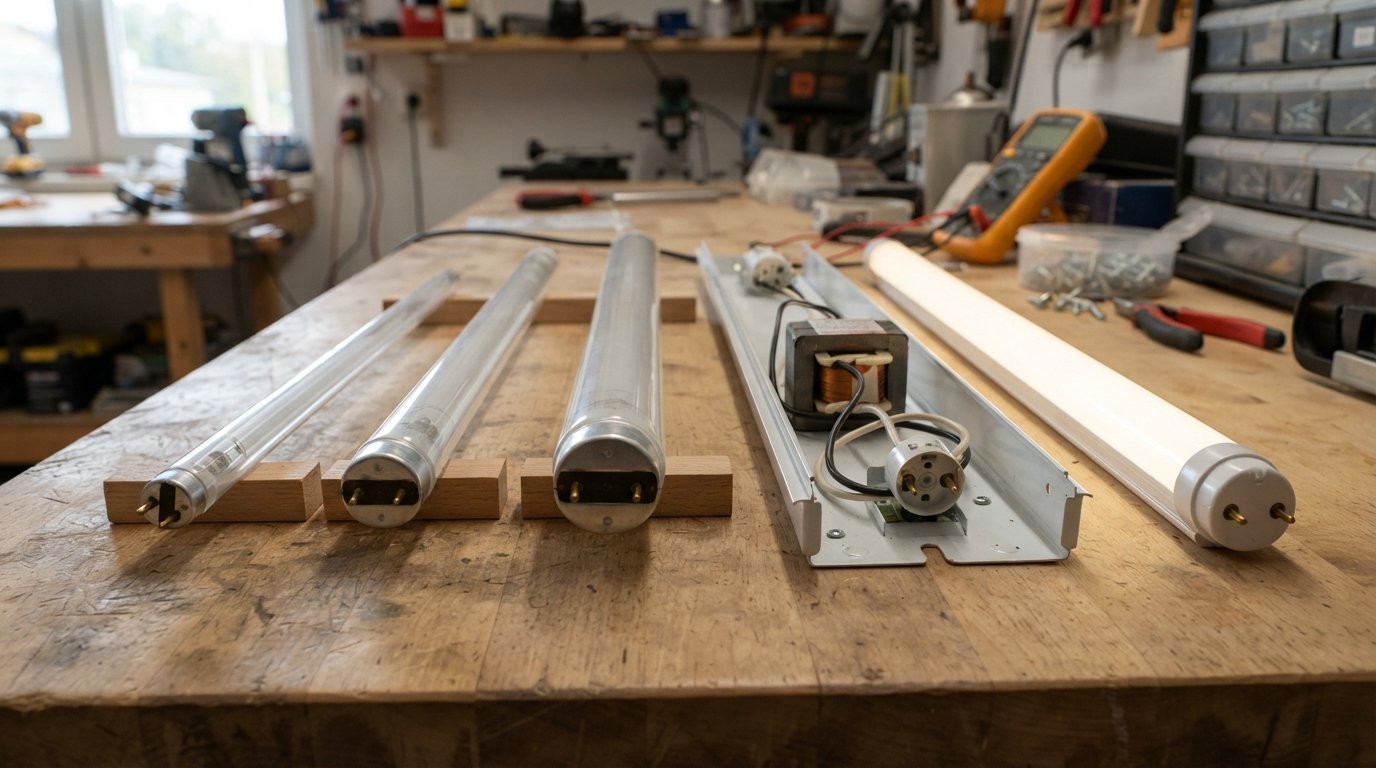
T5, T8, and T12 are among the most important fluorescent tube designations.
The number describes the approximate tube diameter in eighths of an inch.
| Type | Approximate diameter | Common base | Typical use |
|---|---|---|---|
| T5 | 5/8 inch | G5 | Compact commercial fixtures, specialty lighting |
| T8 | 1 inch | G13 | Offices, shops, commercial fixtures |
| T12 | 1.5 inches | G13 | Older fluorescent fixtures |
The T5/T8/T12 designation describes diameter, not length. Current lighting references continue to use this classification when discussing fluorescent and LED replacement tubes.
T5 Fluorescent Bulbs
T5 tubes are thinner than T8 and T12 lamps.
They commonly use a G5 miniature bi-pin base.
T5 lamps are available in standard-output and high-output versions, including T5HO.
They are often found in:
- Commercial fixtures
- Display lighting
- Under-cabinet systems
- High-output applications
- Specialty fixtures
Do not assume that a T5 tube can replace a T8 simply because both are fluorescent.
The diameter, base, length, and ballast requirements can differ.
T8 Fluorescent Bulbs
T8 is one of the most common linear fluorescent formats.
A standard T8 tube has an approximate one-inch diameter and commonly uses a G13 medium bi-pin base.
A familiar example is a 4-foot F32T8 lamp.
The supplied Philips F32T8/TL850/ALTO product, for example, is a 4-foot, 32-watt T8 fluorescent lamp with a G13 medium bi-pin base and 5000K color temperature.
T12 Fluorescent Bulbs
T12 tubes are approximately 1.5 inches in diameter.
They are common in older fluorescent fixtures and can use the same broad G13 bi-pin base family as many T8 lamps.
However, T8 and T12 are not automatically interchangeable.
The fixture and ballast must be compatible with the replacement lamp.
What Does the “T” Mean in T8?
The T stands for tubular.
The number indicates the tube’s diameter in eighths of an inch.
For example:
- T5 = 5/8 inch
- T8 = 8/8 inch
- T12 = 12/8 inch
This does not tell you:
- Tube length
- Wattage
- Lumens
- Color temperature
- Ballast type
Those specifications must be checked separately.
What Does F32T8 Mean?
You may see a fluorescent tube labeled something like F32T8.
The exact coding convention can vary by manufacturer, but generally:
- F identifies a fluorescent lamp
- 32 identifies the lamp’s nominal wattage family
- T8 identifies the tubular diameter category
A product such as Philips F32T8/TL850/ALTO is listed by Zoro as a 32W T8 lamp with a G13 medium bi-pin base.
Always use the manufacturer’s complete lamp code when ordering a replacement rather than relying only on the T-number.
How to Identify Your Fluorescent Bulb
Before buying a replacement, inspect the existing tube.
Look for the printed markings along the glass.
You may find information such as:
- F32T8
- F40T12
- F54T5HO
- Kelvin rating
- Manufacturer code
- Wattage
- Length
- Color designation
Step 1: Check the Tube Diameter
Compare the tube with the common sizes:
- Thin = T5
- Medium = T8
- Thick = T12
If you’re uncertain, measure the diameter.
Step 2: Measure the Length
Measure the lamp itself and compare it with the fixture.
Common fluorescent tube lengths include:
- 2 feet
- 3 feet
- 4 feet
- 5 feet
- 8 feet
Do not choose a replacement based only on diameter.
Step 3: Check the Base
Look at the pins on both ends.
Common fluorescent bases include:
- G5 miniature bi-pin
- G13 medium bi-pin
- 4-pin compact fluorescent bases
- Recessed double contact
- Other specialty bases
Bulbs.com currently lists medium bi-pin, miniature bi-pin, four-pin, recessed-double-contact and other bases in its fluorescent category.
Step 4: Read the Printed Code
The printed lamp code is often the fastest way to identify the replacement.
Write down the complete code before shopping.
What Is a Fluorescent Ballast?
A fluorescent ballast regulates current and provides the electrical conditions needed to start and operate the lamp.
Without the appropriate ballast, a fluorescent tube may fail to start or may operate incorrectly.
Ballasts are available in different designs, including:
- Magnetic ballast
- Electronic ballast
- Rapid-start ballast
- Instant-start ballast
- Programmed-start ballast
- Dimming ballast
Current lighting guidance emphasizes matching the lamp and ballast, including lamp type, number of lamps, and fixture voltage.
Electronic vs Magnetic Ballasts
Magnetic Ballasts
Older fluorescent fixtures frequently use magnetic ballasts.
They can be associated with:
- Audible humming
- Flickering
- Slower starting
- Greater energy losses
Electronic Ballasts
Electronic ballasts became common in newer fluorescent fixtures.
They generally operate at higher frequencies and can provide quieter operation and improved system performance compared with older magnetic designs.
However, compatibility must still be checked.
A fluorescent tube is not automatically compatible with every electronic ballast.
Why Ballast Compatibility Matters
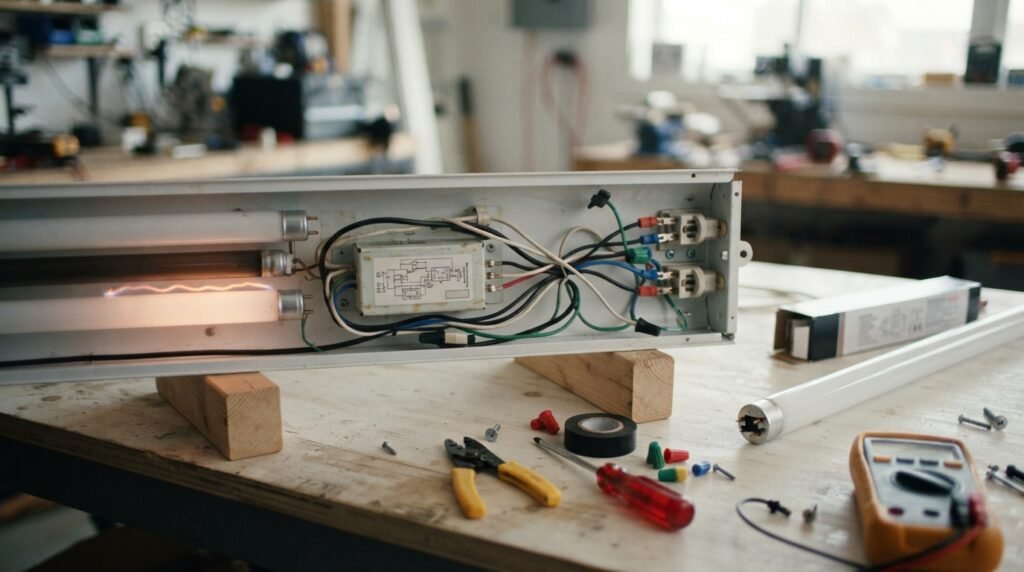
Two fluorescent tubes may look nearly identical while requiring different operating conditions.
Before installing a replacement, check:
- Lamp type
- Lamp wattage
- Lamp length
- Ballast model
- Starting method
- Number of lamps
- Fixture voltage
A current Bulbs.com ballast listing demonstrates how one electronic ballast can specify compatibility with particular combinations of T5, T8, T10, T12 and other lamps.
That illustrates why simply matching the tube’s physical appearance is not enough.
Fluorescent Bulb Watts vs Lumens
One of the most common lighting mistakes is confusing watts with brightness.
Watts
Watts measure electrical power consumption.
A 32W fluorescent lamp uses approximately 32 watts under its specified operating conditions, although total fixture/system consumption can differ.
Lumens
Lumens measure visible light output.
Two bulbs with similar wattage can produce different amounts of light.
Therefore, when choosing a replacement, compare the lamp’s rated lumens as well as wattage.
Fluorescent Bulb Color Temperature
Color temperature is measured in Kelvin (K).
It describes the appearance of the light rather than its brightness.
Common fluorescent color temperatures include:
2700K–3000K
Produces a warmer appearance.
Useful for:
- Residential areas
- Hospitality
- Relaxed spaces
- Decorative applications
3500K–4100K
Produces a neutral or cool-white appearance.
Useful for:
- Offices
- Classrooms
- Retail
- General commercial lighting
5000K–6500K
Produces a cooler, daylight-like appearance.
Useful for:
- Workshops
- Garages
- Utility spaces
- Some retail and commercial applications
For example, the Philips F32T8/TL850/ALTO product supplied for this research is rated at 5000K.
What Is CRI in Fluorescent Bulbs?
CRI, or Color Rendering Index, describes how accurately a light source renders colors compared with a reference light source.
A higher CRI generally means colors appear more naturally under the light.
This matters in applications such as:
- Retail displays
- Art spaces
- Design studios
- Photography-related environments
- Healthcare
- Inspection areas
For ordinary warehouse or utility lighting, other factors may be more important.
How Many Lumens Do Fluorescent Bulbs Produce?
There is no single lumen output for all fluorescent bulbs.
It depends on:
- Tube type
- Wattage
- Length
- Phosphor design
- Ballast
- Lamp efficiency
- Manufacturer
Representative lighting data shows substantial differences among T5, T8 and T12 lamps.
For this reason, compare the actual lumen rating of the replacement lamp rather than assuming all four-foot fluorescent tubes have identical brightness.
How Long Do Fluorescent Bulbs Last?
Fluorescent lamp life varies considerably according to lamp design and operating conditions.
Factors include:
- Lamp quality
- Ballast
- Switching frequency
- Operating temperature
- Fixture condition
- Starting method
Fluorescent lamps generally last much longer than traditional incandescent lamps, although modern LED lighting can provide substantially longer rated life in many applications. Bulbs.com currently notes an average fluorescent lifespan around 10,000 hours on its category page while describing LED products as potentially reaching much longer rated lives.
Always compare the manufacturer’s rated life for the exact lamp you are considering.
Fluorescent Bulbs vs LED
LED technology has become the dominant alternative to fluorescent lighting in many applications.
Advantages of Fluorescent Bulbs
Fluorescent lamps can still make sense when:
- The existing fixture works well
- Replacement lamps are readily available
- A specific fluorescent lamp is required
- The application depends on an existing ballast
- Replacing the entire fixture is not practical
Fluorescent lighting was historically a major efficiency improvement over incandescent lighting.
Advantages of LED
LEDs generally offer:
- Lower energy consumption
- Long service life
- Instant-on operation
- No mercury inside the LED lamp
- Excellent control options
- Easier compatibility with modern lighting systems
DOE’s Federal Energy Management Program says fluorescent lighting is decreasing as LED technology replaces it and encourages conversion to LED systems.
Can You Replace Fluorescent Bulbs With LED?
Yes, in many fixtures, but the replacement method matters.
There are several types of LED tube replacement strategies.
Type A or Ballast-Compatible LED
A ballast-compatible LED tube is designed to operate with a compatible existing ballast.
The major advantage is that the ballast may not need to be removed immediately.
However, compatibility must be verified.
Type B or Ballast-Bypass LED
A ballast-bypass LED tube is wired directly to the appropriate line-voltage configuration.
This can eliminate the old fluorescent ballast.
Because rewiring can involve mains electricity, it should be performed according to the lamp manufacturer’s instructions and applicable electrical requirements.
Type A+B or Hybrid Tubes
Some LED tubes are designed to work in multiple installation configurations.
Again, do not assume compatibility merely because the tube physically fits.
Why LED Tube Compatibility Matters
An LED tube designed for one ballast is not necessarily compatible with another.
Manufacturer compatibility guides can list specific ballasts and tube configurations. Philips/Signify compatibility documentation, for example, distinguishes multiple ballast and lamp combinations for T8, T12 and T5-related LED products.
Fluorescent Bulb Flickering
Flickering is a common fluorescent-light problem.
Possible causes include:
- Aging lamp
- Failing ballast
- Poor electrical connection
- Incorrect lamp
- Cold temperature
- Starter problems on older systems
- Fixture wiring problems
If replacing the tube does not solve the problem, the ballast or fixture may need attention.
Fluorescent Bulb Humming
A humming sound can be associated with a ballast, particularly in older fixtures.
Possible causes include:
- Aging magnetic ballast
- Loose fixture components
- Electrical problems
- Ballast vibration
A qualified professional can determine whether the ballast needs replacement.
Fluorescent Bulb Takes a Long Time to Start
A fluorescent lamp that takes a long time to reach full brightness may indicate:
- Aging lamp
- Ballast problems
- Low temperature
- Incorrect lamp/ballast combination
Low temperatures can particularly affect some fluorescent systems.
If the fixture consistently struggles to start, replacing the tube alone may not solve the problem.
Can Fluorescent Bulbs Be Used in Cold Temperatures?
Some fluorescent lamps are specifically designed for cold-temperature applications.
Do not assume that a standard indoor fluorescent tube will perform properly in an unheated garage, warehouse, freezer area, or outdoor fixture.
The U.S. DOE’s definition of general service fluorescent lamps specifically distinguishes lamps designed for cold-temperature applications from the general-service category.
If the fixture operates in a cold environment, check the lamp’s temperature rating.
Are Fluorescent Bulbs Dimmable?
Some fluorescent lamps and ballasts support dimming.
Others do not.
Dimming depends on the complete system:
- Lamp
- Ballast
- Dimmer/control
- Wiring
- Fixture
A standard fluorescent tube should not be connected to a conventional dimmer unless the complete lighting system is specifically designed for that configuration.
Are Fluorescent Bulbs Safe?
When installed and used correctly, fluorescent lighting can be used safely.
However, fluorescent lamps contain mercury, so broken lamps require appropriate handling.
EPA identifies linear fluorescent tubes, U-shaped lamps, circline lamps and other fluorescent products as mercury-containing bulbs.
What If a Fluorescent Bulb Breaks?
Do not crush or deliberately break fluorescent lamps.
EPA advises preventing mercury release and recommends following local requirements for handling and disposal of mercury-containing lamps.
For a broken lamp, follow current local environmental guidance rather than assuming it belongs in ordinary household trash.
How to Dispose of Fluorescent Bulbs
Fluorescent bulbs should be handled differently from ordinary non-mercury household waste where local rules require special disposal.
EPA recommends taking fluorescent bulbs to available recycling or household hazardous-waste programs and notes that state and local requirements can be stricter than federal guidance.
Why Recycling Matters
Proper recycling can:
- Reduce mercury release
- Recover glass
- Recover metals
- Reduce environmental contamination
- Comply with local regulations
Check your local waste authority for current requirements.
Best Fluorescent Bulbs for Different Applications
The right lamp depends on the environment.
For Offices
Consider:
- T8 fluorescent tubes
- Neutral or cool-white color
- Appropriate CRI
- Compatible electronic ballast
For Garages
Look for:
- Appropriate temperature rating
- Adequate lumen output
- Durable construction
- Correct fixture compatibility
For Workshops
Brightness and color rendering can be especially important.
A higher-color-temperature lamp may provide the visual appearance some users prefer for detailed work.
For Warehouses
Consider:
- Lamp life
- Maintenance requirements
- Fixture height
- Temperature
- Ballast condition
- Energy consumption
For large facilities, an LED retrofit may deserve comparison with continued fluorescent operation.
Fluorescent Bulb Buying Checklist
Before purchasing a replacement, confirm:
- Lamp type: T5, T8, T12, CFL, etc.
- Length: 2 ft, 4 ft, 8 ft, etc.
- Diameter: T5/T8/T12
- Base: G5, G13, 4-pin, etc.
- Wattage: Match the fixture requirements
- Lumens: Compare actual brightness
- Color temperature: 3000K, 3500K, 4000K, 5000K, etc.
- CRI: Important for accurate color
- Ballast: Confirm compatibility
- Starting method: If applicable
- Dimming: Only if supported
- Operating temperature: Especially for cold locations
- Application: Residential, commercial, industrial or specialty
- Replacement technology: Fluorescent or LED
Frequently Asked Questions
1. What are fluorescent bulbs?
Fluorescent bulbs are gas-discharge lamps that use an electrical discharge and phosphor coating to produce visible light. Many fluorescent lamps contain mercury and require appropriate disposal.
2. What is the difference between T5, T8 and T12 bulbs?
The T number primarily describes the tube diameter. T5 is approximately 5/8 inch, T8 is about 1 inch, and T12 is about 1.5 inches. They also differ in bases, lengths, wattages, and ballast requirements.
3. Are T8 and T12 fluorescent bulbs interchangeable?
Not automatically. Although many T8 and T12 lamps use G13-style bi-pin bases, the lamp and ballast combination must be compatible.
4. What is the most common fluorescent tube size?
T8 tubes are widely used in commercial and institutional lighting, although the correct lamp depends on the existing fixture.
5. What does T8 mean on a fluorescent bulb?
T8 indicates a tubular lamp with a nominal diameter of eight-eighths of an inch, or approximately one inch.
6. What is a G13 fluorescent bulb?
G13 refers to a common medium bi-pin base used by many T8 and T12 linear fluorescent tubes.
7. Are fluorescent bulbs being replaced by LED?
Yes. LED technology has replaced many fluorescent applications because of its efficiency, long life, control options, and lack of mercury in the lamp. Fluorescent lamps remain available for existing and specialized applications.
8. Can I put an LED tube in a fluorescent fixture?
Often yes, but the LED tube must be compatible with the fixture and ballast configuration. Some LED tubes work with compatible ballasts, while others require ballast bypass or another installation method.
9. Why is my fluorescent bulb flickering?
Possible causes include an aging lamp, ballast problems, poor electrical connections, cold temperatures, or an incorrect lamp/ballast combination.
10. How many watts is a typical 4-foot fluorescent bulb?
There is no single wattage. A common example is a 32W F32T8 lamp, while other four-foot fluorescent lamps can have different wattages. Always match the exact lamp and fixture specifications.
11. Are fluorescent bulbs brighter than LED bulbs?
Not inherently. Brightness depends on lumen output, not simply on whether a lamp is fluorescent or LED.
12. What color temperature should I choose?
For a warm appearance, consider around 2700K–3000K. Neutral commercial lighting is commonly around 3500K–4100K, while 5000K and higher provides a cooler, daylight-like appearance.
13. Do fluorescent bulbs contain mercury?
Many fluorescent lamps contain mercury. EPA specifically includes linear fluorescent tubes, U-tubes and circline lamps among mercury-containing bulbs.
14. Can fluorescent bulbs go in the regular trash?
Disposal rules vary by location. EPA recommends using available recycling or household hazardous-waste options for fluorescent bulbs and checking local requirements.
15. How do I know which fluorescent bulb to buy?
Read the existing tube’s markings, identify the T-number, measure the length, check the base, confirm wattage, and verify ballast compatibility before ordering a replacement.
Final Thoughts
Fluorescent bulbs are much easier to choose once you understand the specifications printed on the lamp.
Start with the basics: identify the T5, T8, or T12 format, measure the length, check the base, read the lamp code, and confirm the ballast. Then choose the appropriate wattage, lumen output, color temperature, and CRI for the space.
For example, a 4-foot F32T8 lamp is not simply “a fluorescent tube.” Its T8 designation, wattage, G13 base, length, ballast requirements, and color characteristics all help determine whether it is the correct replacement. A current Philips example demonstrates how these specifications appear together on an actual product listing.
It is also worth considering whether you should continue using fluorescent technology or move to LED. LED is increasingly replacing fluorescent lighting, but the best choice depends on the existing fixture, ballast, installation cost, energy goals, and the application.
Finally, remember that fluorescent lamps can contain mercury. When a lamp reaches the end of its useful life, follow your local recycling and disposal requirements rather than automatically placing it in ordinary household waste.
The simplest rule is: match the lamp to the fixture, not just the appearance of the tube.
Related Post
- Hue Light Bulb Serial Number – Where to Find It, How to Use It & Troubleshooting!
- Infrared Bulb Heater Bathroom – Complete Guide to Heat Lamps, Safety, Wattage & Installation!
- Lamp Bulb Drawing – Easy Step-by-Step Guide to Drawing a Lamp and Light Bulb!
About the Author