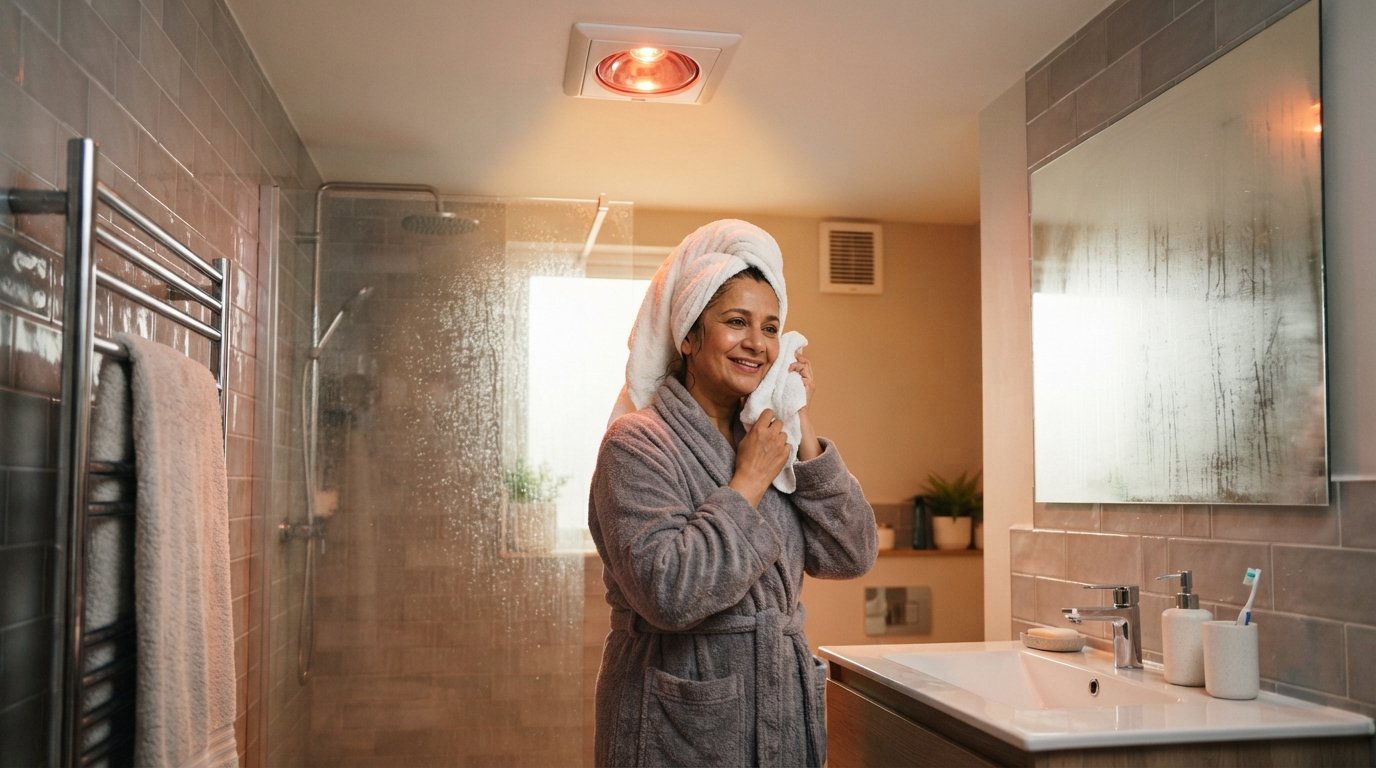
An infrared bulb heater bathroom setup can provide quick, localized warmth when you step out of the shower or bath. Unlike a conventional room heater that warms the surrounding air, an infrared heat lamp produces radiant heat that can be felt directly by people and nearby surfaces.
Bathroom infrared heaters are commonly installed in ceiling fixtures or dedicated heat-lamp units. They are especially useful in colder weather when a bathroom feels chilly even though the rest of the home is comfortable.
But choosing the right infrared bulb heater for a bathroom requires more than simply buying the hottest or highest-wattage bulb. You need to consider the fixture, bulb type, wattage, bathroom location, moisture exposure, electrical safety, ventilation, and whether the product is specifically approved for bathroom use.
This guide explains how infrared bathroom heat lamps work, what wattage to choose, how much electricity they use, how to install and replace them, and the important safety considerations.
What Is an Infrared Bulb Heater for a Bathroom?
An infrared bulb heater is a heating bulb that produces infrared radiation to provide radiant warmth.
In a bathroom, it is typically used as a heat lamp above or near the area where warmth is wanted. Instead of relying primarily on heated air, infrared energy travels outward and warms objects and people within its effective range.
A typical bathroom heat-lamp setup may include:
- Infrared heating bulb
- Heat-resistant socket
- Ceiling fixture
- Protective cover or reflector
- Dedicated switch
- Electrical wiring
- Ventilation fan in some installations
Some products combine lighting, infrared heating, and exhaust ventilation in a single bathroom ceiling unit.
How Does an Infrared Bathroom Heater Work?
An infrared heat bulb converts electrical energy into heat and emits infrared radiation.
When you stand within the lamp’s effective heating area, your body absorbs some of this radiant energy, creating a sensation of warmth.
The basic process is:
Electricity → heating element → infrared radiation → radiant warmth
This is different from a traditional fan heater:
| Infrared Heat Lamp | Conventional Fan Heater |
|---|---|
| Produces radiant heat | Primarily heats and circulates air |
| Warmth can be felt quickly | Usually takes longer to warm the room |
| Good for localized heating | Better suited to broader air heating |
| Often ceiling-mounted | Commonly floor or wall mounted |
| Can work well for short bathroom use | Can be used for longer room heating |
| Requires appropriate heat-rated fixture | Requires appropriate electrical installation |
An infrared bulb does not necessarily warm the entire bathroom evenly. Its main advantage is direct, localized warmth.
Why Use an Infrared Bulb Heater in a Bathroom?
Bathrooms can feel particularly cold because people are often wet after showering or bathing. A localized infrared heat lamp can make that transition more comfortable.
Fast Radiant Warmth
Infrared radiation can be felt without waiting for the entire room’s air temperature to increase substantially.
Localized Heating
You can position the heating area where warmth is most useful, such as near a shower or bathtub.
Useful During Short Periods
A bathroom heat lamp can be particularly practical when the room only needs additional warmth for a limited period.
Ceiling Installation Saves Floor Space
Many bathroom infrared heaters are installed overhead, leaving floors and walls available for other purposes.
Can Complement Bathroom Ventilation
Some bathroom ceiling products combine a heat lamp with an exhaust fan and lighting, although these are separate functions.
Infrared Bulb Heater vs Infrared Panel Heater
Infrared bathroom heating is available in several forms.
An infrared bulb heat lamp is generally designed to provide concentrated radiant heat, while an infrared panel heater usually spreads heat across a larger surface.
| Feature | Infrared Bulb | Infrared Panel |
|---|---|---|
| Heating style | Concentrated radiant heat | Broad radiant heat |
| Warm-up sensation | Usually quick | Depends on design |
| Installation | Often ceiling fixture | Wall or ceiling |
| Typical use | Localized bathroom warmth | General room heating |
| Heat distribution | More directional | More distributed |
| Bulb replacement | Usually possible | Generally not applicable |
For a small bathroom where you want warmth directly below a ceiling fixture, a heat lamp may be more practical. For whole-room heating, a different infrared heating system may be more appropriate.
What Wattage Is Best for an Infrared Bathroom Heat Lamp?
Wattage is one of the most important specifications when choosing an infrared heating bulb.
Common heat-lamp bulbs are available in different wattages, with 250 watts being a familiar size for many infrared heat-lamp applications.
However, you should never assume that a higher wattage is automatically better.
The fixture must be rated for the bulb’s wattage.
For example, installing a bulb with a higher wattage than the fixture allows can create excessive heat and become a safety hazard.
Consider These Factors
Before selecting wattage, check:
- Fixture maximum wattage
- Bulb compatibility
- Manufacturer instructions
- Bathroom size
- Ceiling height
- Desired heating area
- Electrical circuit capacity
- Whether the fixture is specifically designed for heat lamps
How Much Electricity Does an Infrared Bulb Heater Use?
An infrared bulb’s electricity consumption depends mainly on its wattage and operating time.
For example, a 250-watt infrared bulb uses:
0.25 kWh per hour
If it runs for 15 minutes:
0.25 × 0.25 = 0.0625 kWh
If it runs for 30 minutes:
0.25 × 0.5 = 0.125 kWh
If electricity costs $0.20 per kWh, running a 250W bulb for 30 minutes would cost approximately:
0.125 × $0.20 = $0.025
Actual costs depend on your local electricity rate.
Simple Electricity Formula
You can calculate energy consumption using:
Energy used (kWh) = Wattage ÷ 1000 × Hours used
This makes it easy to estimate the operating cost of an infrared bathroom heat lamp.
Are Infrared Bulbs Good for Bathroom Heating?
They can be useful for localized bathroom heating, particularly when you want warmth directly on your body rather than trying to heat the entire room.
However, an infrared bulb may not be the best standalone solution if your goal is to maintain a uniform temperature throughout a large bathroom.
An infrared heat lamp is generally most useful when:
- You need quick warmth
- The bathroom is small or moderately sized
- You want localized heating
- You have a suitable ceiling fixture
- You use the bathroom heater for relatively short periods
For whole-room heating, consider the bathroom’s insulation, ventilation, room size, and the type of heating system being used.
Can You Use a Regular Infrared Bulb in a Bathroom?
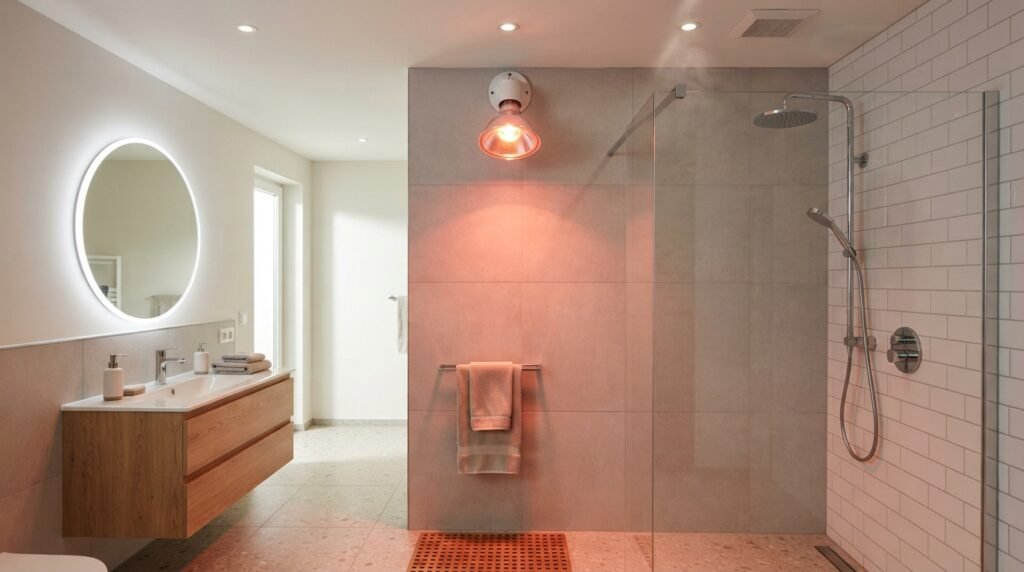
You should only use an infrared heating bulb in a bathroom when the bulb and fixture are compatible and approved for the intended environment.
A bathroom contains moisture and water, which creates additional electrical-safety concerns.
Do not simply install a heat bulb into an ordinary light socket and assume that it is safe.
Check:
- Bulb specifications
- Fixture rating
- Maximum wattage
- Moisture suitability
- Installation location
- Manufacturer instructions
- Local electrical requirements
The fixture is just as important as the bulb.
Can an Infrared Heat Lamp Be Used in a Shower?
This depends on the exact location, fixture rating, and applicable electrical regulations.
A heating bulb should not be installed in an area where it can be directly exposed to water unless the complete fixture is specifically designed and approved for that environment.
The fact that a product is marketed as a “bathroom heat lamp” does not mean it can be installed anywhere in a bathroom.
Bathroom electrical zones and required protection can vary by country and installation type.
For a new installation, have a qualified electrician determine the appropriate location and electrical protection.
Infrared Bathroom Heater Safety
Safety is especially important with infrared heat lamps because the bulb and surrounding fixture can become very hot.
Use the Correct Fixture
Use a fixture specifically designed for the heating bulb’s wattage and operating temperature.
Never Exceed the Maximum Wattage
A fixture rated for a lower wattage should never be fitted with a higher-wattage heat bulb.
Keep Water Away
Do not allow water or spray to contact a hot bulb unless the complete fixture is specifically designed for such exposure.
Avoid Touching a Hot Bulb
Infrared heating bulbs can become extremely hot during operation.
Turn the unit off and allow it to cool completely before touching or replacing the bulb.
Keep Combustible Materials Away
Do not place towels, clothing, paper, or other combustible objects against or immediately around a heat lamp.
Use Proper Electrical Protection
Bathroom electrical installations may require specific protection, such as GFCI/RCD protection, depending on local electrical codes and the installation.
Don’t Modify the Fixture
Do not bypass safety components or modify the socket, wiring, reflector, protective cover, or other components.
Does an Infrared Bulb Heater Need Ventilation?
An infrared heat lamp and a bathroom exhaust fan perform different jobs.
The infrared bulb provides heat.
The exhaust fan removes humid air.
Using a heat lamp does not eliminate the need for appropriate bathroom ventilation.
Good ventilation helps reduce:
- Excess humidity
- Condensation
- Mold growth
- Moisture-related damage
A bathroom heater can therefore be used alongside an exhaust fan rather than as a replacement for one.
Infrared Bathroom Heater With Fan and Light
Some bathroom ceiling units combine three functions:
Heat + Light + Ventilation
These combination units can be convenient because one ceiling installation provides multiple bathroom functions.
A typical unit may have:
- One or more heat lamps
- LED or conventional lighting
- Exhaust fan
- Separate switches
- Ceiling housing
- Protective covers
However, combination units can have more complicated electrical requirements than a simple replacement bulb.
If you are installing a new combination heater, follow the manufacturer’s wiring diagram and local electrical requirements.
Infrared Bulb Heater Bathroom Installation
Installing a bathroom heat lamp involves electrical and heat-safety considerations.
If you are replacing an existing compatible bulb, the process can be relatively straightforward.
If you are installing a completely new fixture, electrical work should generally be handled by a qualified electrician.
Basic Replacement Process
For a compatible replacement bulb:
- Turn the heater off.
- Switch off the electrical supply if required.
- Allow the old bulb to cool completely.
- Remove the protective cover if the fixture has one.
- Carefully remove the old bulb.
- Check the socket for damage.
- Install the correct replacement bulb.
- Reinstall the cover.
- Restore power.
- Test the heater.
Never force a bulb into a socket.
How to Replace an Infrared Bathroom Heat Lamp Bulb
An infrared heat lamp bulb replacement should match the specifications of the original bulb.
Check:
- Voltage
- Wattage
- Bulb shape
- Base/socket type
- Heat-lamp compatibility
- Fixture maximum wattage
For example, if a fixture specifies a particular 250W heat lamp, replacing it with a bulb that has a different wattage or incompatible base can cause problems.
Before Buying a Replacement
Look at the markings on the old bulb and the fixture.
The fixture’s rating should take priority over assumptions based on the old bulb.
If the socket is burned, cracked, loose, or damaged, replacing only the bulb may not solve the problem. The fixture should be inspected.
Infrared Heat Lamp Bulb Types
Infrared heating bulbs are available in several designs.
Some use:
- Red glass
- Clear glass
- Reflector designs
- Different base types
- Different wattages
A red-colored heat lamp is commonly associated with infrared heating because the red glass filters visible light while allowing infrared radiation and some visible red light through.
However, color alone does not determine whether a bulb is appropriate for your bathroom fixture.
Always check the technical specifications.
Red Infrared Bulb vs Clear Infrared Bulb
Both red and clear infrared bulbs can be designed for heating.
Red Heat Lamp
A red bulb can produce the familiar reddish glow associated with traditional heat lamps.
Clear Heat Lamp
A clear infrared bulb can produce more visible light while still providing radiant heat, depending on its construction.
The choice depends on the fixture, intended application, heat output, visible-light preference, and manufacturer’s specifications.
How Hot Does an Infrared Bathroom Bulb Get?
The bulb itself can become extremely hot during operation.
This is why heat-lamp fixtures are designed differently from ordinary household light fixtures.
The high operating temperature means you should:
- Avoid touching the bulb while operating
- Allow it to cool before replacement
- Keep materials away from the bulb
- Use the correct socket
- Never exceed the fixture’s rating
Radiant heat can also warm nearby surfaces, so installation clearance matters.
Can Infrared Heat Lamps Cause a Fire?
Any high-temperature electrical heating device can present a fire risk if it is incorrectly installed, damaged, overloaded, or used near combustible materials.
An infrared bulb does not automatically cause a fire, but incorrect use can create dangerous conditions.
Common mistakes include:
- Using excessive wattage
- Installing an incompatible bulb
- Using a damaged fixture
- Covering the heat lamp
- Placing towels too close
- Using damaged wiring
- Ignoring signs of overheating
If you notice burning smells, discoloration, melting plastic, sparking, smoke, or unusual electrical behavior, switch off the power and have the installation inspected.
Infrared Bulb Heater Bathroom vs Space Heater
Both can provide bathroom warmth, but they work differently.
| Feature | Infrared Bulb Heater | Portable Space Heater |
|---|---|---|
| Installation | Usually fixed | Portable |
| Heating style | Radiant | Usually convection/fan-assisted |
| Floor space | None | Requires floor or counter space |
| Warmth | Localized | Can heat broader area |
| Bathroom suitability | Depends on fixture | Must be specifically suitable for bathroom use |
| Water exposure concerns | Yes | Yes |
| Replacement | Bulb may need replacement | Entire unit/service components |
A portable heater should never be brought into a wet area simply because it is convenient. Follow the manufacturer’s bathroom-use instructions and electrical safety requirements.
Infrared Bulb Heater Bathroom vs Exhaust Fan
These devices solve different problems.
An infrared heat lamp provides warmth.
An exhaust fan removes humid air.
If your bathroom is cold and humid, you may need both heating and ventilation rather than choosing one instead of the other.
Common Infrared Bathroom Heater Problems
The Bulb Does Not Turn On
Possible causes include:
- Burned-out bulb
- Failed socket
- Tripped breaker
- Faulty switch
- Wiring problem
The Bulb Turns On but Does Not Feel Warm
Check whether you have installed an actual heating bulb rather than an ordinary infrared-colored light bulb.
Also verify that the bulb is compatible with the fixture.
The Bulb Keeps Burning Out
Frequent failures can be caused by:
- Incorrect voltage
- Excessive vibration
- Poor-quality bulbs
- Loose connections
- Socket problems
- Incorrect fixture
- Electrical problems
The Fixture Gets Excessively Hot
Heat lamps are expected to become hot, but unusual overheating, melting, burning smells, or discoloration should not be ignored.
Turn the system off and have it inspected.
The Heater Trips the Breaker
A breaker that repeatedly trips may indicate an overloaded circuit, wiring problem, faulty component, or other electrical issue.
Do not repeatedly reset the breaker without finding the cause.
How to Make an Infrared Bathroom Heater More Effective
If your infrared heat lamp does not seem to provide enough warmth, consider:
Position
The heating area should be positioned according to the fixture manufacturer’s instructions.
Ceiling Height
Higher ceilings can change the distance between the user and the heat source.
Room Size
A small localized heat lamp may not provide enough whole-room warmth for a large bathroom.
Drafts
Cold air entering through doors, windows, or ventilation can make a bathroom feel colder.
Insulation
Better insulation can help retain heat.
Ventilation
Use ventilation appropriately because excessive uncontrolled drafts can reduce perceived warmth.
Is an Infrared Bathroom Heater Energy Efficient?
Infrared heating can be efficient for localized heating, because it directly delivers radiant energy to people and surfaces instead of requiring the entire room’s air to reach a target temperature first.
However, “energy efficient” depends on how you use the heater.
A 250W bulb operated for 10 minutes consumes much less electricity than the same bulb operated continuously for several hours.
The key factors are:
- Wattage
- Runtime
- Heating area
- Room conditions
- Electricity price
- Desired temperature
For a short pre-shower or post-shower heating period, a localized heat lamp may be practical.
How Long Should You Run an Infrared Bathroom Heat Lamp?
There is no universal runtime that applies to every fixture.
The correct operating period depends on:
- Manufacturer instructions
- Room temperature
- Fixture design
- Desired comfort
- Heat-lamp wattage
- Bathroom size
Many people use bathroom heat lamps for relatively short periods rather than continuously.
If your fixture has a timer switch, using a timer can prevent accidentally leaving the heater operating longer than intended.
Infrared Bathroom Heater With Timer
A timer can be particularly useful for a bathroom heat lamp.
Instead of relying on memory to turn the heater off, a timer can limit operation to a predetermined period.
Potential benefits include:
- Reduced unnecessary runtime
- Lower electricity consumption
- Less chance of leaving the heater running
- Convenient preheating
Only use a timer that is compatible with the electrical load and heating fixture.
What to Look for When Buying an Infrared Bulb Heater Bathroom
If you are shopping for an infrared bulb heater for bathroom use, consider the following checklist:
1. Correct Wattage
Choose a wattage supported by the fixture.
2. Correct Voltage
Match the bulb to the electrical system and fixture requirements.
3. Correct Base
Make sure the bulb physically and electrically fits the socket.
4. Bathroom-Rated Fixture
The fixture should be appropriate for the intended bathroom location.
5. Heat Resistance
The socket, housing, reflector, and other components must be designed for the bulb’s operating temperature.
6. Safety Features
Look for appropriate protective covers and electrical protection.
7. Replacement Availability
If the bulb eventually fails, make sure a compatible replacement is readily available.
8. Manufacturer Documentation
Good documentation makes installation, replacement, and troubleshooting easier.
Frequently Asked Questions
1. What is an infrared bulb heater in a bathroom?
An infrared bulb heater is a heating lamp that produces radiant infrared energy to provide localized warmth. It is commonly installed in a ceiling fixture or bathroom heat-lamp unit.
2. Are infrared heat lamps safe for bathrooms?
They can be safe when the correct bathroom-rated fixture is installed properly and used according to manufacturer instructions and local electrical requirements. Water exposure, electrical installation, and high operating temperatures make proper installation particularly important.
3. What is the most common wattage for an infrared heat lamp?
250W is a common heat-lamp wattage, but the correct wattage depends on the specific fixture. Never exceed the fixture’s maximum rating.
4. Can I put an infrared bulb in a normal light socket?
Do not assume that a normal light socket is suitable. Infrared heat lamps can operate at much higher temperatures than ordinary lighting bulbs. Use only a socket and fixture specifically rated for the bulb.
5. Do infrared bathroom heaters heat the whole room?
Not necessarily. Infrared heat lamps are primarily designed for localized radiant warmth. They may not provide uniform whole-room heating, particularly in larger bathrooms.
6. Does an infrared bathroom heater need an exhaust fan?
An infrared heater and exhaust fan serve different purposes. The heater provides warmth, while the exhaust fan removes humid air. A bathroom may benefit from both.
7. How much electricity does a 250W infrared bulb use?
A 250W bulb uses approximately 0.25 kWh for one hour of continuous operation. Actual electricity cost depends on your utility rate.
8. Can I leave an infrared bathroom heat lamp on overnight?
It is generally better to follow the manufacturer’s specified operating instructions rather than leaving a high-temperature heat lamp running unattended for extended periods. A timer can help limit operating time when appropriate.
9. Why does my infrared heat bulb get so hot?
Heat lamps are designed to produce significant heat, so high operating temperatures are normal. However, melting, burning smells, discoloration, smoke, or other abnormal signs indicate that the system should be switched off and inspected.
10. How do I replace an infrared bathroom heat lamp?
Turn the power off, allow the old bulb to cool completely, remove it carefully, and install an identical or manufacturer-approved replacement with the correct wattage, voltage, and base.
11. Are red infrared bulbs better than clear bulbs?
Neither color is automatically better. Red and clear infrared heating bulbs have different characteristics, and the correct choice depends on the fixture and intended application.
12. Can an infrared bulb be installed directly above a shower?
The answer depends on the exact fixture, installation zone, moisture protection, and local electrical requirements. Never install a heat lamp in a water-exposed location unless the complete fixture is specifically designed and approved for that location.
Final Thoughts
An infrared bulb heater bathroom setup can be a convenient way to add quick, localized warmth, especially during cold mornings and after showers. Unlike conventional air heaters, an infrared heat lamp provides radiant heat that can be felt directly by people and nearby surfaces.
When choosing or replacing one, focus on more than the bulb itself. Check the wattage, voltage, socket, fixture rating, bathroom suitability, installation location, ventilation, and electrical protection. A 250W infrared heat lamp, for example, can provide substantial localized heat while consuming 0.25 kWh per hour, but it must be used in a fixture designed for that electrical load and temperature.
Most importantly, treat bathroom heat lamps as high-temperature electrical equipment. Use the correct fixture, keep water away unless the complete installation is designed for that exposure, keep combustible materials away, and have new electrical installations performed by a qualified professional when required. With the right fixture and installation, an infrared bathroom heat lamp can provide comfortable radiant warmth without requiring a large portable heater to occupy valuable bathroom space.
Related Post
- Light Bulb Base Types – Complete Guide to Bulb Bases, Sizes & Socket Types!
- Light Bulb Guide Size – Complete Guide to Bulb Sizes, Shapes, Bases & Codes!
- Light Bulb Light In Car – Complete Guide to Car Interior Lights, Warning Bulbs, Headlights, and Replacement!
About the Author