Choosing the right replacement light bulb is not only about brightness, wattage, or bulb shape. The light bulb base type is equally important because the base must physically and electrically match the socket in your fixture.
You may have seen codes such as E26, E27, E12, E17, GU10, G4, G9, and GU5.3 on light bulb packaging. These codes identify different types of bulb bases, and each is designed for specific fixtures and applications.
Understanding light bulb base types can help you choose the correct bulb for lamps, chandeliers, ceiling fixtures, recessed lights, track lighting, bathroom vanities, appliances, and outdoor fixtures.
In this guide, we’ll explain the most common light bulb bases, what their codes mean, how to identify a bulb base, the difference between screw and pin bases, and how to make sure a replacement bulb fits your fixture.
What Is a Light Bulb Base?
The light bulb base is the bottom portion of a bulb that connects it to the electrical socket.
The base performs two main functions:
- It physically holds the bulb in the fixture.
- It provides an electrical connection between the bulb and the fixture.
Light bulb bases come in many different shapes and sizes. Some screw into a socket, while others use pins, loops, or a twist-and-lock mechanism.
Common light bulb base categories include:
- Screw bases
- Pin bases
- Twist-and-lock bases
- Bayonet bases
- Specialty bases
The correct base is essential because a bulb with the wrong base may not physically fit or make the proper electrical connection.
How Are Light Bulb Base Types Named?
Light bulb bases are commonly identified using letters and numbers.
For example, E26 means:
- E = Edison screw
- 26 = approximately 26 mm diameter of the base
Similarly, E12 refers to an Edison screw base approximately 12 mm in diameter.
Other letters identify different base designs.
Examples include:
| Base Code | General Type |
|---|---|
| E12 | Small Edison screw |
| E17 | Intermediate Edison screw |
| E26 | Medium Edison screw |
| E27 | Medium Edison screw |
| GU10 | Twist-and-lock pin base |
| G4 | Two-pin base |
| G9 | Loop-pin base |
| GU5.3 | Two-pin base |
| BA15s | Bayonet-style base |
The exact mechanical and electrical specifications can vary by standard and application, so the code on the original bulb or fixture is the best starting point when selecting a replacement.
What Are the Most Common Light Bulb Base Types?
The most common residential and specialty light bulb base types include:
- E26
- E27
- E12
- E17
- GU10
- GU5.3
- G4
- G9
- BA15s and related bayonet bases
- Specialty appliance bases
Let’s look at each type in more detail.
E26 Light Bulb Base
The E26 base is one of the most common light bulb bases in the United States.
The E26 is known as a medium Edison screw base and is frequently used in household lighting.
You can find E26 bulbs in:
- Table lamps
- Floor lamps
- Ceiling fixtures
- Pendant lights
- Ceiling fans
- Outdoor fixtures
- Wall sconces
Many common household bulb shapes use an E26 base, including:
- A19
- A21
- G25
- BR30
- PAR38
However, bulb shape and base are separate specifications.
For example, an A19 E26 bulb has an A19-shaped bulb body and an E26 screw base.
E27 Light Bulb Base
The E27 is another common Edison screw base.
Its nominal base diameter is approximately 27 mm.
E27 bases are widely used in many international markets and household fixtures.
E26 and E27 are extremely similar in physical size, but they are not technically identical standards.
When replacing a bulb, it is best to follow the specification provided by the fixture or original bulb rather than assuming that every E26 and E27 application is interchangeable.
E26 vs E27: What’s the Difference?
E26 and E27 can look almost identical because their nominal diameters are very close.
| Feature | E26 | E27 |
|---|---|---|
| Base family | Edison screw | Edison screw |
| Nominal diameter | 26 mm | 27 mm |
| Common usage | United States and North America | Many international markets |
| Appearance | Very similar | Very similar |
| Compatibility | Depends on fixture and electrical standard | Depends on fixture and electrical standard |
The one-millimeter difference may seem insignificant, but electrical standards and socket specifications also matter.
Therefore, don’t select a bulb based only on appearance.
E12 Light Bulb Base
The E12 base is commonly called a candelabra base.
It is significantly smaller than an E26 medium base.
E12 bulbs are frequently used in decorative fixtures such as:
- Chandeliers
- Wall sconces
- Decorative lamps
- Night lights
- Ceiling fixtures
- Small decorative fixtures
Common E12 bulb shapes include candle-style and decorative bulbs.
If your fixture has a small screw socket, an E12 bulb may be appropriate—but always check the fixture specification before purchasing.
E17 Light Bulb Base
The E17 base is commonly known as an intermediate base.
It sits between the smaller E12 and larger E26 in the common Edison screw-base family.
E17 bulbs are frequently found in:
- Specialty lamps
- Appliance lighting
- Certain ceiling fixtures
- Specialty household fixtures
One important application is appliance lighting, where a smaller intermediate screw base may be used.
GU10 Light Bulb Base
The GU10 base is commonly used for directional and spotlighting applications.
Unlike an Edison screw bulb, GU10 bulbs typically use two pins that fit into matching slots and then twist to lock into the socket.
GU10 bulbs are often found in:
- Track lighting
- Recessed spotlights
- Kitchen lighting
- Accent lighting
- Display lighting
The twist-and-lock design helps secure the bulb inside the fixture.
GU5.3 Light Bulb Base
GU5.3 is a two-pin base commonly associated with MR16-style lighting.
The two pins are spaced approximately 5.3 mm apart.
GU5.3 bulbs are often used in:
- Track lighting
- Accent lighting
- Recessed fixtures
- Landscape lighting
- Display lighting
Many GU5.3 systems operate at low voltage, but you should always verify the bulb and fixture specifications.
A GU5.3 bulb should not automatically be replaced with a GU10 bulb simply because both are commonly associated with MR16-style lighting.
The socket and electrical system must match.
G4 Light Bulb Base
The G4 base uses two small pins.
It is commonly used in compact lighting applications.
G4 bulbs can be found in:
- Under-cabinet lighting
- Decorative fixtures
- Small lamps
- Landscape lighting
- Specialty lighting
- Some RV and marine applications
Many G4 lighting systems use low voltage, so checking the required voltage is particularly important.
G9 Light Bulb Base
The G9 base uses two loop-shaped contacts rather than traditional screw threads.
G9 bulbs are often found in:
- Decorative lamps
- Pendant lights
- Wall sconces
- Modern ceiling fixtures
- Small decorative fixtures
Because the base design is different from an Edison screw base, a G9 bulb cannot simply be screwed into an E26 or E12 socket.
Bayonet Light Bulb Bases

A bayonet base uses pins or projections that fit into slots in the socket.
Instead of screwing the bulb into the socket, you generally insert it and twist it into place.
Bayonet bases are common in several markets and applications.
Common examples include:
- B22
- BA15s
- BA15d
- Related bayonet configurations
Bayonet bulbs are particularly common in some international lighting systems and automotive applications.
B22 Light Bulb Base
The B22 base is commonly associated with a bayonet-style connection.
The bulb is inserted into the socket and rotated to lock it in position.
B22 bulbs can be found in:
- Household lamps
- Ceiling fixtures
- Decorative lighting
- International residential applications
Because B22 and E26/E27 use different connection mechanisms, they are not direct replacements for one another without an appropriate compatible socket or adapter.
Automotive Light Bulb Bases
Automotive bulbs use many specialized base types.
Examples include:
- 1156
- 1157
- 7440
- 7443
- H1
- H4
- H7
- 9005
- 9006
Automotive bulb codes can identify both the bulb design and electrical/physical configuration.
For vehicle lighting, always match the exact bulb specification recommended for your vehicle.
Do not assume that a household bulb-base code such as E26 applies to automotive lighting.
Light Bulb Base Types Chart
Here’s a quick reference for some common bulb bases:
| Base Type | Approx. Size/Configuration | Common Applications |
|---|---|---|
| E12 | 12 mm screw | Chandeliers, decorative lamps |
| E17 | 17 mm screw | Specialty and appliance fixtures |
| E26 | 26 mm screw | Standard household lighting |
| E27 | 27 mm screw | International household lighting |
| GU10 | Twist-and-lock pins | Spotlights, track lighting |
| GU5.3 | 5.3 mm pin spacing | MR16, accent lighting |
| G4 | Two pins | Low-voltage specialty lighting |
| G9 | Loop contacts | Decorative lighting |
| B22 | Bayonet | Household lighting in many countries |
| BA15s | Bayonet-style | Automotive and specialty lighting |
| BA15d | Double-contact bayonet | Automotive and specialty lighting |
The exact dimensions, voltage, and electrical characteristics should always be verified for the specific bulb and fixture.
Screw Base vs Pin Base
One of the easiest ways to categorize light bulb base types is by how the bulb connects to the socket.
Screw Bases
Screw bases use threaded metal contacts.
Common examples include:
- E12
- E17
- E26
- E27
The bulb is rotated clockwise into the socket.
Pin Bases
Pin-base bulbs use one or more pins instead of threads.
Examples include:
- G4
- G9
- GU5.3
- GU10
Some pin bases are pushed into place, while GU-style bases may use a twist-and-lock mechanism.
How to Identify a Light Bulb Base
If you don’t know what base your bulb uses, identifying it is usually straightforward.
Step 1: Turn Off the Power
Switch off the light before removing the bulb.
Allow a recently used bulb to cool down.
Step 2: Remove the Bulb
Carefully remove the bulb from the fixture.
For screw bulbs, rotate the bulb counterclockwise.
For pin or bayonet bulbs, follow the appropriate removal method.
Step 3: Examine the Bottom
Look at the bulb base.
Ask:
- Does it have screw threads?
- Does it have two pins?
- Does it twist into the socket?
- Does it use a bayonet connection?
- Does it have multiple contacts?
Step 4: Look for a Code
Check the bulb for markings such as:
E26
E12
GU10
G4
G9
GU5.3
The code is often the easiest way to identify the base.
Step 5: Check the Fixture Label
The fixture may list the required bulb type and base.
This information can be found on:
- Socket labels
- Fixture labels
- Product packaging
- Installation instructions
- Manufacturer documentation
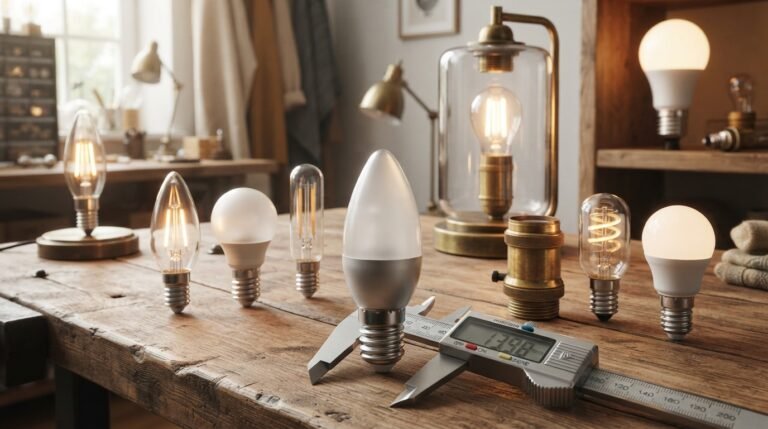
How to Measure a Light Bulb Base
If you cannot find a base code, you can measure the base.
For screw-type bases, measure the approximate outside diameter of the threaded portion.
For example:
- Around 12 mm → potentially E12
- Around 17 mm → potentially E17
- Around 26 mm → potentially E26
- Around 27 mm → potentially E27
Measurement alone should not be the only method of identification because different standards can have similar physical dimensions.
For pin bases, measure:
- Pin spacing
- Pin diameter
- Pin configuration
- Overall base shape
Also check the bulb’s voltage and electrical specifications.
Why Bulb Base Size Matters
The bulb base needs to match the fixture’s socket.
A bulb can have the correct:
- Shape
- Brightness
- Color temperature
- Wattage
and still be completely unsuitable if the base doesn’t fit.
For example, an A19 bulb could be available with an E26 base, but an E12 chandelier socket requires an appropriate E12 bulb.
This is why selecting a replacement bulb requires checking more than the bulb’s appearance.
Bulb Shape vs Bulb Base
This is one of the most common sources of confusion.
Bulb shape describes the outer body.
Examples:
- A19
- A21
- G25
- BR30
- PAR38
- MR16
Bulb base describes the connection to the socket.
Examples:
- E12
- E17
- E26
- E27
- GU10
- GU5.3
- G4
- G9
A bulb specification can contain both.
For example:
A19 E26 LED bulb
means:
- A19 = bulb shape and size
- E26 = base
- LED = lighting technology
Understanding this distinction makes bulb shopping much easier.
Can You Use an Adapter to Change a Bulb Base?
In some situations, a bulb base adapter can allow a bulb with one base type to work in a socket designed for another base.
For example, adapters exist for some combinations of:
- E26 to E12
- E26 to GU10
- E27 to other compatible bases
However, adapters should be used carefully.
Before using one, check:
- Voltage
- Maximum wattage
- Fixture rating
- Physical clearance
- Heat
- Adapter quality
- Whether the adapter is approved for the intended application
An adapter should never be used to bypass an electrical compatibility problem.
Light Bulb Base Types for Different Fixtures
Different fixtures commonly use different base types.
| Fixture | Common Base Types |
|---|---|
| Table lamp | E26, E12 |
| Floor lamp | E26 |
| Chandelier | E12, E14, B22 |
| Ceiling fixture | E26, E27, B22 |
| Bathroom vanity | E26, E12 |
| Track lighting | GU10, GU5.3 |
| Recessed spotlight | GU10, GU5.3 |
| Under-cabinet light | G4, G9 |
| Decorative pendant | E12, E26, G9 |
| Appliance light | E17, specialty bases |
| Automotive lighting | Vehicle-specific bases |
These are common examples rather than universal rules. Always check the fixture specifications.
Does LED Change the Bulb Base?
No.
LED describes the lighting technology, while the base describes how the bulb connects to the fixture.
You can find LED bulbs with many different bases, including:
- E12 LED
- E17 LED
- E26 LED
- E27 LED
- GU10 LED
- GU5.3 LED
- G4 LED
- G9 LED
This allows LED technology to be used in many fixtures originally designed for other bulb technologies.
However, compatibility with dimmers, transformers, enclosed fixtures, and low-voltage systems should still be checked.
Can You Replace an Incandescent Bulb With an LED Bulb?
Often, yes, provided the LED bulb is compatible with the fixture.
Check:
- Base type
- Voltage
- Physical dimensions
- Lumens
- Fixture rating
- Dimming compatibility
- Enclosed-fixture compatibility where applicable
- Transformer compatibility for low-voltage systems
For example, an incandescent E26 bulb can often be replaced by an E26 LED bulb if the other requirements are satisfied.
The LED bulb may use substantially less electrical power while providing a similar amount of light.
Why Does the Base Get Hot?
Some bulb bases can become warm during operation because heat is produced by the lighting system.
The amount of heat depends on the bulb technology, fixture, operating conditions, and design.
If you notice:
- Excessive heat
- Burning smell
- Discoloration
- Melting plastic
- Flickering
- Damaged socket
turn the fixture off and investigate the problem.
An oversized or incompatible bulb can also create problems if it exceeds the fixture’s specifications.
Common Mistakes When Choosing a Bulb Base
Choosing Based Only on Bulb Shape
An A19 bulb can have different bases depending on the product.
Always check the base separately.
Ignoring Voltage
Some pin-base bulbs operate at low voltage and may require a transformer.
Confusing E26 and E27
Although they are extremely similar, they represent different standards.
Assuming All MR16 Bulbs Use the Same Base
MR16 describes a bulb format, not necessarily one universal electrical connection.
MR16 lamps may be associated with different base configurations, including GU5.3 and GU10.
Forgetting Physical Clearance
The base may fit while the bulb body is too large for the fixture.
Ignoring Dimming Compatibility
Some LED bulbs require specific dimmers.
How to Choose the Correct Light Bulb Base
Use this checklist before purchasing a replacement bulb:
1. Identify the Old Bulb
Look for the printed bulb and base code.
2. Check the Socket
Determine whether it uses:
- Screw
- Pin
- Bayonet
- Twist-and-lock
3. Check the Base Size
Measure if necessary.
4. Verify Voltage
This is especially important for low-voltage pin-base lighting.
5. Check Fixture Requirements
Look at the fixture label or manual.
6. Check Physical Dimensions
Make sure the new bulb fits inside the fixture.
7. Check Brightness
Compare lumens rather than relying only on wattage.
8. Check LED Compatibility
If switching to LED, check dimming and transformer compatibility.
Frequently Asked Questions About Light Bulb Base Types
1. What are the most common light bulb base types?
The most common include E26, E27, E12, E17, GU10, GU5.3, G4, G9, and B22. The correct type depends on the fixture and region.
2. What is the most common light bulb base?
E26 is one of the most common household light bulb bases in the United States.
3. What does E26 mean on a light bulb?
E26 indicates an Edison screw base with a nominal diameter of approximately 26 mm.
4. What does E12 mean?
E12 is a small Edison screw base with a nominal diameter of approximately 12 mm. It is commonly called a candelabra base.
5. What does E27 mean?
E27 is an Edison screw base with a nominal diameter of approximately 27 mm and is widely used in international lighting applications.
6. Is E26 the same as E27?
They are very similar Edison screw bases, but E26 and E27 are different standards. Always follow the fixture manufacturer’s specifications.
7. What is a GU10 bulb base?
GU10 is a two-pin, twist-and-lock base commonly used in spotlights, recessed lighting, and track lighting.
8. What is a GU5.3 bulb base?
GU5.3 is a two-pin base with approximately 5.3 mm pin spacing. It is commonly associated with MR16-style low-voltage lighting.
9. What is a G4 bulb base?
G4 is a small two-pin base commonly used in low-voltage specialty, cabinet, decorative, and compact lighting.
10. What is a G9 bulb base?
G9 is a small loop-contact base commonly found in decorative and specialty light fixtures.
11. What is the difference between E12 and E26?
E12 is a smaller candelabra screw base, while E26 is a larger medium screw base commonly used in standard household fixtures.
12. How do I know which bulb base I need?
Check the original bulb, fixture label, socket, and manufacturer’s specifications. If necessary, measure the base and identify whether it uses a screw, pin, twist-and-lock, or bayonet connection.
13. Can I use an E26 bulb in an E12 socket?
No, not directly. E26 and E12 have different base dimensions and socket configurations. A suitable adapter may exist for some applications, but compatibility and safety must be checked carefully.
14. Are LED bulb bases different?
LED bulbs can use the same base types as incandescent, halogen, and other bulbs. LED identifies the lighting technology, not the base.
15. Do all LED bulbs use E26 bases?
No. LED bulbs are available with many base types, including E12, E17, E26, E27, GU10, GU5.3, G4, and G9.
16. What bulb base is used in chandeliers?
Many chandeliers use E12 candelabra bases, although some fixtures use other bases such as E14 or B22 depending on the fixture and region.
17. What bulb base is used for recessed lighting?
Recessed fixtures can use several base types, including E26, GU10, GU5.3, and others depending on the fixture design.
Final Thoughts
Understanding light bulb base types is one of the easiest ways to make sure you purchase the correct replacement bulb. The most common screw bases include E12, E17, E26, and E27, while pin and twist-lock bases include G4, G9, GU5.3, and GU10. Bayonet-style bases such as B22 are also widely used in certain markets and fixtures. Remember that the bulb shape and bulb base are different specifications. A19, A21, BR30, PAR38, and MR16 describe bulb formats, while E26, E12, GU10, G4, and other codes describe the connection to the fixture.
Before buying a replacement, identify the base type, base size, voltage, bulb dimensions, brightness, and fixture requirements. If you’re upgrading from incandescent or halogen to LED, also check dimming, transformer, and enclosed-fixture compatibility. Once you understand how bulb base codes work, choosing the right light bulb becomes much simpler—and you can avoid buying a bulb that looks right but doesn’t actually fit your socket.
Related Post
- Light Bulb Light In Car – Complete Guide to Car Interior Lights, Warning Bulbs, Headlights, and Replacement!
- Mr16 Bulb – Complete Guide to MR16 Light Bulbs, Sizes, Watts, Voltage, Lumens, and Uses!
- Non Led Light Bulbs – Complete Guide to Incandescent, Halogen, CFL, Types, Benefits, and Uses!
About the Author