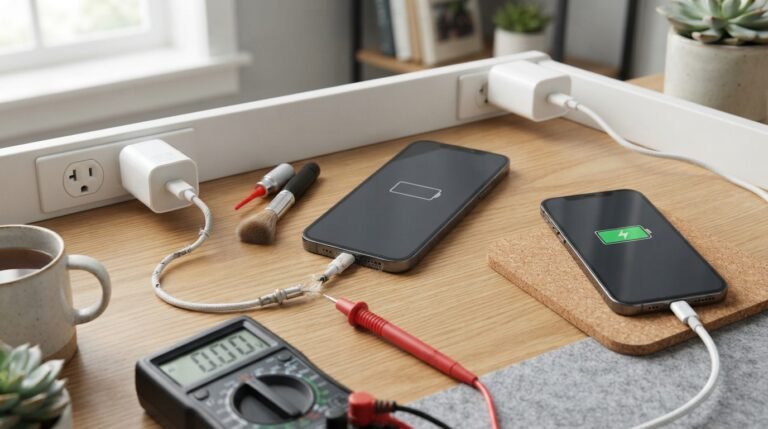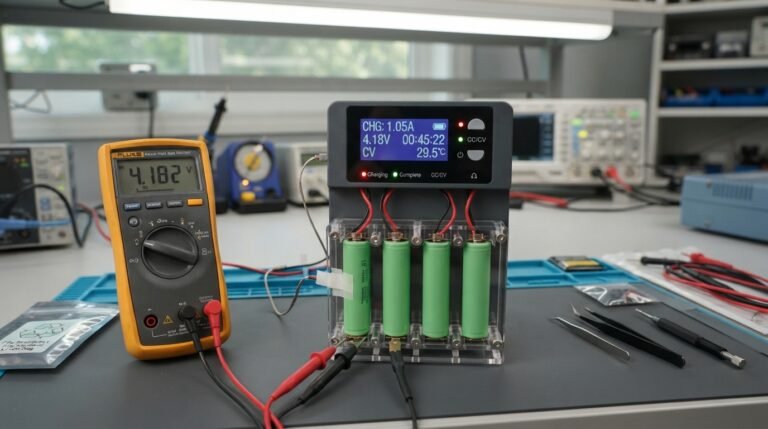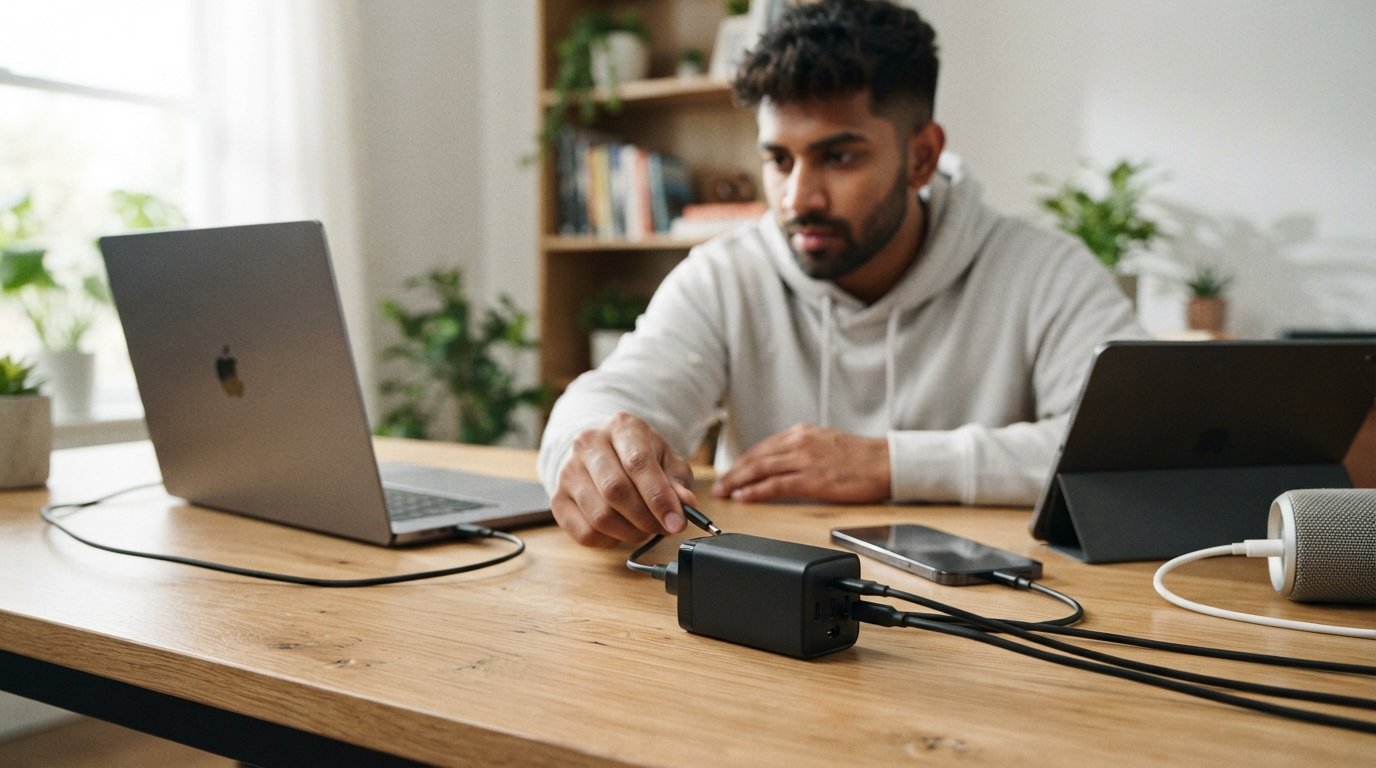
A GaN 150W DC+USB-C charger is a high-power charging solution designed for users who need to power laptops, tablets, smartphones, accessories, and other compatible devices from one compact charger. By combining gallium nitride (GaN) technology, USB-C Power Delivery, and a DC output, these chargers can provide flexible power for multiple types of devices.
Compared with traditional silicon-based chargers, GaN technology allows manufacturers to build chargers that can deliver high power while remaining relatively compact and efficient.
But what exactly does a 150W GaN DC+USB-C charger do, and how do you know whether it is compatible with your laptop or other device?
This guide explains everything you need to know, including GaN technology, 150W power output, USB-C PD, DC charging, ports, compatibility, charging speed, safety, and how to choose the right charger.
What Is a GaN 150W DC+USB-C Charger?
A GaN 150W DC+USB-C charger is a power adapter that uses gallium nitride semiconductor technology and can provide up to 150 watts of power through one or more charging outputs.
The name can be broken down into three parts:
- GaN = Gallium Nitride charging technology
- 150W = Maximum rated power capability
- DC + USB-C = Combination of DC and USB-C charging outputs
USB-C is commonly used for modern laptops, phones, tablets, handheld gaming devices, and accessories, while a DC output may be designed for devices that use a traditional barrel-style power connector or a manufacturer-specific DC input.
This combination makes a 150W GaN charger particularly useful for people who want one power adapter for several devices.
What Is GaN Charging Technology?
GaN stands for Gallium Nitride, a semiconductor material used in modern power electronics.
Traditional chargers commonly use silicon-based components. GaN technology can operate efficiently at high switching frequencies, allowing charger manufacturers to create smaller and more efficient power adapters.
Some major benefits of GaN chargers include:
- Compact size
- High power density
- Efficient power conversion
- Reduced heat generation in suitable designs
- High-power charging in a smaller enclosure
- Support for modern charging standards
This is why you will often see GaN fast chargers rated at 100W, 140W, 150W, 160W, and even higher.
However, GaN itself does not automatically make a charger faster. The actual charging performance depends on the charger’s power specifications, charging protocols, cable, and the device being charged.
What Does 150W Mean on a GaN Charger?
The 150W rating represents the charger’s maximum power capability under its specified operating conditions.
It does not mean that every connected device will receive 150W.
For example, if you connect a smartphone that supports only 30W charging, the phone will generally request and receive power according to its supported charging protocol rather than automatically receiving 150W.
Similarly, a laptop designed for a particular USB-C Power Delivery input will negotiate an appropriate voltage and current with the charger.
This is an important distinction:
A 150W charger provides up to 150W of available power; it does not force 150W into every connected device.
What Is USB-C Power Delivery?
USB-C Power Delivery (USB-C PD) is a charging and power-negotiation standard that allows compatible devices and chargers to communicate and determine an appropriate power level.
A USB-C PD charger can support different voltage and current combinations rather than simply providing one fixed output.
Depending on the charger and device, USB-C PD can be used to charge:
- Smartphones
- Tablets
- Laptops
- Portable monitors
- Gaming devices
- Power banks
- USB-C accessories
A high-power 150W USB-C charger can therefore be useful for devices that require substantially more power than a typical phone charger.
What Is the DC Output on a 150W Charger?
The DC output is generally intended for devices that receive power through a dedicated DC input rather than USB-C.
Depending on the charger design, the DC port may support a particular voltage, current, connector size, or polarity.
This is where compatibility becomes especially important.
Unlike USB-C PD, a traditional DC barrel connection does not automatically guarantee that the voltage is correct for every device.
Before connecting a DC output to a device, check:
- Required voltage
- Required current
- Connector size
- Polarity
- Maximum input power
- Manufacturer specifications
Using an incorrect DC voltage or connector can damage equipment.
GaN 150W DC+USB-C Charger vs. Traditional Charger
A traditional charger may be larger because its internal power components require more physical space.
GaN technology allows manufacturers to design high-power chargers with greater power density.
| Feature | Traditional Charger | 150W GaN Charger |
|---|---|---|
| Semiconductor | Usually silicon | Gallium nitride |
| Power density | Generally lower | Generally higher |
| Size | Often larger | Often more compact |
| High-power charging | Available | Excellent for high-power designs |
| USB-C PD | Model dependent | Common on modern models |
| Multi-device charging | Model dependent | Common |
| Portability | Varies | Often very good |
The actual size and efficiency still depend on the charger’s engineering and thermal design.
How Fast Is a 150W GaN Charger?
Charging speed depends on the device’s maximum supported input power, not simply the charger’s advertised wattage.
For example:
- A 20W phone may use around 20W.
- A 45W tablet may use around 45W.
- A 100W-compatible laptop may use up to around 100W.
- A compatible high-power device may use more.
The charger can only provide power within the limits negotiated between the charger and device.
Other factors can also affect charging speed:
- Battery percentage
- Device temperature
- Cable rating
- Charging protocol
- Number of connected devices
- Device workload
- Charger temperature
- Manufacturer charging limits
Can a 150W GaN Charger Charge a Laptop?
Yes, if the laptop supports the charger’s output specifications.
Many modern laptops can charge through USB-C Power Delivery. However, not every laptop supports USB-C charging, and some gaming laptops require considerably more power than standard USB-C laptop charging.
Before replacing a laptop’s original charger, check:
- USB-C charging support
- Required wattage
- Supported USB-C PD profiles
- Required voltage
- Cable capability
- Manufacturer recommendations
For a laptop requiring 65W, a 150W USB-C charger can have enough overall power capacity, but compatibility still depends on the laptop’s charging requirements.
Can a 150W GaN Charger Charge a Phone?
Yes.
A 150W charger can charge phones that support USB-C or compatible charging standards, but the phone determines how much power it can accept.
For example, a phone supporting 25W charging will not become a 150W phone simply because you connect it to a 150W adapter.
A high-power charger can be useful because the same adapter can also power a laptop or tablet.
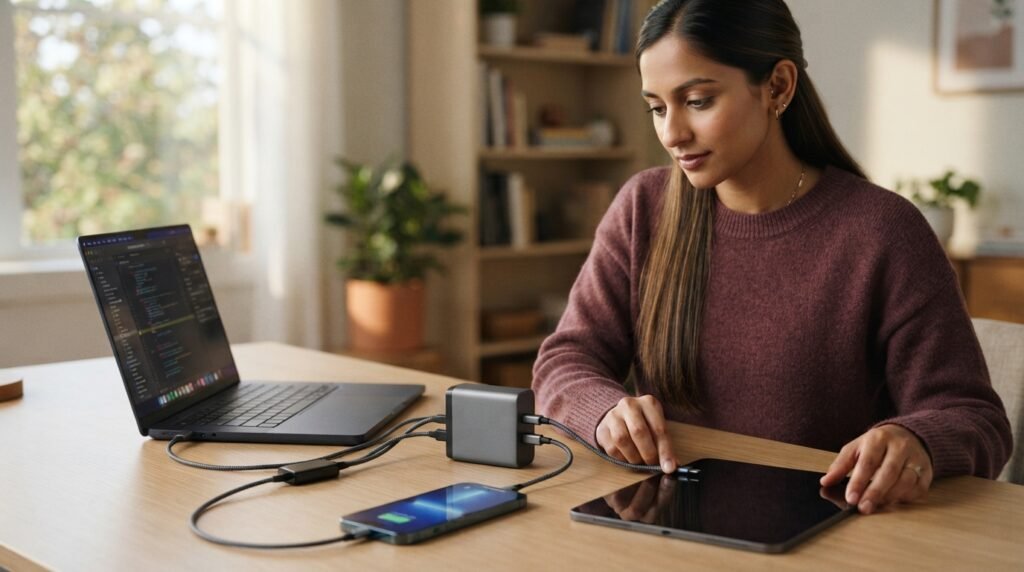
Can You Charge Multiple Devices With a 150W GaN Charger?
Many 150W GaN chargers are designed for multi-device charging, although the exact power distribution varies by model.
A charger might include:
- USB-C port
- Additional USB-C ports
- USB-A port
- DC output
When multiple devices are connected, the charger may dynamically distribute available power.
For example, a charger could allocate more power to a laptop and less to a smartphone.
The exact output combination depends on the manufacturer’s port specifications.
Always check the power distribution table before assuming that every port can simultaneously deliver its maximum advertised wattage.
What Devices Can a 150W DC+USB-C Charger Power?
Depending on its output specifications, a high-power GaN charger can potentially support:
- Laptops
- MacBooks
- Windows laptops
- Smartphones
- Tablets
- Handheld gaming consoles
- Portable monitors
- USB-C power banks
- Cameras
- Networking equipment
- Compatible DC-powered electronics
- Other USB-C accessories
The key word is compatible.
A charger should never be selected solely based on its maximum wattage.
USB-C vs. DC Charging
USB-C and traditional DC charging work differently.
| Feature | USB-C PD | Traditional DC |
|---|---|---|
| Connector | USB-C | Usually barrel-style |
| Power negotiation | Supported through PD | Usually no automatic PD negotiation |
| Common use | Phones, tablets, laptops | Electronics and specialized devices |
| Voltage selection | Negotiated when supported | Must match device requirements |
| Cable requirements | USB-C PD-rated cable may be required | Correct connector and specifications required |
USB-C is generally easier for multi-device use because the charging protocol can negotiate power between compatible devices.
Traditional DC connections require more careful checking of voltage, polarity, and connector dimensions.
Why Is Cable Quality Important With 150W Charging?
A high-power charger is only as capable as the complete charging system.
The cable must support the required power level.
For high-power USB-C charging, look for a cable that is appropriately rated for the power you intend to use. Depending on the charging specification and power level, an electronically marked cable may be required.
Using a low-rated cable can limit charging performance.
For example, if your charger and laptop support high-power USB-C charging but the cable is not rated for that level, the system may operate at a lower power level.
Therefore, when purchasing a 150W GaN USB-C charger, pay attention to the cable as well as the charger.
Does a 150W Charger Use 150W All the Time?
No.
The 150W rating is a maximum capability, not constant power consumption.
A connected device may draw only the amount of power it needs.
For example, when a smartphone is fully charged or close to full, its power consumption during charging can decrease significantly.
Laptop charging can also vary depending on:
- Battery level
- CPU/GPU workload
- Display usage
- Battery temperature
- Power-management settings
Therefore, a 150W charger does not continuously consume 150W simply because it is plugged in.
Is a 150W GaN Charger Safe?
A quality GaN charger can be safe when it is properly designed, certified where applicable, and used according to its specifications.
Modern chargers can include protections such as:
- Over-voltage protection
- Over-current protection
- Over-temperature protection
- Short-circuit protection
- Over-power protection
However, safety depends on the actual charger.
Avoid extremely cheap or counterfeit chargers with unclear specifications.
When purchasing a 150W GaN charger, look for:
- Reputable manufacturer
- Clear output specifications
- Appropriate safety certifications
- Proper thermal management
- Quality cable
- Device compatibility information
Why Does My GaN Charger Get Warm?
Some heat during high-power charging is normal.
Power conversion generates heat, and a charger operating close to its maximum capacity may become noticeably warm.
Heat can increase when:
- Charging a high-power laptop
- Multiple devices are connected
- The charger is enclosed
- Airflow is restricted
- The charger is operating near its maximum output
- The ambient temperature is high
A charger becoming warm does not automatically indicate a problem.
However, if it becomes extremely hot, smells unusual, makes abnormal sounds, or repeatedly shuts down, disconnect it and investigate the issue.
150W GaN Charger Power Distribution
One of the most important specifications to check is power distribution.
A charger advertised as 150W may not provide 150W independently from every port.
For example, a manufacturer may specify a maximum total output such as:
150W total
rather than:
150W per USB-C port
When multiple devices are connected, available power may be divided between ports.
Always read the manufacturer’s output table to determine:
- Maximum USB-C output
- Maximum DC output
- USB-A output
- Combined output
- Multi-port charging limits
This is especially important if you want to charge a laptop and several other devices simultaneously.
What Should You Look for in a 150W GaN Charger?
Before buying a GaN 150W DC+USB-C charger, consider these specifications.
1. Maximum USB-C Output
Check how much power the primary USB-C port can actually deliver.
2. DC Voltage Range
If you need the DC output, verify that its voltage matches your device.
3. Port Configuration
Check whether you need:
- One USB-C
- Two USB-C
- USB-C + USB-A
- USB-C + DC
- Multiple outputs
4. Power Distribution
Find out how the 150W total output is divided when multiple ports are being used.
5. Cable Rating
Use an appropriate high-power USB-C cable when required.
6. Safety Features
Look for appropriate protection mechanisms and certifications.
7. Size and Weight
One major advantage of GaN is high power density, so compare the charger’s physical size if portability matters.
8. Device Compatibility
Check the requirements of every device you plan to charge.
150W GaN Charger for Travel
A high-power GaN charger can be especially useful when traveling.
Instead of carrying separate adapters for:
- Laptop
- Smartphone
- Tablet
- Gaming device
- Accessories
you may be able to use one multi-output charger.
A compact charger can reduce the number of adapters in your travel bag.
However, international travelers should also check:
- Input voltage range
- Plug type
- Country-specific electrical requirements
- Required adapters
- Airline or destination restrictions
A DC output can be particularly useful if you travel with specialized electronics, but connector and voltage compatibility must be verified carefully.
150W GaN Charger for Gaming Devices
A 150W charger can be useful for compatible gaming equipment such as:
- Gaming laptops
- Handheld gaming consoles
- Portable displays
- Controllers
- USB-C power banks
Gaming laptops require special attention because some models require more power than USB-C PD can provide or may reduce performance while charging through USB-C.
Always check the gaming device manufacturer’s charging requirements.
150W GaN Charger vs. 100W Charger
A 150W charger offers more total power capacity than a 100W charger.
| Feature | 100W GaN Charger | 150W GaN Charger |
|---|---|---|
| Maximum rated power | 100W | 150W |
| Laptop charging | Excellent for many laptops | Excellent for compatible high-power laptops |
| Multiple devices | Good | Better power headroom |
| High-power devices | More limited | More capable |
| Portability | Usually compact | May be somewhat larger |
| Best for | Everyday devices | Higher-power and multi-device setups |
If your devices only require 65W or 100W, a 150W charger isn’t necessarily going to charge them faster. Its main advantage is additional power capacity and flexibility.
Is a 150W GaN Charger Better Than a 65W Charger?
Not automatically.
The better charger depends on your devices.
A 65W charger may be ideal if you only need to charge:
- Smartphone
- Tablet
- Ultrabook
- Small laptop
A 150W charger becomes more useful when you need:
- Higher laptop power
- Multiple devices
- DC output
- More power headroom
- One charger for several devices
The goal should be to match the charger to your actual power requirements.
Common Problems With a 150W GaN Charger
Charger Is Not Delivering Full Power
The device may not support the advertised power level, or another connected device may be using part of the available output.
Laptop Charges Slowly
Check:
- USB-C PD support
- Cable rating
- Charger port
- Laptop power requirements
- Multi-port power distribution
DC Device Does Not Work
Verify:
- Voltage
- Current
- Polarity
- Connector size
Do not repeatedly connect a DC device if you are uncertain about compatibility.
Charger Gets Too Hot
Reduce the load, improve airflow, and check whether the charger is being operated beyond its specified conditions.
Phone Does Not Fast Charge
The phone and charger must support a compatible fast-charging protocol. A high wattage number alone does not guarantee maximum charging speed.
Frequently Asked Questions About GaN 150W DC+USB-C Chargers
1. What is a 150W GaN charger?
A 150W GaN charger is a high-power power adapter that uses gallium nitride technology and can provide up to 150W of rated output under specified conditions.
2. What does DC+USB-C mean on a charger?
It means the charger provides both a DC output and a USB-C output. The DC connection may use a barrel-style connector, while USB-C can support standards such as USB-C Power Delivery.
3. Can a 150W GaN charger charge a laptop?
Yes, when the laptop supports the charger’s output specifications, such as compatible USB-C Power Delivery profiles and sufficient power.
4. Can a 150W charger damage a phone?
A properly designed compatible charger should not force 150W into a phone that supports less power. The device and charger negotiate an appropriate charging level when using supported protocols.
5. Does a 150W charger charge faster than a 100W charger?
Not necessarily. Charging speed depends on the device’s maximum supported input power and the charging protocol. A 150W charger mainly provides greater available power capacity.
6. Can I use a 150W GaN charger for multiple devices?
Yes, if the charger supports multi-port charging. However, the 150W rating may represent total output rather than the maximum available from every port simultaneously.
7. Is GaN better than silicon?
GaN technology can provide high power density and efficient power conversion, allowing manufacturers to create compact high-power chargers. However, the quality of the overall charger design still matters.
8. Why does my GaN charger get hot?
Heat is produced during power conversion, particularly when charging high-power devices. Moderate warmth can be normal, but excessive heat, burning smells, or abnormal behavior should be treated as a potential safety issue.
9. Can a 150W GaN charger replace my laptop charger?
It can if your laptop supports the charger’s output requirements and connector/charging protocol. Some high-performance laptops still require proprietary or higher-power charging systems.
10. Do I need a special USB-C cable for 150W charging?
For high-power USB-C charging, you need a cable rated for the required power level and compatible with the relevant USB-C specifications. An unsuitable cable can limit charging performance.
Final Thoughts
A GaN 150W DC+USB-C charger can be an excellent high-power charging solution for users who want one adapter capable of handling several modern devices. The combination of GaN technology, USB-C Power Delivery, and DC output provides flexibility for laptops, phones, tablets, gaming devices, accessories, and compatible DC-powered electronics.
However, the 150W rating does not mean every device will receive 150W. Actual charging power depends on the device, charging protocol, cable, port configuration, and power distribution. Before purchasing one, pay particular attention to the USB-C PD output, DC voltage and polarity, connector type, cable rating, total power distribution, safety protections, and device compatibility. For someone who regularly carries multiple chargers, a well-designed 150W GaN USB-C and DC charger can reduce the number of adapters needed while providing enough power headroom for demanding devices.
Related Post
- How Long Does It Take To Charge A Car Battery – Complete Charging Time Guide!
- Ion Charges For Periodic Table – Complete Guide to Element Charges, Common Ions, and Oxidation States!
- Iphone 13 Charger Type – Complete Guide to Cable, Adapter, Charging Speed, and Compatibility!
About the Author