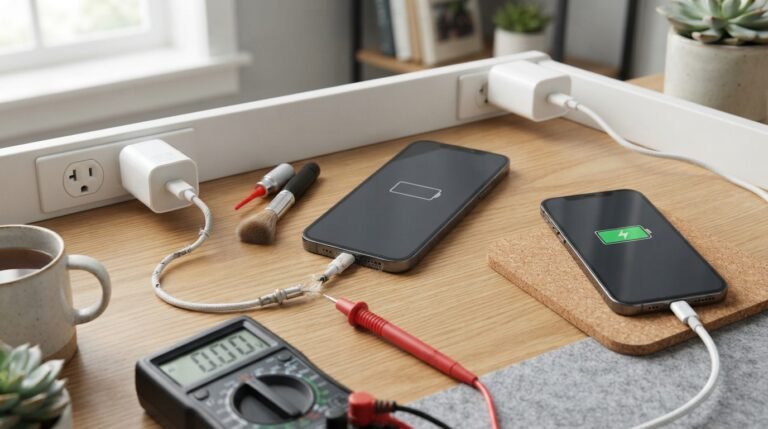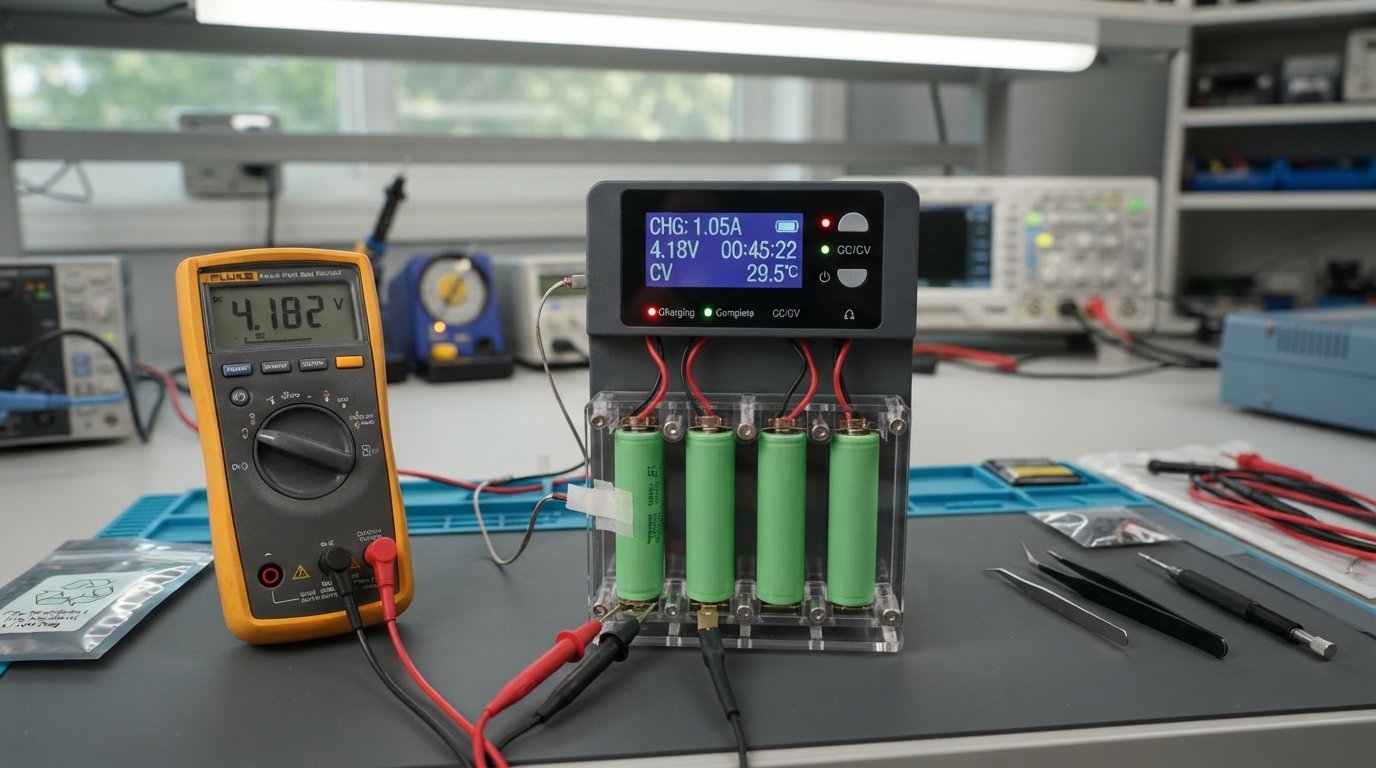
Charging Li ion cells requires more than connecting a power source to a battery and waiting for the voltage to rise. Lithium-ion cells need a controlled charging process with appropriate voltage and current limits, and the correct settings depend on the cell chemistry and battery configuration.
For conventional lithium-ion cells, charging commonly uses a constant-current/constant-voltage (CC/CV) profile. The charger supplies controlled current while the cell voltage rises, then holds the voltage at its specified limit while the current gradually falls. Accurate voltage control is important because lithium-ion cells have relatively tight charging limits.
A common lithium-ion chemistry may charge to approximately 4.2 volts per cell, but that number is not universal. Lithium iron phosphate (LiFePO4/LFP), lithium-titanate (LTO), and other chemistries have different voltage characteristics and charging requirements.
That is why the safest rule is simple:
Use a charger designed for the exact battery chemistry and configuration, and follow the manufacturer’s charging specifications.
What Does Charging a Li-Ion Cell Actually Mean?
A lithium-ion cell stores energy through reversible electrochemical reactions involving lithium ions moving between electrodes.
During charging, electrical energy supplied by the charger drives lithium ions toward the negative electrode. During discharge, the process reverses and the stored chemical energy is converted back into electrical energy.
A basic Li-ion cell contains:
- Positive electrode
- Negative electrode
- Separator
- Electrolyte
- Current collectors
- Protective components in many finished battery assemblies
Lithium-ion batteries can be found in phones, laptops, power tools, electric vehicles, power stations, cameras, e-bikes, and many other products.
The charging system must control the electrical conditions carefully because excessive voltage, current, heat, or physical damage can create serious safety problems.
Li-Ion Cell vs Li-Ion Battery Pack
The words cell and battery are often used interchangeably, but technically they are different.
A cell is one electrochemical unit.
A battery pack can contain one or multiple cells connected together, often with additional electronics.
For example:
- 1S = one cell in series
- 2S = two cells in series
- 3S = three cells in series
- 4S = four cells in series
Parallel connections increase available capacity/current capability while keeping the nominal voltage approximately the same.
Series connections increase the overall voltage.
This distinction matters because a charger designed for a single cell is not automatically appropriate for a multi-cell series pack.
How Are Li-Ion Cells Charged?
The standard charging method for many conventional Li-ion cells is called CC/CV, meaning:
Constant Current → Constant Voltage
Analog Devices describes Li-ion charging as a constant-current phase followed by a high-accuracy constant-voltage phase.
The simplified process looks like this:
Battery starts → Constant Current → Target Voltage → Constant Voltage → Current Tapers → Charge Terminates
The exact thresholds depend on the chemistry and manufacturer’s specification.
Stage 1: Constant Current Charging
During the constant-current portion, the charger supplies a controlled charging current.
The battery voltage gradually rises as the cell accepts charge.
This is generally the faster portion of the charging process.
Battery University describes the initial constant-current phase as the bulk-charging stage and notes that a conventional Li-ion cell reaches its voltage limit during this phase before entering the saturation stage.
Stage 2: Constant Voltage Charging
Once the cell reaches its specified maximum charging voltage, the charger changes from constant-current control to constant-voltage control.
The charger now maintains the voltage near the specified limit.
As the battery approaches full charge, the charging current naturally decreases.
This is why a Li-ion battery may charge quickly at first and then take substantially longer to move from a high state of charge toward full.
Stage 3: Charge Termination
Unlike some older battery chemistries, Li-ion should not be continuously trickle-charged at its maximum voltage.
Once the charging current has fallen to the appropriate termination level, the charger ends the charging cycle according to its design.
Battery University specifically notes that Li-ion cannot absorb overcharge and that continuous charging at the maximum voltage can increase stress and safety risks.
The exact termination threshold depends on the charger and battery design.
What Voltage Should You Use to Charge a Li-Ion Cell?
There is no single charging voltage that applies to every lithium battery.
For many conventional Li-ion cells, approximately 4.20 V per cell is a common full-charge voltage.
Battery University identifies 4.20 V/cell as a typical value for traditional cobalt-blended Li-ion chemistries, while noting that some chemistries use different limits.
Analog Devices likewise describes common Li-ion charging controllers with final voltage options such as 4.2 V per cell and emphasizes the need for accurate voltage control.
But you should never assume 4.2 V is correct simply because the battery is labeled “lithium.”
Why chemistry matters
Different lithium-based chemistries have different voltage ranges.
For example:
| Chemistry | Typical nominal voltage | Charging requirements |
|---|---|---|
| Conventional Li-ion | About 3.6–3.7 V | Chemistry-specific, often around 4.2 V/cell |
| LiFePO4/LFP | About 3.2 V | Lower charging voltage than conventional Li-ion |
| LTO | About 2.4 V | Different voltage limits again |
These are broad reference values, not universal charger settings.
Battery University specifically warns that chargers for LiFePO4 and conventional 3.6 V Li-ion systems are not interchangeable because their charge voltages differ.
What Current Should You Use to Charge Li-Ion Cells?
Charging current depends on the cell’s specifications.
The relevant number is often expressed as a C-rate.
For example, for a 2 Ah cell:
- 0.5C = 1 A
- 1C = 2 A
- 2C = 4 A
But those calculations do not mean every cell can safely accept any of those currents.
The cell manufacturer specifies the acceptable charging current.
Some cells are designed for relatively modest charge rates, while specially designed power cells can support considerably higher charging currents.
Battery University notes that recommended charging rates vary by cell type and application.
Why the C-rate matters
A higher charging current can reduce charging time, but it can also increase:
- Heat
- Chemical stress
- Charging losses
- Battery aging
The fastest possible charge is therefore not automatically the best charge for long-term battery life.
What Is a C-Rate?
The C-rate expresses charging or discharging current relative to battery capacity.
A 1C rate means the current is numerically equal to the battery’s rated amp-hour capacity.
For a 3 Ah cell:
1C = 3 A
For the same cell:
0.5C = 1.5 A
2C = 6 A
The manufacturer’s charging specification should always take priority over a generic C-rate calculation.
How Long Does It Take to Charge a Li-Ion Cell?
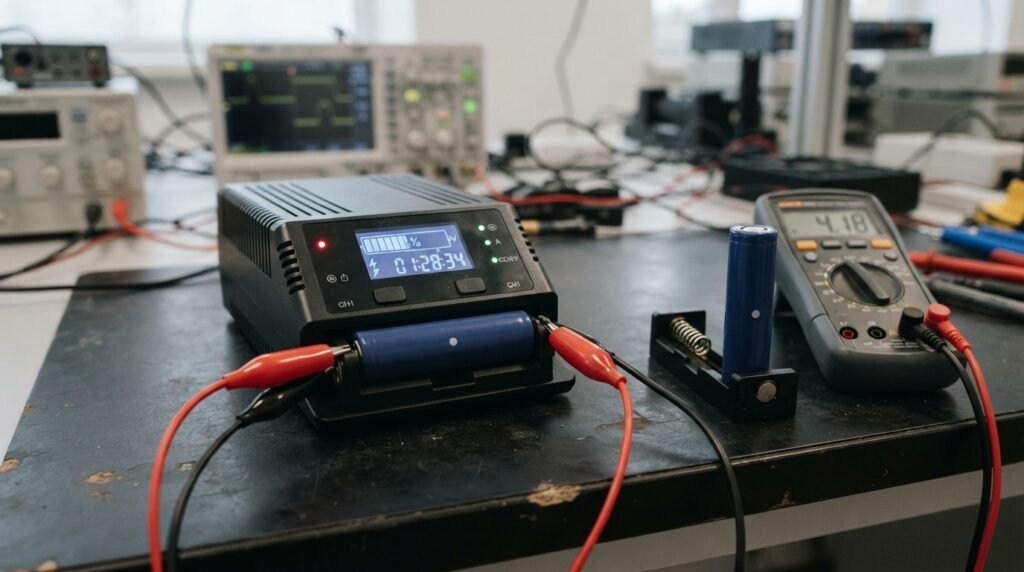
Charging time depends on:
- Battery capacity
- Starting state of charge
- Maximum charging current
- Charging voltage
- CC/CV profile
- Temperature
- Cell chemistry
- Charger efficiency
- Charge-termination settings
A simple capacity/current calculation can provide a rough starting estimate, but it will not accurately represent the entire charging cycle because current tapers during the constant-voltage stage.
For that reason, a battery charged at a higher current may reach a high state of charge quickly but still spend additional time in the CV stage.
Does a Li-Ion Battery Need to Reach 100%?
No.
A lithium-ion battery does not have to be fully charged every time.
Battery University notes that Li-ion does not require full saturation and that avoiding prolonged high-voltage conditions can reduce stress on the cell.
FireBoard similarly recommends partial charging rather than repeatedly running the battery through deep discharge and full-charge cycles.
For many applications, a partial charge can be a reasonable everyday strategy.
However, the ideal operating range depends on the particular battery, device, and manufacturer’s recommendations.
Is Charging to 80% Better for Battery Life?
For many lithium-ion applications, avoiding prolonged operation at the highest state of charge can reduce battery stress.
This is one reason some devices offer an 80% charge limit or optimized charging mode.
The exact benefit depends on the battery chemistry, temperature, usage pattern, and charging system.
Therefore, 80% should be considered a battery-life strategy rather than a universal charging rule.
Can You Charge a Li-Ion Cell With a Power Supply?
A laboratory power supply is not automatically a substitute for a dedicated Li-ion charger.
A proper lithium charging system must control the required:
- Voltage
- Current
- Charge profile
- Termination behavior
- Safety conditions
Battery University discusses power-supply charging of Li-ion with additional caution and emphasizes matching the correct voltage and monitoring the charging process.
For ordinary users, a charger specifically designed for the exact battery chemistry and configuration is the safer choice.
This is especially important when dealing with loose cells.
Why You Should Not Use a Random Charger
Lithium batteries are not universally interchangeable.
UL Research Institutes explains that different electrode and chemistry combinations have different voltage ranges and charging limits. A mismatched charger can result in overcharging, excessive current, overheating, or other dangerous conditions.
There have also been real-world charger recalls involving lithium-ion products.
For example, the U.S. Consumer Product Safety Commission has issued warnings about lithium-ion chargers that could overheat or ignite.
The practical rule is:
Do not choose a charger solely because its connector fits.
The electrical specifications must also match.
Can You Charge Li-Ion Cells in Parallel?
Li-ion cells can be designed into parallel battery configurations, but creating or charging a parallel cell assembly is not simply a matter of connecting random cells together.
Parallel cells should be appropriately matched and designed as a suitable battery assembly.
Important considerations include:
- Cell chemistry
- Voltage
- Capacity
- State of charge
- Internal resistance
- Cell age
- Cell condition
- Protection circuitry
- Interconnect design
Engineering discussions on parallel Li-ion cells highlight the importance of cell matching and the potential for unwanted current flow when cells have substantially different conditions.
For consumer users, the safest approach is to use a professionally manufactured battery pack or a charger specifically designed for the intended configuration.
Can You Charge Li-Ion Cells in Series?
Series-connected cells require a charging system designed for the complete series configuration.
For example, a multi-cell series pack has a higher total voltage than one individual cell.
But simply multiplying the single-cell voltage is not enough to create a safe charging system.
A multi-cell pack may also require:
- Cell monitoring
- Balancing
- Overvoltage protection
- Undervoltage protection
- Overcurrent protection
- Temperature monitoring
That is where a battery management system, or BMS, becomes important in many multi-cell packs.
What Does a BMS Do?
A Battery Management System (BMS) monitors and protects a battery pack.
Depending on its design, a BMS can provide functions such as:
- Cell-voltage monitoring
- Overvoltage protection
- Undervoltage protection
- Overcurrent protection
- Short-circuit protection
- Temperature monitoring
- Cell balancing
- Charge/discharge control
A BMS and a charger are not necessarily the same thing.
The charger controls the external charging process.
The BMS monitors the battery and provides protection and management functions.
A properly designed battery system may use both.
Why Cell Balancing Matters
When multiple lithium cells are connected in series, the cells can develop different states of charge over time.
Without appropriate management, one cell can reach its voltage limit before the others.
A balancing system can help keep series-connected cells within appropriate operating limits.
This is one reason a multi-cell lithium battery pack should not be treated like a collection of completely independent cells.
What Happens If a Li-Ion Cell Is Overcharged?
Overcharging can damage lithium-ion cells and create serious safety risks.
Excessive voltage can contribute to unwanted chemical reactions, lithium plating, internal damage, and thermal instability.
The U.S. Department of Energy notes that safe Li-ion charging requires tight control to prevent overvoltage and lithium plating, and that charging substantially above the specified voltage can produce unsafe failure conditions.
This is why accurate voltage regulation is one of the central requirements of Li-ion charger design.
Can You Charge a Damaged Li-Ion Cell?
A damaged, swollen, leaking, punctured, or otherwise compromised lithium-ion cell should not be charged.
Physical damage can compromise the internal separator or other components and increase the possibility of an internal short circuit or thermal event.
The Canadian Centre for Occupational Health and Safety warns that damaged lithium-ion batteries and improper charging can increase the risk of overheating, fire, or explosion.
If a cell appears damaged, discontinue use and follow appropriate battery-disposal or hazardous-waste guidance.
Can You Charge a Frozen Li-Ion Battery?
Charging lithium-ion batteries at very low temperatures can be hazardous and can damage the cell.
Do not assume that because a battery is electrically capable of accepting current, it is safe to charge at that temperature.
CCOHS recommends charging lithium-ion batteries around room temperature and specifically warns against charging below freezing unless the manufacturer permits it.
Some sophisticated battery systems include temperature monitoring and heating functions, but those systems should not be confused with ordinary consumer chargers.
What Temperature Is Best for Charging Li-Ion?
Moderate temperatures are generally preferred.
Excessive heat can accelerate battery degradation and increase safety concerns.
Very low temperatures can also make charging unsafe for many lithium-ion chemistries.
The exact acceptable range depends on the cell and manufacturer.
Therefore, the battery datasheet or product documentation should always take priority over a generic temperature number.
How to Charge 18650 Li-Ion Cells Safely
18650 cells are cylindrical lithium-ion cells commonly used in battery packs and electronic equipment.
However, loose 18650 cells deserve particular caution.
The U.S. CPSC has warned consumers about loose 18650 cells because they can have exposed terminals, may lack appropriate protection, and can create short-circuit, thermal-runaway, fire, and explosion hazards when mishandled or charged incorrectly.
If you use 18650 cells, the safest approach is to use:
- Cells from a reputable source
- The correct chemistry-specific charger
- A charger designed for the exact cell type
- Appropriate protection
- Intact cells
- Proper storage
- Manufacturer specifications
Do not assume every cell labeled “18650” has identical charging requirements.
Can You Charge a Lithium-Ion Battery Overnight?
The answer depends on the specific device and charger design.
Modern consumer devices generally incorporate charging-management electronics, but that does not mean every charger, battery, or third-party accessory is safe to leave unattended.
Safety organizations recommend using the manufacturer-approved charging equipment and avoiding defective or uncertified chargers.
For high-energy battery packs, e-bikes, scooters, tools, and loose cells, following the manufacturer’s charging instructions is especially important.
Is It Better to Charge Li-Ion Slowly?
Not necessarily.
A moderate charging current can reduce stress and heat compared with aggressive fast charging, but the correct charging current is determined by the cell design.
The objective is not simply “slow charging.”
It is charging within the manufacturer’s specified limits.
A charger that supplies too little current may simply charge more slowly, while a charger that supplies excessive current can create dangerous conditions.
Common Mistakes When Charging Li-Ion Cells
Using the wrong voltage
A charger designed for one lithium chemistry may not be suitable for another.
Assuming every Li-ion cell charges to 4.2V
Many conventional Li-ion cells use approximately 4.2V/cell, but this is not universal.
Charging damaged cells
A damaged battery should not be treated as a normal battery.
Using an unverified charger
Poor-quality or counterfeit chargers can lack proper protection.
UL Research Institutes recommends buying batteries and chargers from trustworthy sources and looking for appropriate safety certification.
Mixing cells carelessly
Cells in a multi-cell pack need appropriate matching and management.
Ignoring temperature
Charging outside the manufacturer’s permitted temperature range can damage the battery or create safety risks.
Treating a BMS as a charger
A BMS provides battery-management and protection functions; it does not automatically replace a properly designed charger.
Leaving loose cells where they can short
Loose cells can short against metal objects.
The CPSC specifically warns about this hazard with loose 18650 cells.
Li-Ion Charging vs LiFePO4 Charging
One of the most common mistakes is assuming that all lithium batteries use the same charger.
They don’t.
Conventional Li-ion and LiFePO4 have different voltage characteristics.
Battery University identifies LiFePO4 as having a lower nominal and charging voltage than conventional 3.6V Li-ion cells.
Therefore:
Do not select a charger based only on the word “lithium.”
Check the actual chemistry.
Li-Ion Charging Best Practices
For everyday users, the most important rules are:
- Use the manufacturer’s recommended charger.
- Confirm the charger matches the battery chemistry.
- Follow the specified voltage limit.
- Follow the specified charge-current limit.
- Avoid charging damaged batteries.
- Keep batteries away from excessive heat.
- Avoid charging below the manufacturer’s permitted temperature.
- Do not short loose cells.
- Use appropriate protection for multi-cell packs.
- Do not assume a generic power supply is a safe battery charger.
- Use reputable batteries and chargers.
- Stop using equipment if the battery becomes unusually hot, swollen, damaged, or otherwise abnormal.
Safety guidance from CCOHS similarly emphasizes manufacturer instructions, compatible charging equipment, temperature control, avoiding damaged batteries, and appropriate electrical safety practices.
How to Make Li-Ion Batteries Last Longer
Charging behavior affects battery aging.
Useful habits include:
- Avoid unnecessary deep discharges.
- Avoid keeping the battery at maximum voltage for unnecessarily long periods.
- Use moderate charging rates when practical.
- Keep the battery within its recommended temperature range.
- Avoid counterfeit batteries and chargers.
- Follow device-specific charging limits.
- Use optimized charging features when available.
Battery University notes that reducing the time spent at the highest voltage can reduce stress, while FireBoard recommends partial charging and avoiding full discharge cycles as general battery-care practices.
Frequently Asked Questions
What voltage is needed to charge a Li-ion cell?
It depends on the chemistry. Approximately 4.2V per cell is common for many conventional Li-ion cells, but other lithium chemistries use different limits. Always follow the cell manufacturer’s specification.
What is CC/CV charging?
CC/CV means constant current/constant voltage. The charger initially controls current and then switches to voltage regulation as the cell reaches its specified charging voltage.
Can I charge a Li-ion battery with any charger?
No. The charger must be compatible with the battery’s chemistry, voltage, current requirements, and configuration.
Does a Li-ion battery need to reach 100%?
No. Lithium-ion batteries can be partially charged, and avoiding prolonged time at maximum voltage may help reduce battery stress.
Can Li-ion cells be charged in parallel?
Parallel battery configurations are possible, but the cells and charging system must be appropriately designed and matched. Randomly connecting cells with different conditions can create unwanted current flow and safety problems.
Can Li-ion cells be charged in series?
Yes, series battery packs can be charged using appropriately designed multi-cell charging systems. Such packs may require cell monitoring and balancing.
What does a BMS do?
A BMS monitors and protects a battery pack and may provide functions such as voltage monitoring, temperature monitoring, overcurrent protection, and cell balancing.
Can I charge a damaged Li-ion battery?
No. A swollen, punctured, leaking, severely dented, or otherwise damaged battery should not be charged.
Can I charge LiFePO4 with a regular Li-ion charger?
Not automatically. LiFePO4 has different voltage characteristics, so a charger must be specifically compatible with the battery chemistry.
Is fast charging bad for Li-ion batteries?
Fast charging is not inherently unsafe when the battery and charger are specifically designed for it. However, higher charging rates can increase heat and stress, and the manufacturer’s maximum charging current should not be exceeded.
Can I use a bench power supply to charge Li-ion cells?
A suitable CC/CV-controlled supply can be used in some engineering setups, but a generic bench supply is not automatically a safe substitute for a purpose-designed Li-ion charger. For routine consumer charging, use the charger specified for the battery.
How do I know when a Li-ion cell is fully charged?
In a typical CC/CV system, the cell reaches its specified voltage limit and charging current then tapers toward the charger’s termination threshold. The exact termination behavior varies by charger and battery.
Final Thoughts
Charging Li ion cells is fundamentally a controlled electrical and chemical process—not simply a matter of applying voltage until the battery reads “full.”
For many conventional Li-ion cells, the familiar CC/CV charging profile consists of a controlled-current stage followed by a controlled-voltage stage. The current gradually decreases as the cell approaches its charge limit.
But the most important lesson is that there is no universal lithium-ion charging setting.
Different chemistries have different voltage limits. Multi-cell packs introduce additional requirements. Parallel configurations require appropriately matched cells, while series packs may require balancing and BMS protection.
Safety should always come before charging speed.
Use the correct charger, follow the battery manufacturer’s specifications, avoid damaged cells, control temperature, and treat loose high-energy cells—particularly unprotected 18650 cells—with extreme caution. CPSC specifically warns that loose lithium-ion cells can create serious fire and injury hazards when improperly handled or charged.
When in doubt, the safest answer is not to experiment with an unknown cell. Identify its chemistry, specifications, and intended charging method first.
Related Post
- Dodge Charger 2014 – Complete Guide to Specs, Trims, MPG, Reliability, Problems & Used Buying!
- Dodge Charger 2016 – Specs, Trims, Engines, Reliability & Used Buying Guide!
- Ds Charger – Complete Guide to Compatibility, Charging, Replacement & Troubleshooting!
About the Author