If your car battery is dead, one of the first questions you may have is how long does it take to charge a car battery? The answer depends on several factors, including the battery’s condition, its capacity, the type of charger you are using, and how much charge remains in the battery.
A healthy car battery that is only partially discharged may take several hours to recharge with a standard charger. A deeply discharged battery can take 8–24 hours or longer, depending on the charger and battery size. A smart charger typically takes longer than a high-output charger but can provide a controlled and safer charging process.
In this guide, we’ll explain how long it takes to charge a car battery, charging times for different charger sizes, how to tell when a battery is fully charged, whether you can charge a battery overnight, and what to do if your car battery won’t hold a charge.
How Long Does It Take to Charge a Car Battery?
A typical 12-volt automotive battery can take anywhere from a few hours to more than 24 hours to charge, depending on the circumstances.
Here is a general guide:
| Charger Output | Approximate Charging Time* |
|---|---|
| 1–2 amps | 24–48+ hours |
| 4 amps | 10–24 hours |
| 6 amps | 8–16 hours |
| 10 amps | 4–10 hours |
| 15 amps | 3–6 hours |
| 20 amps | 2–5 hours |
*Actual charging time varies according to battery capacity, state of charge, temperature, battery condition, charger type, and charging efficiency.
A completely flat battery generally takes longer than a battery that still has some charge.
What Determines Car Battery Charging Time?
Several factors affect car battery charging time.
1. Battery Size
Automotive batteries are commonly rated by their amp-hour (Ah) capacity or related specifications such as reserve capacity and cold-cranking amps.
A larger battery generally requires more energy to reach a full charge.
For example, a battery with approximately 60 Ah of capacity will generally take longer to charge than a much smaller battery when both are connected to the same charger.
2. Battery’s State of Charge
A battery that is 70% charged requires considerably less energy than one that is deeply discharged.
If your battery is only slightly low, it may recharge relatively quickly.
If the battery is completely or nearly completely discharged, charging can take many hours.
3. Charger Amperage
The charger’s output affects charging speed.
A 2-amp battery charger charges slowly, while a 10-amp charger can restore charge much faster.
However, higher amperage isn’t always better. The charger should be appropriate for the battery and used according to the manufacturer’s instructions.
4. Battery Condition
An old, damaged, sulfated, or internally faulty battery may charge differently from a healthy battery.
A battery that repeatedly loses its charge may have a problem that charging alone cannot fix.
5. Temperature
Extremely cold or hot conditions can affect battery charging and performance.
Charging should be performed according to the battery and charger’s temperature requirements.
6. Charger Efficiency
Not all of the electrical energy supplied by a charger becomes stored chemical energy in the battery.
Charging efficiency and the charger’s charging algorithm affect the actual time required.
How Long Does It Take to Charge a Car Battery With a 10-Amp Charger?
A 10-amp battery charger can often charge a typical automotive battery in several hours.
For example, if a 60-Ah battery were significantly discharged, a simple theoretical calculation might suggest around 6 hours at 10 amps.
However, real-world charging usually takes longer because:
- Charging is not 100% efficient.
- The battery’s charging rate changes as it approaches full capacity.
- Smart chargers reduce current during later charging stages.
- Battery condition affects charging performance.
A practical estimate could therefore be 6–10 hours or more, depending on the starting charge level and battery condition.
How Long Does a 12-Volt Car Battery Take to Charge?
The term 12-volt car battery normally refers to a nominal 12V automotive battery.
The actual voltage of a fully charged lead-acid battery at rest is higher than 12 volts.
Charging time depends primarily on the battery’s capacity and the charger’s current.
For example:
- A small automotive battery may charge relatively quickly.
- A typical passenger-car battery may require several hours.
- A deeply discharged larger battery may require overnight charging or longer.
The charger manufacturer’s instructions should always take priority over general estimates.
How Long Does It Take to Charge a Dead Car Battery?
A dead car battery can take anywhere from several hours to more than a day to recharge.
If the battery is only partially discharged, a charger may restore it in a few hours.
If the battery is deeply discharged, a low-amperage charger may require 12–24 hours or longer.
There is another important issue: a battery described as “dead” may actually be defective.
If the battery reaches full charge but quickly becomes dead again, the problem could be:
- An aging battery
- A parasitic electrical drain
- A charging-system problem
- A faulty alternator
- Loose or corroded battery connections
How Long Does It Take to Charge a Car Battery While Driving?
The vehicle’s alternator can recharge a battery while the engine is running.
However, driving time varies considerably.
A short drive may not fully recharge a deeply discharged battery. Modern vehicles also have electrical systems that consume power while the engine is running.
If the battery was severely discharged, relying solely on a short drive may not be sufficient.
A dedicated battery charger can provide a more controlled way to recharge a significantly discharged battery.
Does Idling Charge a Car Battery?
Yes, the alternator can charge the battery while the engine is idling, but idling is generally not an efficient way to recharge a deeply discharged battery.
Alternator output varies with:
- Engine speed
- Vehicle design
- Electrical load
- Alternator condition
- Battery condition
Driving may provide better charging conditions than prolonged idling, but neither should be assumed to fully recharge a deeply discharged battery in a short period.
How Long Does It Take to Charge a Car Battery With a Trickle Charger?

A trickle charger typically supplies a low current, so charging can take a long time.
Depending on the battery size and state of charge, it may take many hours or even more than a day to reach full charge.
Trickle chargers are often used for maintaining batteries rather than quickly recovering a completely discharged battery.
A modern automatic battery maintainer can be particularly useful for vehicles that are stored for long periods.
How Long Does a 2-Amp Charger Take to Charge a Car Battery?
A 2-amp charger is a low-current charger.
For a 50–60 Ah automotive battery that is substantially discharged, charging could take roughly 24–36 hours or longer.
The actual time depends on how much charge the battery needs.
A 2-amp charger is useful when you don’t need fast charging and want a slower charging process.
How Long Does a 4-Amp Charger Take to Charge a Car Battery?
A 4-amp charger generally takes less time than a 2-amp charger.
For a typical passenger-car battery, a significantly discharged battery may require approximately 12–24 hours, depending on capacity and battery condition.
A partially discharged battery will take considerably less time.
How Long Does a 6-Amp Charger Take to Charge a Car Battery?
A 6-amp charger can provide a reasonable balance between charging speed and relatively moderate charging current.
A typical 50–70 Ah battery may require roughly 8–16 hours when substantially discharged.
Again, this is only a general estimate.
How Long Does a 10-Amp Charger Take to Charge a Car Battery?
A 10-amp charger can recharge many passenger-car batteries within approximately 4–10 hours, depending on the battery’s capacity and starting state of charge.
For a battery that is only partly discharged, charging can be much faster.
How Long Does a 15-Amp Charger Take to Charge a Car Battery?
A 15-amp charger can recharge a typical automotive battery faster than lower-output chargers.
A substantially discharged passenger-car battery might take approximately 3–6 hours, although the actual time varies.
Always make sure the charger is compatible with your battery before using a high-current charging mode.
How Long Does a 20-Amp Charger Take to Charge a Car Battery?
A 20-amp charger can charge a compatible automotive battery relatively quickly.
A typical battery might require around 2–5 hours when significantly discharged.
However, the battery’s capacity, temperature, condition, and charger design all affect the actual charging time.
Do not assume that increasing amperage indefinitely will make charging better. Always follow the battery and charger manufacturer’s specifications.
How Long Does a Car Battery Take to Charge With a Battery Charger?
The answer depends on the charger’s output.
A simple estimate can be made using:
Charging time ≈ amp-hours needed ÷ charger amperage
For example:
60 Ah ÷ 10 A = 6 hours
This is only a theoretical estimate.
Real charging time will usually be longer because charging is not perfectly efficient and many automatic chargers gradually reduce current as the battery approaches full charge.
Can You Charge a Car Battery Overnight?
In many cases, a modern automatic or smart battery charger is designed to monitor charging and reduce or stop the charging current when the battery reaches the appropriate state.
However, you should not assume every charger is safe for unattended overnight charging.
Before leaving a charger connected:
- Read the charger instructions.
- Confirm it is designed for your battery type.
- Check the battery for damage or leakage.
- Use the charger in an appropriate location.
- Follow all safety instructions.
A damaged battery should not be charged.
Can You Overcharge a Car Battery?
Yes.
Traditional chargers without automatic regulation can potentially overcharge a battery if left connected too long.
Overcharging can cause:
- Excessive heating
- Electrolyte loss
- Battery damage
- Reduced battery life
- Gas production
A properly designed smart charger can help reduce this risk by regulating the charging process.
How Do You Know When a Car Battery Is Fully Charged?
The best indicator depends on the battery and charger.
Many modern smart chargers display a charging status or indicate when the battery has reached full charge.
For a conventional flooded lead-acid battery, voltage can also provide information, but voltage should be measured after the battery has rested because a recently charged battery can show a temporary surface charge.
A charger should be used according to its instructions rather than relying on a single voltage reading.
What Voltage Should a Fully Charged Car Battery Have?
A healthy conventional 12V lead-acid automotive battery typically measures around 12.6–12.8 volts at rest when fully charged, although the exact reading depends on battery type, temperature, and measurement conditions.
A reading significantly below this after the battery has rested may indicate that it is not fully charged or may have a problem.
Do not diagnose a battery based on voltage alone.
How Long Does a Car Battery Last After Charging?
A healthy battery should retain its charge when the vehicle is parked for a reasonable period.
If your freshly charged battery becomes weak or dead within a short time, investigate the cause.
Possible reasons include:
Old Battery
Automotive batteries have a limited service life and eventually lose their ability to store energy.
Parasitic Drain
An electrical component may continue drawing current while the vehicle is turned off.
Alternator Problem
The alternator may not be properly charging the battery while the engine runs.
Loose Battery Connection
Corroded or loose terminals can interfere with charging and starting.
Why Won’t My Car Battery Hold a Charge?
If a battery won’t hold a charge, it may be reaching the end of its useful life.
Common causes include:
- Sulfation
- Internal damage
- Age
- Extreme temperatures
- Repeated deep discharge
- Electrical drain
- Charging-system problems
If the battery repeatedly needs charging, have both the battery and vehicle charging system tested.
Can a Completely Dead Car Battery Be Recharged?
Sometimes.
A deeply discharged battery can potentially be recharged if it is still physically and electrically healthy.
However, some smart chargers will not begin charging a battery if its voltage is extremely low because they cannot identify it correctly or consider it unsafe.
A severely discharged battery may require professional evaluation.
Never attempt to charge a battery that is swollen, cracked, leaking, frozen, or otherwise visibly damaged.
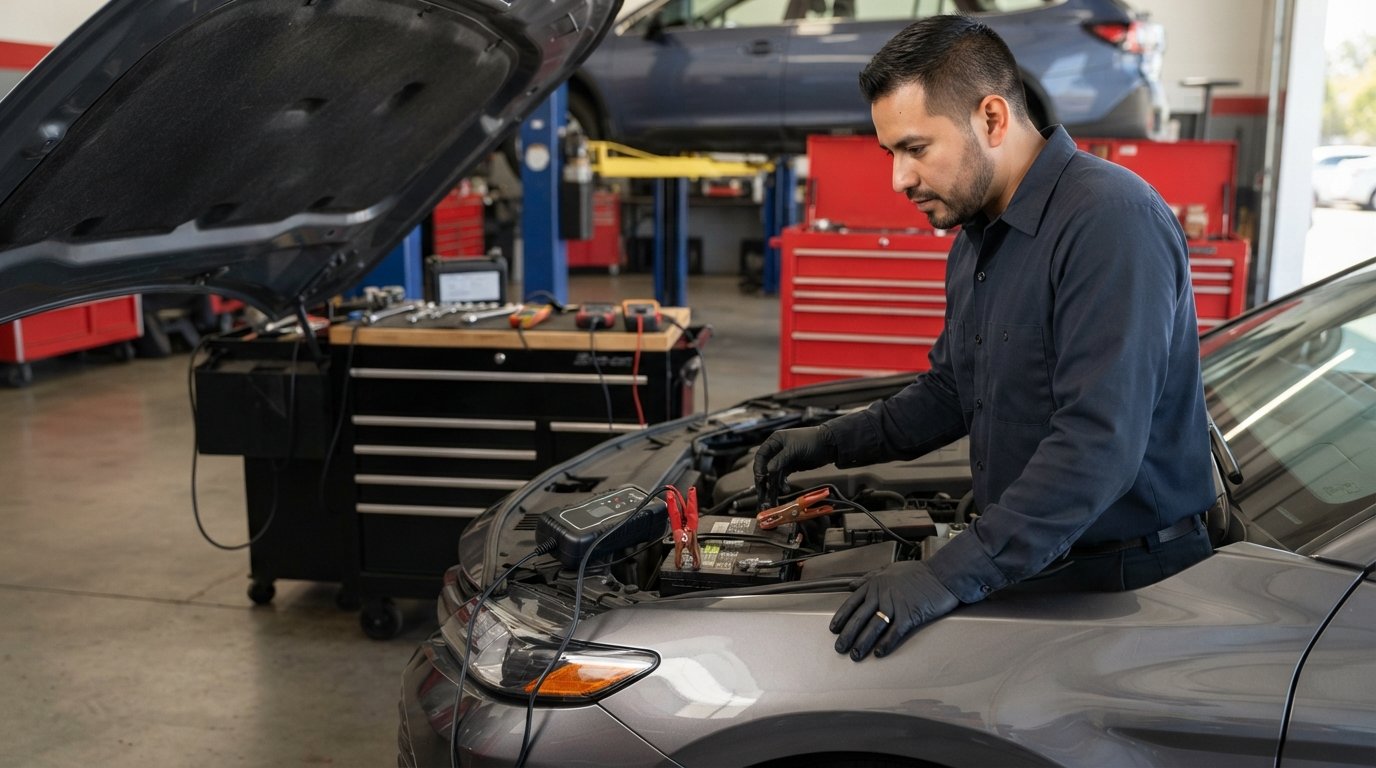
How to Charge a Car Battery Safely
Follow the battery and charger manufacturer’s instructions.
A general approach is:
- Park the vehicle safely.
- Turn off the engine and electrical accessories.
- Make sure the charger is switched off before connecting it.
- Connect the charger according to its instructions.
- Select the correct battery type and charging mode.
- Start the charging process.
- Allow the charger to complete its cycle.
- Turn off and disconnect the charger according to the manufacturer’s procedure.
Work in a well-ventilated area and keep sparks, flames, and cigarettes away from lead-acid batteries.
Should You Disconnect the Battery Before Charging?
It depends on the vehicle, charger, and manufacturer’s instructions.
Some chargers are specifically designed to charge batteries while they remain installed in a vehicle.
Others may have different requirements.
Modern vehicles contain sensitive electronic systems, so follow the vehicle owner’s manual and charger instructions rather than assuming every charging method is interchangeable.
Can You Charge a Car Battery Without Removing It?
Yes, many battery chargers can be connected while the battery remains installed.
However, the correct connection points and procedure depend on the vehicle.
Some vehicles provide dedicated charging or jump-start terminals.
Always consult the vehicle manual before connecting a charger.
What Happens If You Charge a Car Battery Too Long?
Excessive charging can damage a battery, especially when using an uncontrolled charger.
Potential problems include:
- Overheating
- Electrolyte loss
- Excessive gas formation
- Reduced battery life
- Internal damage
This is why an automatic charger with appropriate charging stages can be preferable for many users.
Does a Longer Drive Fully Recharge a Car Battery?
Not necessarily.
The amount of energy returned to the battery depends on the alternator’s output and the vehicle’s electrical demand.
A longer drive can provide more opportunity for charging than a short trip, but it doesn’t guarantee that a deeply discharged battery will reach full charge.
If a battery was completely flat, using a dedicated charger and checking the charging system may be more appropriate.
Car Battery Charging Time: Quick Reference
Here is a simplified reference for a typical automotive battery:
| Charger | General Charging Speed |
| 1–2A | Very slow |
| 4A | Slow |
| 6A | Moderate |
| 10A | Faster |
| 15A | Fast |
| 20A | Very fast for suitable batteries |
These are general categories, not guaranteed charging times.
The battery’s capacity and starting state of charge are equally important.
Frequently Asked Questions
1. How long does it take to charge a car battery?
A car battery can take anywhere from a few hours to more than 24 hours to charge. The exact time depends on battery capacity, starting charge level, charger amperage, temperature, and battery condition.
2. How long does it take to charge a dead car battery?
A deeply discharged battery may take approximately 8–24 hours or longer with a conventional low-to-moderate-current charger.
3. How long does a 10 amp charger take to charge a car battery?
A typical significantly discharged passenger-car battery may take around 4–10 hours, although actual charging time varies.
4. How long does a 2 amp charger take?
A 2-amp charger can take 24–48 hours or longer to charge a substantially discharged automotive battery.
5. Can I charge my car battery overnight?
A compatible automatic smart charger may be designed for extended charging, but always follow the charger’s instructions and safety requirements before leaving it connected unattended.
6. Does driving charge a car battery?
Yes. The alternator charges the battery while the engine is running, although a short drive may not fully recharge a deeply discharged battery.
7. Does idling charge a car battery?
The alternator can charge the battery while the engine idles, but prolonged idling is generally not an efficient way to recover a deeply discharged battery.
8. How do I know when my car battery is fully charged?
A smart charger may indicate when charging is complete. Resting voltage can also provide useful information for conventional lead-acid batteries, but voltage alone does not fully determine battery health.
9. Can a dead car battery be recharged?
A deeply discharged but healthy battery can sometimes be recharged. A damaged or severely degraded battery may not recover and should be professionally tested or replaced.
10. Why does my car battery keep dying after charging?
Possible causes include an aging battery, alternator problem, parasitic electrical drain, poor battery connections, or another electrical fault.
11. How long should a car battery hold a charge?
A healthy battery should retain enough charge to start the vehicle when the car is parked normally. If it repeatedly loses charge while parked, the battery and vehicle electrical system should be checked.
Final Thoughts
So, how long does it take to charge a car battery? There is no single charging time that applies to every vehicle or battery. A typical automotive battery may take several hours with a 10-amp charger, while a low-current 2-amp charger can require a day or longer. A deeply discharged battery can take considerably longer than a partially discharged one. The most important factors are battery capacity, state of charge, charger amperage, battery condition, temperature, and charging efficiency.
If your battery repeatedly becomes dead after charging, don’t simply keep recharging it. The battery may be failing, or the vehicle may have an alternator, wiring, or parasitic-drain problem. For the best results, use a charger that is compatible with your battery, follow the manufacturer’s instructions, and focus on safe, controlled charging rather than simply choosing the highest available amperage.
Related Post
- Iphone 13 Charger Type – Complete Guide to Cable, Adapter, Charging Speed, and Compatibility!
- Iphone 4 Charger – Complete Guide to Charging, Cables, Adapters, Compatibility, and Replacement!
- Mac Won’t Turn On But Is Charging – Complete Troubleshooting Guide!
About the Author