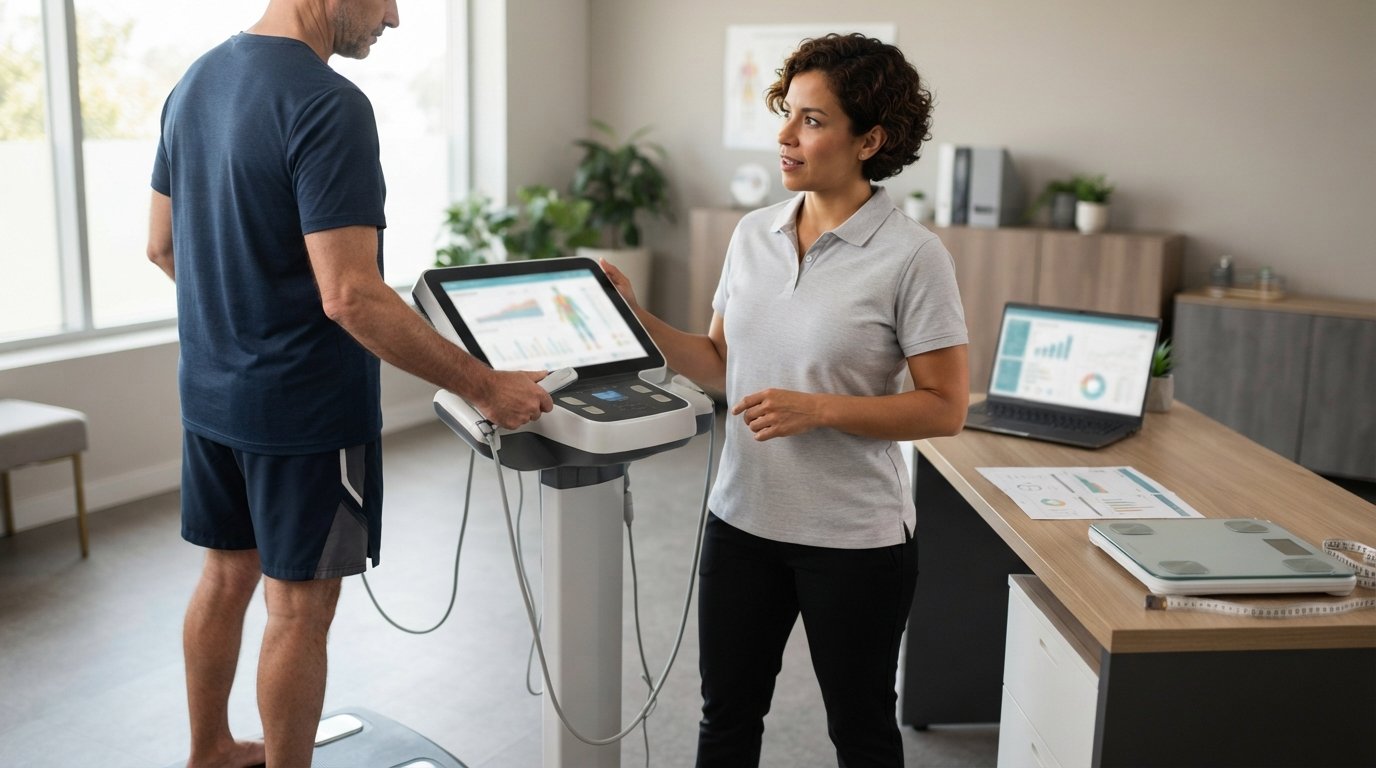
An InBody scanner is a body composition analyzer designed to provide more information about the body than a traditional weighing scale. Instead of reporting only body weight, an InBody device can estimate measurements such as body fat percentage, skeletal muscle mass, body water, BMI, and segmental body composition.
These scanners are commonly found in gyms, fitness centers, medical facilities, wellness clinics, research environments, and sports-performance settings.
This complete guide explains what an InBody scanner is, how an InBody body composition scanner works, what the results mean, how accurate InBody measurements are, how to prepare for a scan, and how to interpret the report.
What Is an InBody Scanner?
An InBody scanner is a body composition testing device that uses bioelectrical impedance analysis (BIA) to estimate different components of the body.
Unlike a standard scale that primarily measures total body weight, an InBody analysis can provide a broader picture of body composition.
Depending on the model, an InBody test may report:
- Body weight
- Skeletal muscle mass
- Body fat mass
- Percent body fat
- BMI
- Total body water
- Protein
- Mineral content
- Segmental lean analysis
- Segmental body fat
- Basal metabolic rate
- Visceral fat-related measurements
- Weight-control recommendations
The exact measurements vary by device and model.
How Does an InBody Scanner Work?
An InBody scanner uses bioelectrical impedance analysis, commonly abbreviated as BIA.
During a test, a very small electrical current passes through the body through electrodes.
Different tissues conduct electricity differently.
For example:
- Water-rich tissues generally conduct electrical current more easily.
- Fat tissue offers greater resistance.
- Muscle contains a relatively high amount of water and electrolytes.
The device measures electrical impedance and combines that information with other inputs and proprietary algorithms to estimate body composition.
The current used during a typical BIA measurement is very small and is not normally felt by the person being tested.
What Is Bioelectrical Impedance Analysis?
Bioelectrical impedance analysis is a method used to estimate body composition by measuring how electrical current travels through the body.
BIA devices can estimate body compartments such as:
Total body water → Fat-free mass → Fat mass
These measurements are estimates rather than direct measurements of every tissue in the body.
Different BIA devices use different electrode configurations, frequencies, algorithms, and equations, so results from different devices should not automatically be considered interchangeable.
What Does an InBody Scanner Measure?
The exact results depend on the particular InBody model.
Common measurements can include:
Body Weight
This is your total body mass.
Skeletal Muscle Mass
This estimates the amount of skeletal muscle in the body.
Body Fat Mass
This estimates the total mass of body fat.
Percent Body Fat
This represents the estimated percentage of total body weight that consists of body fat.
BMI
Body Mass Index is calculated using body weight and height.
Total Body Water
This estimates the amount of water contained within the body.
Segmental Analysis
Some InBody models divide measurements into body regions such as:
- Right arm
- Left arm
- Trunk
- Right leg
- Left leg
This can help users examine differences in estimated lean mass and fat distribution between body segments.
What Is InBody Body Composition Analysis?
An InBody body composition analysis provides a more detailed assessment than body weight alone.
For example, two people can weigh exactly the same while having different amounts of:
- Muscle
- Fat
- Body water
- Lean mass
This is why body composition can be useful when tracking fitness or changes in body weight.
What Is Skeletal Muscle Mass on an InBody Scan?
Skeletal muscle mass refers to muscle associated with the skeleton that contributes to movement.
An InBody report may provide an estimated skeletal muscle mass value.
Tracking this measurement over time can help someone evaluate whether changes in body weight are accompanied by changes in estimated muscle mass.
However, short-term fluctuations should not automatically be interpreted as actual muscle gain or loss because hydration and other factors can influence BIA measurements.
What Is Body Fat Percentage on an InBody Scanner?
Percent body fat indicates the estimated proportion of total body weight that is fat.
For example, if someone weighs 80 kg and has an estimated body fat percentage of 25%, the estimated fat mass would be approximately:
80 × 0.25 = 20 kg
The remaining mass consists of fat-free components such as water, muscle, organs, connective tissue, and bone minerals.
What Is Visceral Fat?
Visceral fat is fat located around internal organs within the abdominal cavity.
Some InBody reports provide a visceral-fat-related rating or estimate.
This should be interpreted according to the specific device’s reporting system rather than treated as a direct measurement of the exact amount of visceral fat.
For medical assessment of health risks, consult a qualified healthcare professional.
What Is Segmental Body Composition?
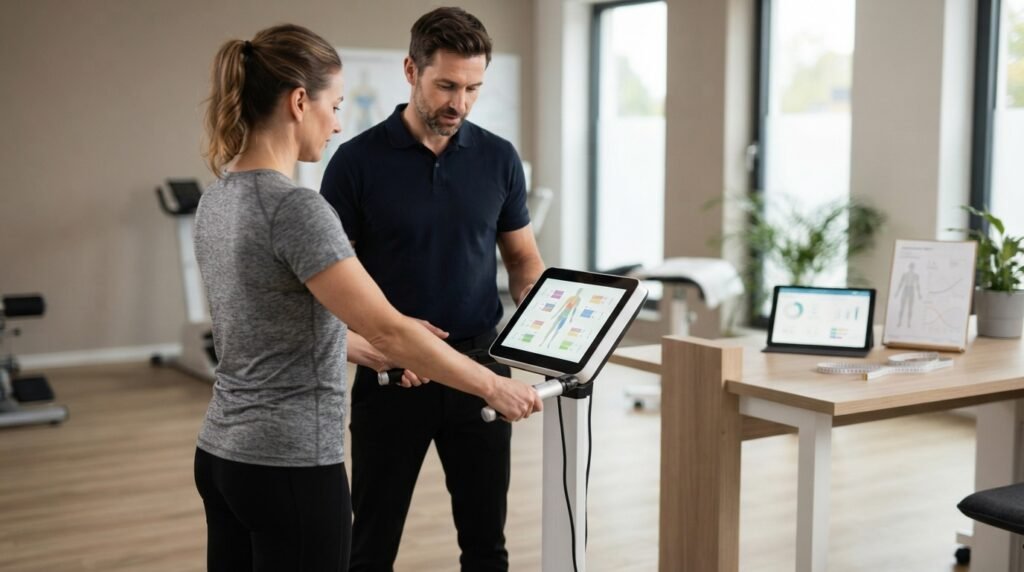
Segmental analysis divides the body into different regions.
A report may show estimated composition for:
- Left arm
- Right arm
- Left leg
- Right leg
- Trunk
This can help identify differences in estimated lean mass between body regions.
For athletes and fitness users, segmental information can be useful for monitoring training-related changes.
What Is an InBody Scan Used For?
An InBody scan can be used in several settings.
Fitness Tracking
Gyms and trainers may use body composition measurements to track changes during a fitness program.
Weight Management
Body composition data can provide additional context beyond the number displayed on a scale.
Sports Performance
Athletes may use measurements to monitor body composition and training progress.
Wellness Programs
Corporate and wellness programs may use body composition testing as part of broader health initiatives.
Clinical and Research Settings
Some healthcare and research environments use BIA as one component of a broader assessment.
An InBody result should not replace a complete medical evaluation.
How Accurate Is an InBody Scanner?
The accuracy of an InBody scanner depends on the device, measurement conditions, individual characteristics, and the comparison method being used.
BIA provides estimates rather than directly measuring body fat or muscle tissue.
Results can be influenced by:
- Hydration
- Recent food intake
- Exercise
- Body temperature
- Alcohol consumption
- Skin condition
- Time of day
- Recent fluid intake
- Bladder contents
- Measurement technique
For this reason, an InBody scan is generally more useful for tracking trends under consistent conditions than treating one measurement as an absolute value.
Is an InBody Scan Accurate for Body Fat?
An InBody scanner can provide a useful estimate of body fat, but it should not be considered a perfect direct measurement.
Different methods can produce different results.
For example, body-composition estimates from BIA may differ from measurements obtained through:
- DEXA
- Air displacement plethysmography
- Hydrostatic weighing
- Skinfold measurements
Even different BIA devices can produce different estimates.
The most useful approach is often to use the same device and standardized conditions when monitoring changes over time.
InBody Scanner vs DEXA
Both InBody and DEXA can be used to assess body composition, but they use different technologies.
| Feature | InBody/BIA | DEXA |
|---|---|---|
| Technology | Bioelectrical impedance | X-ray attenuation |
| Typical testing time | Very short | Short |
| Radiation | No ionizing radiation | Uses low-dose X-rays |
| Portability | Many models are portable or compact | Larger specialized equipment |
| Measurements | Body composition estimates | Detailed bone and body composition measurements |
| Cost/access | Often more accessible | Usually more specialized |
Neither method should automatically be considered perfect for every purpose.
The appropriate method depends on the user’s goals and the clinical or research setting.
How to Prepare for an InBody Scan
Consistent preparation can improve the usefulness of repeated measurements.
Before an InBody scan, many testing protocols recommend:
- Avoiding strenuous exercise beforehand
- Avoiding large meals shortly before testing
- Maintaining normal hydration
- Using the restroom before the test
- Removing shoes and socks when required
- Testing at approximately the same time for repeat measurements
- Following the testing facility’s specific instructions
The exact preparation protocol can vary.
Should You Drink Water Before an InBody Scan?
Hydration can influence BIA measurements.
This doesn’t mean you should intentionally become dehydrated before testing.
Instead, follow a consistent routine.
If you are comparing multiple scans, testing under similar hydration conditions can make the results easier to compare.
Can You Eat Before an InBody Scan?
Food and fluid intake can affect body weight and body-water measurements.
For the most consistent results, many testing protocols recommend avoiding a large meal shortly before testing.
Follow the instructions provided by the testing facility or device operator.
Can You Exercise Before an InBody Scan?
It is generally better to avoid strenuous exercise immediately before a body-composition test if the goal is to compare results consistently.
Exercise can temporarily change:
- Hydration
- Blood flow
- Fluid distribution
- Body temperature
These changes may influence BIA measurements.
What Should You Wear for an InBody Scan?
Most InBody tests are performed while standing on the device and holding its hand electrodes, depending on the model.
Shoes and socks are typically removed because the electrodes need appropriate skin contact.
Wear comfortable clothing and follow the testing center’s instructions.
How Long Does an InBody Scan Take?
The actual measurement is generally very quick.
Depending on the device and setup, the test can often be completed within a few minutes.
The exact duration depends on:
- InBody model
- Testing procedure
- Data entry
- Report generation
How Often Should You Get an InBody Scan?
There is no single schedule that works for everyone.
People tracking a fitness or weight-management program may repeat measurements periodically rather than every day.
Testing too frequently can make normal short-term fluctuations appear more significant than they really are.
For meaningful comparisons, use:
- The same device
- Similar time of day
- Similar hydration
- Similar food intake
- Similar exercise conditions
How to Read an InBody Scan
An InBody report can contain many numbers, which may seem confusing at first.
Focus on major categories:
Weight
Look at the overall body-weight trend.
Skeletal Muscle Mass
Monitor changes in estimated muscle mass over time.
Body Fat Mass
Compare changes in estimated fat mass.
Percent Body Fat
Consider whether estimated body-fat percentage is trending up or down.
Segmental Analysis
Look for meaningful differences between body regions.
Body Water
Remember that hydration can affect BIA results.
A single number should rarely be interpreted without considering the rest of the report.
InBody Result Interpretation
An InBody result is most useful when compared with previous results collected under similar conditions.
For example, suppose a person has several measurements:
| Measurement | Scan 1 | Scan 2 |
| Weight | 80 kg | 79 kg |
| Body Fat Mass | 22 kg | 20 kg |
| Skeletal Muscle Mass | 32 kg | 32.5 kg |
This pattern could suggest a favorable change in estimated body composition.
However, the differences should be interpreted in context because BIA measurements naturally have variability.
What Is InBody Score?
Some InBody reports include an InBody Score or similar summary metric.
This score is generated according to the manufacturer’s methodology and may incorporate body-composition measurements.
It can be useful as a quick summary, but it should not be treated as a universal measure of health or fitness.
The individual measurements are often more informative for tracking specific goals.
What Does a High InBody Score Mean?
A higher score generally indicates that the device’s algorithm considers the measured body-composition profile favorable according to its scoring system.
However, the score should be interpreted within the context of the specific InBody report.
Fitness goals, body structure, age, sex, and other factors can affect how body composition should be interpreted.
What Does Low Skeletal Muscle Mass Mean on an InBody Scan?
A low estimated skeletal muscle mass value may indicate that the device estimates less muscle relative to its reference ranges.
However, one result should not be used to diagnose a medical condition.
If you are concerned about muscle mass, nutrition, or physical function, discuss the result with an appropriate healthcare professional.
Why Did My InBody Results Change Overnight?
Short-term changes don’t necessarily represent actual changes in muscle or fat.
BIA results can change because of:
- Hydration
- Food intake
- Exercise
- Sodium intake
- Alcohol
- Body temperature
- Bathroom use
- Time of day
For this reason, large changes over a short period should be interpreted carefully.
Why Is My InBody Body Fat Percentage Higher?
An increase in estimated body-fat percentage can occur because of an actual change in body composition, but measurement conditions can also contribute.
For example, differences in hydration or food intake may affect the measurement.
Compare scans taken under similar conditions before drawing conclusions.
Can InBody Detect Muscle Gain?
An InBody device can estimate changes in skeletal muscle mass.
However, it does not directly count newly formed muscle fibers.
If your goal is to track muscle gain, combine body-composition measurements with:
- Strength progression
- Training performance
- Body measurements
- Weight trends
- Nutrition
- Consistent photographs, when appropriate
Using multiple indicators provides a more complete picture.
Can InBody Detect Fat Loss?
InBody can estimate changes in body fat mass and body-fat percentage.
A downward trend in estimated fat mass across consistent measurements can support the conclusion that body composition is changing.
However, individual measurements can fluctuate.
Is an InBody Scan Safe?
BIA devices use a very small electrical current to measure impedance.
However, people with certain implanted or electronic medical devices may need to avoid BIA testing depending on the device manufacturer’s instructions.
If you have an implanted electronic medical device or are unsure whether BIA is appropriate for you, consult your healthcare provider and follow the scanner manufacturer’s safety guidance.
Pregnancy-related testing should also follow the manufacturer’s and healthcare provider’s guidance.
Who Should Not Use an InBody Scanner?
The appropriate answer depends on the specific device and individual circumstances.
People with certain implanted electronic medical devices may be advised not to undergo BIA measurements.
Always check the device’s safety instructions and tell the operator about relevant medical devices or conditions before testing.
InBody Scanner for Weight Loss
An InBody scanner for weight loss can provide additional information beyond body weight.
For example, someone losing weight may want to know whether the change is primarily associated with estimated fat mass, lean mass, or body water.
However, body composition should be considered alongside:
- Diet
- Physical activity
- Strength training
- Sleep
- Overall health
- Long-term weight trends
A scanner should be a tracking tool rather than the sole measure of progress.
InBody Scanner for Muscle Gain
People focused on building muscle may use an InBody test to monitor estimated skeletal muscle mass.
The most useful strategy is to compare measurements over time while keeping testing conditions consistent.
Strength and performance improvements should also be considered.
InBody Scanner for Athletes
Athletes may use body composition testing as one part of performance monitoring.
Depending on the sport, relevant measurements may include:
- Lean mass
- Fat mass
- Body-fat percentage
- Segmental muscle estimates
- Body weight
Athletes should avoid making training or nutrition decisions based solely on a single BIA measurement.
InBody Scanner at Gyms
Many gyms offer InBody testing as part of personal training or fitness programs.
The process usually involves:
- Entering personal information.
- Standing on the analyzer.
- Holding the hand electrodes if required.
- Maintaining the required position.
- Completing the measurement.
- Reviewing the generated report.
The exact procedure varies by model.
How Much Does an InBody Scan Cost?
The cost of an InBody scan varies significantly depending on the location and service provider.
Some gyms include testing within memberships, while other facilities charge separately.
Specialized clinics or professional testing centers may have different pricing.
Because prices vary by location, check directly with the facility offering the scan.
InBody Scanner vs Regular Scale
A regular scale primarily tells you how much you weigh.
An InBody scanner can provide estimates of:
- Body fat
- Skeletal muscle
- Body water
- Lean mass
- Segmental composition
This makes body composition analysis potentially more informative for people who want to understand changes beyond body weight.
Limitations of an InBody Scanner
An InBody scanner is useful, but it has limitations.
It Provides Estimates
BIA does not directly measure every body compartment.
Hydration Matters
Changes in hydration can influence measurements.
Results Vary Between Devices
Results from different BIA machines may not be directly comparable.
One Scan Is Not the Whole Picture
A single measurement provides limited information about long-term changes.
Reference Ranges Are Not Diagnoses
A value outside a device’s reference range does not automatically indicate a medical problem.
Tips for Getting More Consistent InBody Results
For better trend tracking:
- Use the same InBody device.
- Test at a similar time of day.
- Maintain similar hydration.
- Avoid strenuous exercise immediately before testing.
- Keep food intake conditions similar.
- Use the restroom before testing.
- Follow the same preparation routine.
- Focus on long-term trends rather than individual fluctuations.
Consistency is one of the most important factors when using BIA for progress tracking.
Frequently Asked Questions
1. What is an InBody scanner?
An InBody scanner is a body-composition analyzer that uses bioelectrical impedance analysis to estimate measurements such as body fat, muscle mass, body water, and other body-composition characteristics.
2. Is an InBody scan accurate?
An InBody scan can provide useful estimates, but it is not a perfect direct measurement of body composition. Hydration, food, exercise, and other conditions can affect results.
3. How does an InBody scanner work?
It passes a very small electrical current through the body and measures electrical impedance. The device uses these measurements and other information to estimate body composition.
4. Does an InBody scanner measure body fat?
Yes. Depending on the model, an InBody device can estimate body fat mass and percent body fat.
5. Does an InBody scanner measure muscle?
It can estimate skeletal muscle mass and other lean-body measurements, depending on the model.
6. How long does an InBody test take?
The actual measurement is generally completed within a few minutes, although the total appointment can take longer depending on the testing process.
7. Can I eat before an InBody scan?
Food and fluid intake can influence measurements. For consistent results, follow the testing facility’s preparation instructions and avoid a large meal immediately before testing when instructed.
8. Should I exercise before an InBody scan?
Strenuous exercise immediately before testing can affect hydration and fluid distribution. For consistent measurements, many protocols recommend avoiding strenuous exercise beforehand.
9. Can I drink water before an InBody test?
Hydration affects BIA measurements. Rather than intentionally dehydrating yourself, maintain a consistent hydration routine between tests.
10. How often should I use an InBody scanner?
Testing frequency depends on your goals. Periodic measurements under consistent conditions are generally more useful than frequent tests that capture normal daily fluctuations.
11. Can InBody show visceral fat?
Some InBody models provide a visceral-fat-related estimate or rating. This should be interpreted according to the specific device’s methodology.
12. Is an InBody scan better than a scale?
An InBody scan provides more body-composition information than a basic scale, but a regular scale remains useful for tracking body-weight trends.
13. Is InBody better than DEXA?
They use different technologies and have different strengths. DEXA provides a different type of body-composition assessment, while BIA is generally faster and more accessible.
14. Can InBody detect muscle gain?
It can estimate changes in skeletal muscle mass, but results should be interpreted alongside strength, training performance, body weight, and other progress indicators.
15. Why does my InBody result change from one day to another?
Hydration, food intake, exercise, sodium, body temperature, and other factors can change BIA measurements from one test to another.
16. Is an InBody scanner safe?
BIA uses a very small electrical current, but certain people, particularly those with some implanted electronic medical devices, may need to avoid testing. Follow the manufacturer’s safety instructions and consult a healthcare professional if unsure.
Final Thoughts
An InBody scanner is a useful tool for estimating body composition using bioelectrical impedance analysis (BIA). Unlike a traditional weighing scale, it can provide information about estimated body fat, skeletal muscle mass, body water, BMI, and segmental composition, depending on the model. The most important thing to remember is that an InBody result is an estimate, not an absolute measurement. Hydration, food, exercise, time of day, and other factors can affect the numbers.
For the most meaningful results, use the same InBody scanner under similar testing conditions and focus on long-term trends rather than a single reading. When combined with body weight, strength, fitness performance, nutrition, and other appropriate measurements, body-composition testing can provide a useful way to monitor progress. If an InBody result raises a health concern, discuss it with a qualified healthcare professional rather than relying on the scanner alone.
Related Post
- Kenosha Scanner – Complete Guide to Kenosha Police Scanner, Fire Scanner, Frequencies, Apps, and Online Listening!
- Lapd Scanner – Complete Guide to Los Angeles Police Scanner Frequencies, Apps, and Public Safety Radio!
- Lidar Scanner Control Tower – How LiDAR Scanning Works for Tower Monitoring and 3D Mapping!
About the Author