Have you ever wondered whether a heartbeat scanner can read through walls? Modern radar technology has made it possible to detect certain human vital signs without physical contact, and researchers have demonstrated that heartbeats can be detected through some walls under controlled conditions.
However, a heartbeat scanner read through walls does not work like an X-ray or a camera. It does not produce a normal visual image of a person’s heart. Instead, specialized radar systems transmit electromagnetic signals and analyze tiny changes in the reflected signal caused by movements associated with breathing and heartbeat.
Research published in Frontiers in Physiology demonstrated human heart-rate detection through wood and brick barriers using a single-channel 24-GHz continuous-wave radar system. In the experiment, researchers reported an average heart-rate extraction accuracy of 95.27% for measurements at distances of 20 to 100 cm through the tested barriers.
This guide explains how the technology works, what a through-wall heartbeat scanner can detect, how accurate it can be, what affects performance, and where this technology is actually useful.
Can a Heartbeat Scanner Read Through Walls?
Yes, specialized radar systems can detect signals associated with a person’s heartbeat through certain walls.
Research into through-wall vital-sign detection has been ongoing for years. Radar can detect extremely small movements of the human body because the reflected electromagnetic signal changes when the chest moves.
A heartbeat produces tiny periodic movements in the chest. A radar receiver can capture changes in the reflected signal and process them to estimate heart rate.
The important distinction is that this is signal detection, not literal visual scanning through a wall.
A radar-based heartbeat detector generally does not show:
- A photograph of the person
- A medical image of the heart
- A detailed view of internal organs
- A normal video image through the wall
Instead, it analyzes reflected signals to estimate physiological activity.
The 2024 Frontiers in Physiology study specifically investigated whether a relatively simple single-channel continuous-wave radar system could extract heart-rate information through barriers.
How Does a Heartbeat Scanner Detect a Heartbeat Through a Wall?
The basic principle involves radar reflection and tiny body movements.
A radar device sends an electromagnetic signal toward an area where a person may be present. Some of that signal reflects from objects and people.
When a person’s chest moves slightly because of breathing and cardiac activity, the reflected radar signal changes.
The system then processes these changes to identify periodic patterns associated with vital signs.
A simplified process looks like this:
Radar transmission → signal reflection → tiny chest movement → reflected-signal changes → signal processing → estimated heart rate
This is fundamentally different from optical imaging.
A camera needs a visible path to see an object. Radar can sometimes detect motion-related information even when a physical barrier blocks normal vision.
Research on through-wall vital-sign monitoring describes Doppler radar as a non-contact approach in which the phase of the reflected signal can contain information associated with periodic chest movements.
What Is a Through-Wall Heartbeat Scanner?
A through-wall heartbeat scanner is a radar-based sensing system designed to detect physiological activity from a person without requiring a sensor to be attached directly to their body.
Depending on the system, it may be designed to estimate:
- Heart rate
- Breathing rate
- Presence of a person
- Periodic body movement
- Other physiological signals
Different radar technologies can be used for this type of research, including:
- Continuous-wave (CW) radar
- Frequency-modulated continuous-wave (FMCW) radar
- Ultra-wideband (UWB) radar
- Stepped-frequency continuous-wave systems
The exact capabilities depend heavily on the radar frequency, antenna configuration, signal processing, environment, barrier, distance, and movement of the person being measured.
What Is Continuous-Wave Radar?
Continuous-wave radar, often abbreviated as CW radar, continuously transmits a signal at a selected frequency.
When that signal reflects from a moving object, the characteristics of the received signal can change.
For vital-sign detection, the relevant movements can be extremely small.
The 2024 study used a single-channel 24-GHz continuous-wave radar and investigated whether it could detect heart rate through wood and brick barriers.
One advantage of single-channel CW radar is its relatively simple architecture compared with more complex multi-channel systems.
However, single-channel systems also have limitations. The researchers noted that CW radar of this type does not directly provide the target’s range and angular location.
How Accurate Is a Heartbeat Scanner Through a Wall?
Accuracy depends on many factors, so there is no single accuracy percentage that applies to every heartbeat scanner.
In the 2024 research study, seven subjects were tested at distances ranging from 20 to 100 cm through two types of barriers. The researchers reported an average heart-rate extraction accuracy of 95.27% compared with a Biopac ECG reference measurement.
The researchers also investigated simultaneous measurements involving two subjects. Using their signal-processing method, the experiment achieved a reported accuracy of 97.04% for the tested two-subject measurements at a fixed 40 cm radar distance.
These numbers are important, but they should not be interpreted as meaning every commercial or homemade radar device can achieve the same performance.
Laboratory results depend on the:
- Radar hardware
- Signal-processing algorithm
- Wall material
- Wall thickness
- Distance
- Subject position
- Subject movement
- Environmental interference
- Number of people
- Reference measurement method
A controlled research experiment is not the same thing as an unrestricted real-world scanner.
What Walls Can a Heartbeat Scanner Detect Through?
Wall material can significantly affect radar performance.
In the 2024 study, researchers tested:
- A wooden barrier approximately 5 cm thick
- A brick barrier approximately 10 cm thick
Subjects were positioned at distances between 20 and 100 cm from the radar, including the barrier in the experimental setup.
The results demonstrate that radar-based heart-rate detection can work through certain barriers, but they should not be interpreted as proof that a radar can detect a heartbeat through every wall.
Different construction materials can interact with electromagnetic signals differently.
Potentially important factors include:
- Wall thickness
- Material composition
- Reinforcement
- Moisture
- Distance
- Radar frequency
- Antenna design
- Signal strength
- Reflections from surrounding objects
A thin wooden wall is not equivalent to a thick reinforced concrete structure.
Can Radar Detect a Heartbeat Through Brick?
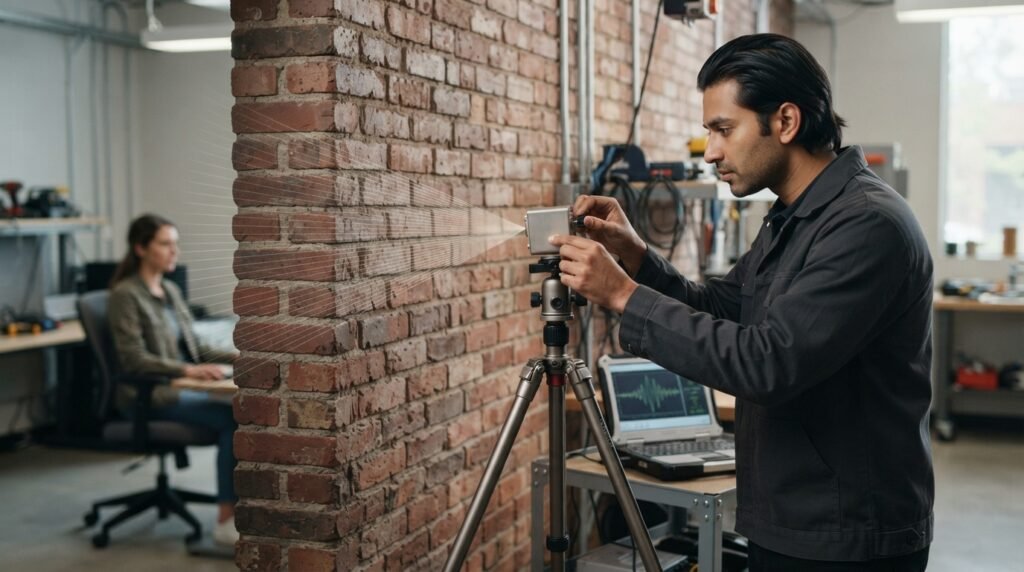
Research shows that it can under controlled conditions.
The 2024 single-channel CW radar study tested a brick barrier approximately 10 cm thick and reported successful heart-rate extraction across the experimental distances.
However, brick construction varies considerably.
A real building may contain:
- Multiple layers
- Concrete
- Steel reinforcement
- Pipes
- Electrical wiring
- Insulation
- Furniture
- Other reflective objects
Consequently, research results from a specific laboratory setup should not be treated as a guarantee of performance in every building.
Can a Heartbeat Scanner Detect Someone Through a Concrete Wall?
It depends on the radar system and the characteristics of the concrete wall.
Concrete can create significant attenuation and reflection, particularly when combined with reinforcement and other building materials.
A specialized radar system may be designed for through-wall sensing, but performance can vary dramatically from one environment to another.
Therefore, it is more accurate to say:
Some radar systems can detect human vital signs through certain barriers, but there is no universal heartbeat scanner that reliably detects a heartbeat through every type of wall.
This distinction is important when evaluating claims about “see-through-wall” technology.
Can a Radar Scanner Actually See a Heart?
No—not in the same way that an imaging system sees an object.
A heartbeat radar generally detects motion-related signal changes, rather than producing a conventional picture of the heart.
The heartbeat creates very small physical movements. Radar can detect the corresponding changes in the reflected signal and use signal processing to estimate the heart rate.
This means a radar-based system may tell researchers that a periodic cardiac signal is present without creating a detailed anatomical image.
A useful comparison is:
| Technology | What It Primarily Detects |
|---|---|
| Camera | Visible light and images |
| Thermal camera | Infrared radiation and temperature patterns |
| ECG | Electrical activity of the heart |
| Pulse oximeter | Optical changes associated with blood oxygen and pulse |
| Radar vital-sign sensor | Motion-related electromagnetic signal changes |
| X-ray | Internal structures using X-rays |
A radar heartbeat detector is therefore better understood as a non-contact physiological sensor, not an X-ray machine.
What Can a Through-Wall Heartbeat Scanner Detect?
Depending on the radar design and signal-processing technique, a system may detect or estimate several types of information.
Heart Rate
Heart rate is the number of heartbeats per minute.
Radar can analyze periodic chest movements and extract a heart-rate signal under suitable conditions.
Respiration Rate
Breathing produces larger chest movements than heartbeat, making respiratory motion another important target for radar-based vital-sign monitoring.
Many earlier through-wall radar studies focused heavily on respiration-rate detection.
Human Presence
Some radar systems can detect whether a person is present by analyzing motion or reflected electromagnetic signals.
Multiple Subjects
Separating signals from multiple people is more difficult because their physiological signals can overlap.
The 2024 study specifically explored simultaneous heart-rate measurements from two subjects and used a signal-processing approach called maximal overlap discrete wavelet transform (MODWT) to help isolate the individual heartbeat signals.
Why Is Detecting a Heartbeat Through a Wall Difficult?
A human heartbeat produces extremely small movements.
The radar does not receive a perfectly clean heartbeat signal.
Instead, it can receive a mixture of reflections caused by:
- Walls
- Furniture
- Floors
- Ceilings
- Other people
- Body movement
- Breathing
- Electrical or environmental interference
The desired heartbeat signal can therefore be buried inside much stronger or unrelated signals.
This is why signal processing is a critical part of a radar heartbeat scanner.
What Is MODWT in Heartbeat Detection?
The 2024 research used Maximal Overlap Discrete Wavelet Transform (MODWT) to process the radar signal.
MODWT is a signal-processing technique that can help separate useful frequency components from complex data.
In the study, researchers used MODWT to suppress subharmonic components and help extract fundamental heartbeat information. The method was also used to separate heartbeat waveforms associated with two subjects in the experimental setup.
This illustrates an important point:
Detecting a heartbeat is not simply a matter of pointing radar at a wall.
The received signal generally needs appropriate processing before a meaningful heart-rate estimate can be produced.
Can a Heartbeat Scanner Work While Someone Is Moving?
Movement can make heart-rate detection much more difficult.
The heartbeat produces tiny periodic movements, while larger body movements can overwhelm the signal.
Examples include:
- Walking
- Turning around
- Moving an arm
- Changing position
- Leaning forward
- Sitting down
- Standing up
The 2024 experiment primarily involved subjects in relatively controlled seated or standing conditions rather than unrestricted movement.
Therefore, a research result obtained with a stationary subject should not automatically be applied to a person moving freely behind a wall.
Does Distance Affect Through-Wall Heartbeat Detection?
Yes.
Distance is an important factor in radar sensing.
As the subject becomes farther from the radar, the reflected signal can become more difficult to distinguish from noise and other reflections.
In the 2024 experiment, researchers tested subject-radar distances from 20 cm to 100 cm and observed heart-rate extraction performance across those distances.
The exact usable range of another radar system may be very different.
Range depends on factors such as:
- Transmit power
- Frequency
- Antenna gain
- Receiver sensitivity
- Signal-processing techniques
- Barrier properties
- Subject movement
- Environmental reflections
Heartbeat Scanner vs. Traditional Heart Rate Monitor
A radar heartbeat scanner and a conventional heart-rate monitor work in very different ways.
| Feature | Radar Heartbeat Scanner | Traditional Heart Monitor |
| Physical contact | No direct contact required | Usually contact required |
| Sensor attached to body | No | Often yes |
| Works through some barriers | Research demonstrates feasibility | Generally no |
| ECG waveform | No | ECG can measure electrical heart activity |
| Continuous monitoring | Possible with suitable systems | Common |
| Main principle | Electromagnetic reflection | Electrical/optical sensing |
| Typical environment | Specialized applications | Healthcare, fitness, home use |
Radar sensing is especially interesting when attaching a physical sensor to a person is inconvenient or impossible.
Where Are Through-Wall Heartbeat Scanners Used?
The technology has several potential applications.
Search and Rescue
One of the most important potential uses is locating people trapped under debris.
After an earthquake, building collapse, or other disaster, a person may be hidden from direct view.
A radar system capable of detecting life signs could potentially help rescuers identify whether a person is present.
The 2024 research specifically discusses post-disaster search and rescue and detection of trapped or injured people as potential applications.
Emergency Response
Non-contact vital-sign sensing could potentially help emergency personnel assess people when conventional sensors are difficult to apply.
Patient Monitoring
Radar-based physiological sensing is also being investigated for non-contact monitoring of vital signs.
This could be useful in situations where continuous physical contact with a sensor is inconvenient.
Building Safety Research
Researchers can investigate human presence and vital signs in environments where conventional optical sensing is obstructed.
Specialized Security Applications
Radar-based life-sign detection has also been researched for specialized security and surveillance applications. However, real-world use raises important privacy, consent, and legal considerations.
Are Heartbeat Scanners the Same as X-Ray Vision?
No.
The phrase “heartbeat scanner read through walls” can make the technology sound much more powerful than it actually is.
A radar-based system does not necessarily create a detailed image of everything behind a wall.
Instead, it analyzes electromagnetic reflections.
Depending on the system, it may estimate:
- Presence
- Movement
- Breathing
- Heart rate
- Distance
- Direction
Some advanced radar systems can provide spatial information, while simpler single-channel systems may have substantially fewer capabilities.
The 2024 research specifically points out that its single-channel CW radar architecture cannot measure the target’s range and angular location directly.
What Factors Affect a Heartbeat Scanner’s Performance?
Several variables can influence results.
Wall Thickness
Thicker barriers can make signal detection more difficult.
Wall Material
Wood, brick, concrete, glass, and reinforced structures can interact differently with radar signals.
Distance
Increasing the distance between the radar and person can reduce the strength and quality of the received signal.
Body Movement
Large movements can interfere with the much smaller movements caused by heartbeat.
Breathing
Respiration can create a much stronger periodic signal than heartbeat and may interfere with extraction.
Multiple People
Signals from several people can overlap, making separation more difficult.
Radar Frequency
Different frequencies behave differently when interacting with materials and human bodies.
Antenna Configuration
Antenna design affects how energy is transmitted and received.
Signal Processing
Advanced algorithms can help extract weak physiological signals from noisy radar measurements.
Can a Phone Detect a Heartbeat Through a Wall?
A normal smartphone should not be confused with a specialized through-wall radar system.
A phone may use:
- Camera-based pulse measurement
- Flash-based optical sensing
- Wearable connections
- Bluetooth sensors
But these are fundamentally different from specialized radar systems designed for through-wall vital-sign detection.
Research demonstrations use dedicated radar hardware and signal-processing techniques. The 2024 study, for example, used a 24-GHz single-channel CW radar system rather than an ordinary smartphone.
Therefore, claims that a standard phone can simply scan through a wall and identify someone’s heartbeat should be treated skeptically.
Can You Buy a Heartbeat Scanner That Reads Through Walls?
Specialized radar sensing equipment exists, but consumers should be careful about marketing claims.
A product advertised as a through-wall heartbeat detector may have capabilities that differ substantially from those demonstrated in academic research.
Before evaluating such a system, consider:
- What radar technology does it use?
- What frequency does it operate at?
- What wall materials were tested?
- What maximum wall thickness was tested?
- What distance was tested?
- Was the person stationary?
- Can it distinguish multiple people?
- Does it detect presence or actually estimate heart rate?
- What independent testing supports the claimed accuracy?
Research results should not automatically be used as proof of a commercial product’s performance.
Is Through-Wall Heartbeat Detection Safe?
Radar-based physiological sensing is generally studied as a non-contact measurement technique, but safety and regulatory requirements depend on the specific equipment, frequency, transmit power, and intended use.
A research system operating under controlled conditions should not be assumed to be equivalent to every commercial radar product.
Anyone deploying radio-frequency equipment should follow applicable regulations and manufacturer requirements.
For medical applications, another important distinction is that experimental heart-rate detection is not automatically equivalent to a clinically validated medical device.
Privacy and Ethical Concerns With Through-Wall Scanning
The ability to detect human presence or physiological signals without direct contact creates legitimate privacy concerns.
A person may reasonably expect privacy inside a private room or building.
Before using through-wall sensing technology, users should consider:
- Consent
- Local laws
- Privacy regulations
- Property rights
- Intended purpose
- Data storage
- Who can access collected information
Research into through-wall vital-sign sensing often highlights applications such as rescue and healthcare, but the same underlying technology can raise concerns when used for surveillance without appropriate authorization.
Responsible use should prioritize legitimate, authorized purposes.
What Is the Future of Heartbeat Radar Technology?
Research is continuing to make radar-based physiological sensing more practical.
Potential improvements include:
- Better signal processing
- Smaller radar hardware
- Lower power consumption
- Improved multiple-person detection
- Better movement compensation
- More accurate heart-rate extraction
- Improved range estimation
- Portable systems
- Integration with healthcare monitoring systems
The 2024 research is particularly interesting because it demonstrated heart-rate extraction using a relatively simple single-channel 24-GHz CW radar architecture and explored simultaneous measurements from two subjects.
However, further research is needed before laboratory performance should be generalized to every building, wall, subject, and real-world environment.
Frequently Asked Questions About Heartbeat Scanner Read Through Walls
1. Can a scanner really detect a heartbeat through a wall?
Yes. Specialized radar systems have demonstrated the ability to detect heart-rate information through certain barriers under controlled experimental conditions. A 2024 study used 24-GHz CW radar to detect heart rate through wood and brick barriers.
2. How does a heartbeat scanner see through walls?
It does not literally see through the wall. Radar sends electromagnetic signals and analyzes changes in reflected signals caused by small movements associated with human vital signs.
3. Can radar detect a heartbeat through brick?
Research has demonstrated heart-rate detection through a brick barrier under controlled conditions. The cited 2024 experiment used a brick wall approximately 10 cm thick.
4. Can radar detect a heartbeat through concrete?
Specialized radar may be able to detect human activity through some concrete structures, but performance varies greatly depending on wall thickness, reinforcement, distance, radar hardware, and environmental conditions.
5. Can a heartbeat scanner detect two people?
Research has demonstrated simultaneous heart-rate detection from two subjects under controlled conditions. The 2024 study used MODWT signal processing to help isolate the heartbeat signals of two subjects.
6. Can a radar scanner see a person through a wall?
Some radar systems can detect human presence or movement through certain barriers. However, detection capabilities depend heavily on the system and environment.
7. Does a heartbeat scanner show an image of the heart?
No. A radar vital-sign detector generally estimates physiological activity from reflected electromagnetic signals rather than producing a medical image of the heart.
8. Can a normal phone detect a heartbeat through a wall?
A standard smartphone is not equivalent to a specialized through-wall radar system. Research demonstrations use dedicated radar hardware and signal-processing techniques.
9. Does movement affect heartbeat radar?
Yes. Large body movements can interfere with the tiny motion patterns associated with heartbeat and make accurate extraction more difficult.
10. What is the difference between radar and ECG?
Radar detects motion-related changes without requiring direct contact, while an ECG measures the heart’s electrical activity using electrodes attached to the body.
11. Can through-wall radar detect breathing?
Yes. Respiration-rate detection is one of the major areas of research in through-wall radar sensing. Radar can detect chest movements associated with breathing.
12. Is a through-wall heartbeat scanner accurate?
Accuracy depends on the system and test conditions. The cited 2024 study reported 95.27% average heart-rate extraction accuracy for its tested single-subject measurements and 97.04% for its tested two-subject measurements at a fixed distance. These figures should not be treated as universal performance specifications.
Final Thoughts
The idea of a heartbeat scanner reading through walls may sound futuristic, but specialized radar systems can detect heart-rate signals without physical contact. Radar senses tiny movements caused by heartbeat and breathing, then processes reflected signals. A 2024 study demonstrated heart-rate detection through wood and brick using 24-GHz radar. However, accuracy depends on wall material, distance, movement, and equipment. These systems have potential for search and rescue, emergency response, healthcare research, and non-contact monitoring.
Related Post
- Inbody Scanner – Complete Guide to Body Composition Scanners, Results, Accuracy, and How They Work!
- Indianapolis Police Scanner – Complete Guide to Live Police Radio, Frequencies, Apps & Online Listening!
- Kenosha Scanner – Complete Guide to Kenosha Police Scanner, Fire Scanner, Frequencies, Apps, and Online Listening!
About the Author