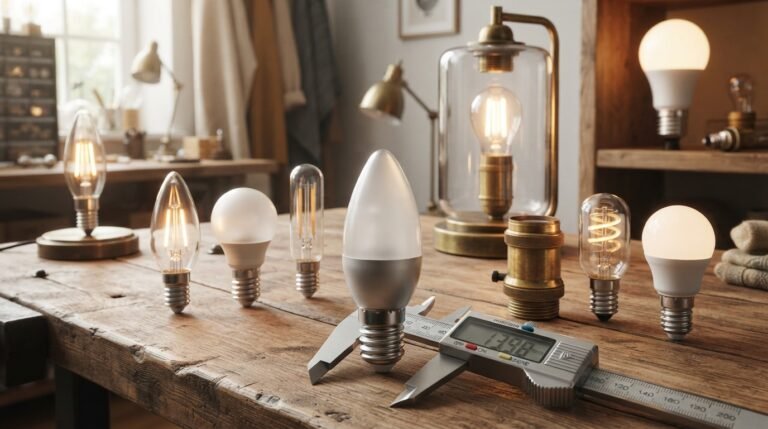
Choosing the correct light bulb can be confusing when you see codes such as A19, A21, BR30, PAR38, MR16, E12, E26, or E27 on the package. These letters and numbers are not random—they tell you important information about the bulb’s shape, size, and base.
This light bulb guide size explains how light bulb sizes work, how to read bulb codes, how to measure a light bulb, and how to choose the right bulb for your fixture.
Whether you need a replacement bulb for a lamp, ceiling light, recessed fixture, chandelier, bathroom vanity, or outdoor light, understanding bulb sizes can help you avoid buying the wrong replacement.
What Is a Light Bulb Size?
A light bulb size describes the physical dimensions and shape of a bulb. Most standard bulbs use a letter-and-number code.
The letter usually identifies the bulb shape or design, while the number generally represents the bulb’s diameter. For many common bulbs in the United States, that diameter is expressed in eighths of an inch.
For example:
- A19 = A-shaped bulb with a diameter of 19/8 inches
- A21 = A-shaped bulb with a diameter of 21/8 inches
- BR30 = bulged reflector bulb measuring 30/8 inches across
- PAR38 = parabolic aluminized reflector bulb measuring 38/8 inches
- MR16 = multifaceted reflector bulb in the MR16 size category
An A19 bulb is approximately 2.375 inches in diameter, because 19 ÷ 8 = 2.375.
However, bulb size is only one part of choosing the correct replacement. You also need to check the base, voltage, wattage or LED equivalent, brightness, shape, and fixture clearance.
How Do Light Bulb Size Codes Work?
Light bulb codes normally combine letters and numbers.
The Letter Shows the Bulb Shape
The first letter or group of letters describes the general bulb design.
Common examples include:
| Code | Bulb Type/Shape | Common Uses |
|---|---|---|
| A | Standard household bulb | Lamps, ceiling fixtures |
| B | Bullet or decorative shape | Chandeliers, decorative fixtures |
| C | Candle/conical | Chandeliers, sconces |
| CA | Candle-shaped with curved tip | Decorative fixtures |
| G | Globe | Vanity lights, decorative fixtures |
| R | Reflector | Recessed and directional lighting |
| BR | Bulged reflector | Recessed lights and flood lighting |
| PAR | Parabolic reflector | Spotlights and outdoor lighting |
| MR | Multifaceted reflector | Track and accent lighting |
| T | Tubular | Tube and specialty fixtures |
GE Lighting similarly identifies A, C, R, MR, PAR, G, and T as common bulb shape families.
The Number Shows the Size
For many common North American bulb codes, the number represents the bulb diameter in eighths of an inch.
For example:
A19
19 ÷ 8 = 2.375 inches
A21
21 ÷ 8 = 2.625 inches
A25
25 ÷ 8 = 3.125 inches
This means an A21 bulb is wider than an A19 bulb, even though both have the same general A-shaped design.
Light Bulb Size Chart
The following chart provides a quick reference for common residential and specialty bulb sizes.
| Bulb Size | Approximate Diameter | Common Application |
| A15 | 1.875 inches | Small household fixtures |
| A19 | 2.375 inches | Standard lamps and ceiling fixtures |
| A21 | 2.625 inches | Larger general-purpose fixtures |
| A25 | 3.125 inches | Larger decorative/general lighting |
| BR20 | 2.5 inches | Recessed lighting |
| BR30 | 3.75 inches | Recessed and flood lighting |
| BR40 | 5 inches | Large recessed fixtures |
| PAR16 | 2 inches | Accent and track lighting |
| PAR20 | 2.5 inches | Spot and flood lighting |
| PAR30 | 3.75 inches | Recessed/outdoor lighting |
| PAR38 | 4.75 inches | Outdoor flood and spotlighting |
| MR11 | 1.375 inches | Small accent lighting |
| MR16 | 2 inches | Track and spotlighting |
| G25 | 3.125 inches | Bathroom vanity lighting |
| G30 | 3.75 inches | Decorative and vanity fixtures |
The actual bulb dimensions can vary somewhat by manufacturer and design, so always check the product’s listed dimensions when fixture clearance is important.
How Do You Measure a Light Bulb?
If you don’t know the bulb code, you can measure the bulb yourself.
You usually need a ruler or measuring tape.
Step 1: Turn Off the Power
Before removing or measuring a bulb installed in a fixture, turn the fixture off and allow the bulb to cool.
For extra safety, disconnect power when appropriate.
Step 2: Remove the Bulb
Carefully remove the bulb from the fixture.
Do not force a bulb that is stuck. If the glass is damaged or broken, use appropriate safety precautions instead of handling it normally.
Step 3: Measure the Widest Part
Measure across the widest point of the bulb.
For many common bulbs, the measurement corresponds to the bulb’s diameter.
For example, if the widest part measures approximately 2.375 inches, it may correspond to an A19 size.
Step 4: Check the Shape
Diameter alone isn’t enough.
Look at whether the bulb is:
- Round
- Pear-shaped
- Candle-shaped
- Globe-shaped
- Tubular
- Reflector-shaped
- Spotlight-shaped
The shape helps identify the correct bulb family.
Step 5: Measure the Base
The base must also fit your fixture.
A bulb can have the correct diameter but still be incompatible because its base is different.
How to Read a Light Bulb Code
Understanding a bulb code becomes much easier when you separate the letters from the numbers.
Consider BR30.
- BR = bulged reflector
- 30 = 30/8-inch diameter
- Approximate diameter = 3.75 inches
Now consider PAR38.
- PAR = parabolic aluminized reflector
- 38 = 38/8-inch diameter
- Approximate diameter = 4.75 inches
And A19 means:
- A = standard household shape
- 19 = 19/8-inch diameter
- Approximate diameter = 2.375 inches
The coding system makes it easier to compare different bulb sizes and shapes.
What Is the Most Common Light Bulb Size?
The A19 is one of the most common standard household light bulb sizes in the United States.
It is widely used in:
- Table lamps
- Floor lamps
- Ceiling fixtures
- Pendant fixtures
- Household room lighting
- Some ceiling fans
An A19 bulb has an approximate diameter of 2.375 inches and commonly uses an E26 medium screw base in U.S. household applications.
That doesn’t mean every fixture using an A19 bulb requires an A19 replacement. Always check the original bulb and fixture specifications before purchasing.
A19 vs A21 Light Bulb Size
A19 and A21 bulbs have similar shapes but different diameters.
| Feature | A19 | A21 |
| Shape | Standard A shape | Standard A shape |
| Diameter | 2.375 inches | 2.625 inches |
| Size difference | Smaller | Larger |
| Typical use | General household lighting | Larger household fixtures |
| Common base | E26 | E26 |
The number is the key difference.
19/8 = 2.375 inches
21/8 = 2.625 inches
Both may use the same medium screw base, but the larger A21 bulb requires more physical space inside the fixture. GE notes that different A-series bulbs can share a standard household base even though their bulb sizes differ.
Common Light Bulb Base Sizes
Bulb shape and bulb base are two different things.
The bulb shape describes the glass or outer body, while the base is the part that connects the bulb to the electrical fixture.
Common base codes include:
| Base | Description | Common Uses |
| E12 | Candelabra base | Chandeliers, decorative fixtures |
| E17 | Intermediate base | Specialty and appliance fixtures |
| E26 | Medium base | Standard household lighting |
| E27 | Medium base | Common international applications |
| GU10 | Twist-and-lock base | Spotlights and track lighting |
| G4 | Bi-pin base | Low-voltage specialty lighting |
| GU5.3 | Bi-pin base | MR16 lighting |
| G9 | Pin base | Decorative and specialty fixtures |
GE Lighting lists E26/E27 as common medium bases, E12 as a candelabra base, E17 as an intermediate base, and GU10 as a twist-and-lock base.
Is E26 the Same as A19?

No.
This is one of the most important things to understand when buying a replacement bulb.
A19 describes the bulb’s shape and size.
E26 describes the base.
Therefore, an A19 E26 bulb has:
- A19 outer bulb shape
- E26 screw base
This is why you should check both the bulb size and base size when choosing a replacement.
Common Light Bulb Shapes and Their Sizes
Different fixtures require different bulb shapes. Here’s a closer look at the most common types.
A-Series Light Bulbs
A-series bulbs are the classic household bulb shape.
Common sizes include:
- A15
- A19
- A21
- A25
A19 is especially common for general household lighting.
These bulbs are frequently used in lamps, ceiling fixtures, and other general-purpose applications.
B-Series Light Bulbs
B bulbs have a narrow, decorative shape and are commonly associated with chandelier and decorative fixtures.
They can create a candle-like appearance and are often used where appearance is as important as illumination.
C-Series Light Bulbs
C bulbs have a candle or conical appearance.
Common applications include:
- Chandeliers
- Wall sconces
- Pendant fixtures
- Decorative lamps
C7 and C9 bulbs are also common in certain decorative lighting applications.
G-Series Globe Bulbs
G bulbs have a rounded globe shape.
Common examples include:
- G16
- G25
- G30
- G40
G25 bulbs are particularly common in bathroom vanity fixtures.
GE identifies globe bulbs as a decorative lighting option and lists several G-series sizes, including G25 and G30.
BR-Series Bulbs
BR stands for bulged reflector.
Common sizes include:
- BR20
- BR30
- BR40
BR30 bulbs are widely used in recessed ceiling fixtures and provide a broad spread of light. GE distinguishes BR bulbs from PAR bulbs partly by their light distribution, with BR designs generally providing a wider wash.
PAR-Series Bulbs
PAR means Parabolic Aluminized Reflector.
Common sizes include:
- PAR16
- PAR20
- PAR30
- PAR36
- PAR38
PAR bulbs are commonly used for directional lighting, outdoor lighting, spotlights, and floodlights.
They are generally designed for more controlled light distribution than standard household bulbs.
MR-Series Bulbs
MR stands for Multifaceted Reflector.
Common sizes include:
- MR11
- MR16
MR bulbs are commonly used for:
- Track lighting
- Recessed accent lighting
- Display lighting
- Landscape lighting
- Spotlighting
MR16 bulbs are particularly common in directional lighting applications.
What Do T5, T8, and T12 Mean?
Tubular fluorescent bulbs use a different sizing system.
The T indicates a tubular shape, while the number refers to the tube diameter in eighths of an inch.
For example:
- T5 = 5/8 inch diameter
- T8 = 8/8 inch, or 1 inch diameter
- T12 = 12/8 inch, or 1.5 inches diameter
T5, T8, and T12 bulbs may also be available in different lengths, so the tube diameter alone does not tell you the complete replacement size. GE explains that fluorescent tubes have both diameter and length considerations.
When replacing a tube, check:
- Tube diameter
- Tube length
- Base/pin configuration
- Ballast requirements
- Fixture compatibility
- Whether the replacement is fluorescent or LED
Light Bulb Size vs. Wattage
Bulb size and wattage are not the same thing.
Bulb size describes physical dimensions.
Wattage describes electrical power consumption.
For example, two A19 LED bulbs can have the same physical size but produce different brightness levels and consume different amounts of electricity.
When buying an LED bulb, pay attention to:
- Lumens
- Wattage
- Color temperature
- Base type
- Bulb shape
- Physical dimensions
- Dimming compatibility
For LED lighting, lumens are more useful than wattage for comparing brightness because LED bulbs can produce substantial light while using relatively little power.
Does Bulb Shape Affect Light Distribution?
Yes.
The shape and reflector design can significantly affect how light spreads.
For example:
- A bulbs are commonly used for general, relatively broad illumination.
- BR bulbs are designed for broader reflector-style lighting.
- PAR bulbs can provide more controlled directional light.
- MR bulbs are commonly used for focused accent and spotlighting.
- Globe bulbs provide a decorative appearance and can distribute light differently depending on their design.
This means choosing a bulb isn’t only about whether it physically fits. The shape can also affect how the room or object is illuminated.
How to Choose the Right Light Bulb Size
Use this simple process when buying a replacement bulb.
1. Check the Old Bulb
Look for markings printed on the bulb or its packaging.
You may find information such as:
A19 E26 800 lm 3000K
Each part provides different information.
2. Identify the Shape
Determine whether the bulb is:
- A
- B
- C
- G
- BR
- PAR
- MR
- T
- Another specialty shape
3. Identify the Size
Check the number following the bulb shape.
For example:
- A19
- A21
- BR30
- PAR38
- MR16
4. Check the Base
Make sure the replacement has the correct base, such as:
- E12
- E17
- E26
- E27
- GU10
- G4
- GU5.3
5. Check Fixture Clearance
Even if the bulb screws into the socket, it may not physically fit inside an enclosed fixture.
Check the bulb’s:
- Diameter
- Overall length
- Shape
- Neck dimensions
6. Choose the Correct Brightness
Look at lumens, not just watts.
7. Check Color Temperature
Common options include:
- Warm white
- Soft white
- Cool white
- Bright white
- Daylight
8. Check Dimming Compatibility
If your fixture uses a dimmer, make sure the bulb is rated for dimming.
LED Light Bulb Sizes
LED bulbs are available in many of the same physical size categories as traditional bulbs.
For example, you can find:
- A19 LED bulbs
- A21 LED bulbs
- BR30 LED bulbs
- BR40 LED bulbs
- PAR20 LED bulbs
- PAR30 LED bulbs
- PAR38 LED bulbs
- MR16 LED bulbs
- G25 LED bulbs
The important point is that LED describes the lighting technology, not the physical bulb size.
An LED A19 and an incandescent A19 can have a similar overall shape and base, but their internal technology, power consumption, brightness, and heat characteristics can differ.
LED bulbs are widely used as replacements because they can provide high light output with lower energy consumption than traditional incandescent bulbs.
Light Bulb Size Chart by Common Application
| Application | Common Bulb Sizes |
| Table lamp | A15, A19 |
| Floor lamp | A19, A21 |
| Ceiling fixture | A19, A21 |
| Ceiling fan | A15, A19 |
| Chandelier | B, C, CA, E12-based bulbs |
| Bathroom vanity | G25, G30 |
| Recessed lighting | BR30, BR40 |
| Outdoor floodlight | BR30, BR40, PAR30, PAR38 |
| Track lighting | MR16, PAR20 |
| Accent lighting | MR11, MR16 |
| Decorative fixtures | B, C, G |
| Fluorescent tube fixtures | T5, T8, T12 |
The correct size still depends on the fixture, socket, voltage, and manufacturer’s specifications.
Can You Use a Different Size Light Bulb?
Sometimes, but not always.
A replacement bulb may work if it has a compatible:
- Base
- Voltage
- Physical size
- Fixture rating
- Wattage or power requirement
- Light distribution
- Dimming compatibility
For example, an A21 bulb may fit the same E26 socket as an A19 bulb, but the A21 is physically larger. If the fixture is designed around the smaller A19 dimensions, the A21 may not fit properly.
Never assume that bulbs are interchangeable simply because they use the same socket.
How to Find Your Light Bulb Size Without the Old Package
If you no longer have the packaging, try these methods.
Look at the Bulb
Many bulbs have their specifications printed directly on the glass or plastic housing.
Check the Fixture
Some fixtures have a label showing:
- Recommended bulb type
- Maximum wattage
- Voltage
- Base type
Measure the Bulb
Measure the widest point and compare it with common bulb sizes.
Measure the Base
Determine whether the socket uses an E12, E17, E26, E27, GU10, or another base.
Check the Fixture Manual
If you know the fixture’s model number, the manufacturer’s documentation can provide the correct bulb specifications.
What Is the Difference Between E12, E17, and E26?
These codes identify screw-base sizes.
E12
E12 is commonly called a candelabra base and is frequently found in chandeliers and decorative fixtures.
E17
E17 is an intermediate base that is larger than E12 and smaller than E26.
E26
E26 is the common medium screw base used for many standard household bulbs in the United States.
GE lists E12, E17, and E26 among common light bulb base sizes.
Light Bulb Size Guide: Quick Reference
If you only need a quick answer, remember these basic rules:
A19: Standard household bulb, approximately 2.375 inches wide.
A21: Larger standard household bulb, approximately 2.625 inches wide.
BR30: Bulged reflector, approximately 3.75 inches wide.
BR40: Larger bulged reflector, approximately 5 inches wide.
PAR38: Directional reflector bulb, approximately 4.75 inches wide.
MR16: Multifaceted reflector bulb, approximately 2 inches across.
E12: Small candelabra screw base.
E17: Intermediate screw base.
E26: Standard medium screw base.
E27: Similar medium screw-base designation commonly used in international applications.
Remember that bulb diameter and base size are separate specifications.
Frequently Asked Questions About Light Bulb Guide Size
1. What does the number on a light bulb mean?
For many common bulb codes, the number represents the bulb’s diameter in eighths of an inch. For example, A19 means approximately 19/8 inches in diameter.
2. What is the standard light bulb size?
A19 is one of the most common standard household bulb sizes in the United States. It typically uses an E26 medium screw base.
3. Is A19 bigger than A21?
No. A21 is larger than A19. A19 is approximately 2.375 inches in diameter, while A21 is approximately 2.625 inches.
4. Is E26 the same as A19?
No. A19 describes the bulb’s shape and size, while E26 describes the screw base.
5. How do I know what size light bulb I need?
Check the old bulb or fixture label for its bulb code and base type. If that information isn’t available, measure the bulb’s widest diameter and inspect the socket to identify the correct base.
6. What is the most common bulb base?
E26 is a very common medium screw base for standard household lighting in the United States.
7. What does BR30 mean?
BR30 identifies a bulged reflector bulb in the 30/8-inch size category, which is approximately 3.75 inches in diameter.
8. What does PAR38 mean?
PAR38 identifies a parabolic aluminized reflector bulb with a nominal diameter of 38/8 inches, or approximately 4.75 inches.
9. What does MR16 mean?
MR16 identifies a multifaceted reflector bulb in the MR16 size category. These bulbs are commonly used for directional, track, accent, and spotlighting applications.
10. Are LED bulbs available in standard sizes?
Yes. LED bulbs are available in many common physical sizes, including A19, A21, BR30, BR40, PAR, MR, and globe styles.
11. Does a bigger bulb mean it is brighter?
Not necessarily. Physical size does not directly determine brightness. Brightness is better compared using lumens, while bulb size determines physical dimensions.
12. Can I use an A21 instead of an A19?
Possibly, if the socket and electrical specifications are compatible and the fixture has enough space for the larger A21 bulb. Always check the fixture’s size and manufacturer’s recommendations.
Final Thoughts
Understanding light bulb guide size doesn’t have to be difficult. The most important thing is to separate the bulb’s shape, physical size, base, brightness, and technology. A code such as A19 tells you the bulb’s general shape and diameter, while E26 tells you the screw-base type. Reflector bulbs use codes such as BR30 and PAR38, while directional accent bulbs commonly use MR11 and MR16. Tubular bulbs such as T5, T8, and T12 use their own diameter-based sizing system.
When replacing a bulb, don’t rely on size alone. Check the bulb code, base, dimensions, voltage, lumens, color temperature, fixture clearance, and dimmer compatibility. Taking a few minutes to measure and identify the old bulb can save you from purchasing the wrong replacement. Once you understand how light bulb codes work, choosing the right bulb becomes much easier—whether you’re replacing a basic A19 household bulb or selecting a BR30, PAR38, MR16, globe, candle, or tubular light for a specialized fixture.
Related Post
- Mr16 Bulb – Complete Guide to MR16 Light Bulbs, Sizes, Watts, Voltage, Lumens, and Uses!
- Non Led Light Bulbs – Complete Guide to Incandescent, Halogen, CFL, Types, Benefits, and Uses!
- Sylvania Bulb Finder – Complete Guide to Finding the Right Sylvania Light Bulb!
About the Author