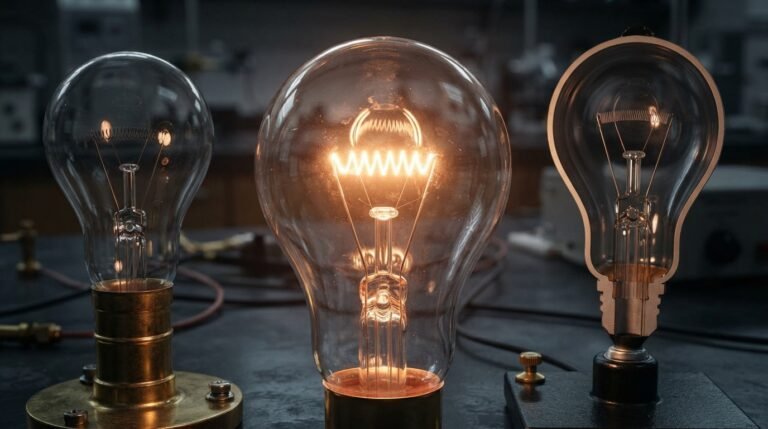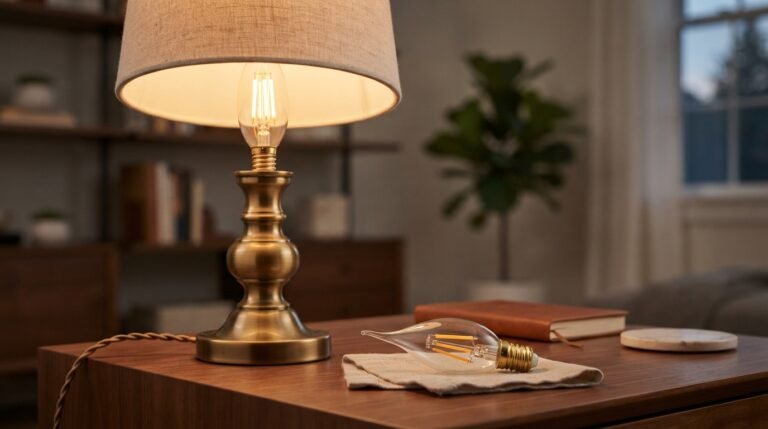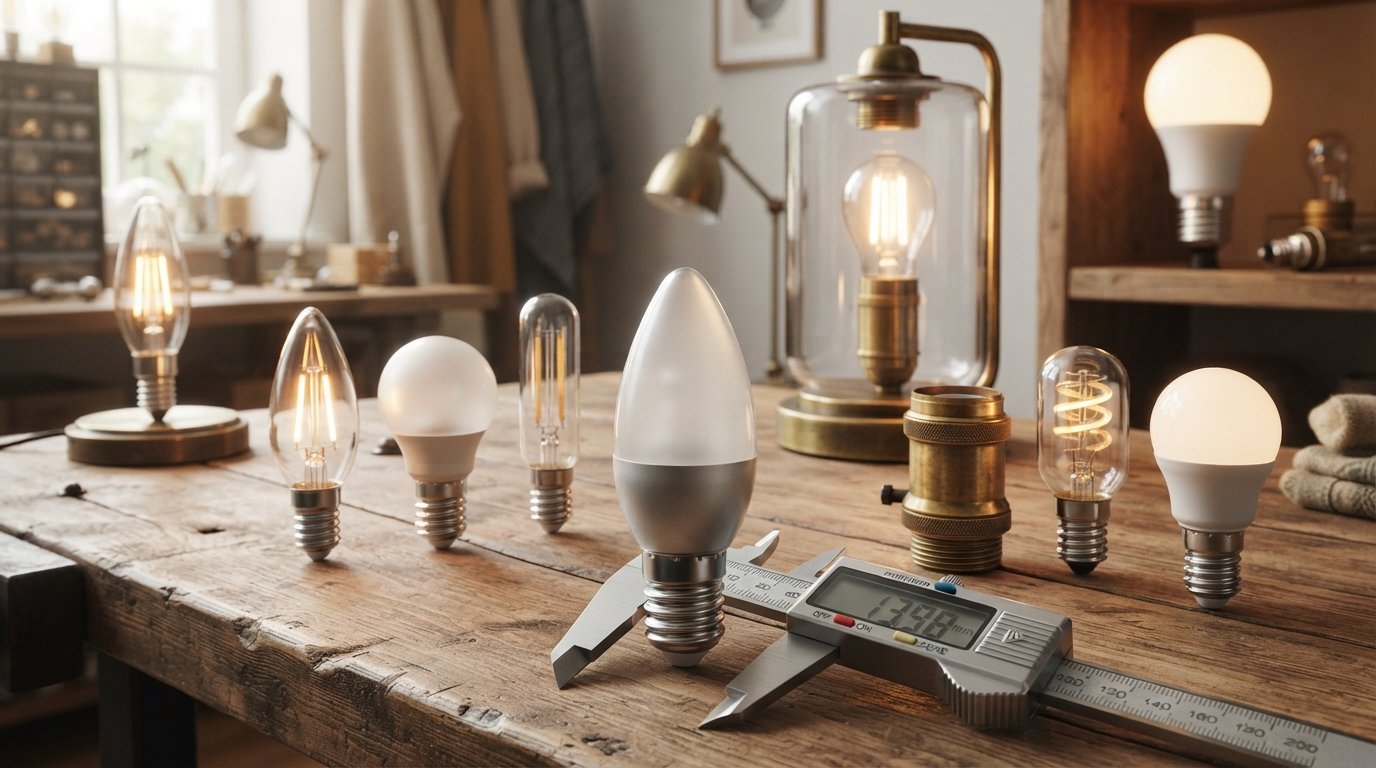
An E14 bulb is a light bulb with a Small Edison Screw (SES) base measuring approximately 14 mm across. It is commonly used in chandeliers, wall sconces, table lamps, bedside lamps, decorative fixtures, and some appliance lighting.
The important thing to understand is that E14 describes the bulb base, not the bulb’s shape, brightness, wattage, or voltage. An E14 bulb can be candle-shaped, globe-shaped, tubular, reflector-style, filament-style, smart, dimmable, or designed for a specialist application.
That means choosing the right E14 bulb involves more than checking the word “E14” on the package. You should also consider voltage, physical dimensions, lumens, color temperature, dimming compatibility, fixture limitations, and the intended application.
What Is an E14 Bulb?
An E14 bulb uses an Edison screw base with a nominal diameter of 14 mm. The “E” identifies the Edison screw connection, while “14” refers to the approximate diameter of the screw base. E14 is also commonly called SES, or Small Edison Screw.
The base is what screws into the matching lamp holder.
The actual glass or plastic bulb can have many different shapes. For example, you can find:
- E14 candle bulbs
- E14 golf-ball bulbs
- E14 globe bulbs
- E14 filament bulbs
- E14 tubular bulbs
- E14 reflector bulbs
- E14 pygmy bulbs
- E14 smart bulbs
- E14 appliance bulbs
So an E14 bulb is best understood as a connection size, rather than a particular bulb shape.
What Does E14 Mean?
The simplest explanation is:
E14 = Edison screw + approximately 14 mm base diameter.
It does not automatically tell you:
- How bright the bulb is
- How many watts it uses
- What voltage it requires
- Whether it is dimmable
- What color the light will be
- How large the glass envelope is
Those specifications have to be checked separately.
What Size Is an E14 Bulb?
The E14 screw base has a nominal diameter of 14 mm, or approximately 0.55 inches.
However, don’t confuse the 14 mm base with the overall size of the bulb.
For example, two E14 bulbs can have exactly the same screw base while having very different overall dimensions. One might be a short pygmy bulb, while another might be a long candle bulb.
This distinction matters when installing a bulb inside:
- A small lampshade
- A chandelier
- A wall sconce
- A refrigerator
- A cooker hood
- A decorative glass cover
- An enclosed fixture
Always check the manufacturer’s listed bulb diameter and length when physical clearance is limited.
What Does SES Mean on a Light Bulb?
SES means Small Edison Screw.
It is another common name for an E14 fitting.
You may therefore see a product described as:
- E14
- SES
- E14 SES
- Small Edison Screw
- Small screw bulb
These terms generally refer to the same basic screw-base family.
If your fixture specifies E14/SES, look for a replacement with the same base specification.
Where Are E14 Bulbs Used?
E14 bulbs are particularly useful in compact and decorative fixtures.
Common applications include:
Chandeliers
Candle-shaped E14 bulbs are especially popular in chandeliers because the narrow base and decorative bulb shapes complement multi-arm fixtures.
Clear filament or candle bulbs can create a traditional appearance, while frosted LED versions provide softer illumination.
Table and Bedside Lamps
Many compact table lamps use E14 bulbs because the smaller screw base works well with relatively narrow lamp designs.
Wall Sconces
E14 bulbs are frequently found in decorative wall lights and sconces where a compact bulb is preferred.
Pendant Lights
Small pendant fixtures can use E14 bulbs, particularly when the designer wants a decorative candle, globe, or filament appearance.
Decorative Lighting
E14 is well suited to ornamental lighting where the bulb itself is visible.
Appliance Lighting
Some refrigerators, cooker hoods, ovens, and other appliances can use E14 lamps.
However, never assume that an ordinary E14 LED bulb is automatically suitable for an appliance. Appliance fixtures can have special temperature, enclosure, vibration, or heat requirements. Use a bulb specifically rated for the appliance and its operating environment.
E14 Bulb Shapes
One of the biggest advantages of E14 is the range of available shapes.
| E14 bulb shape | Common application | Main advantage |
|---|---|---|
| Candle | Chandeliers, sconces | Decorative appearance |
| Globe | Lamps, open fixtures | Rounded appearance and broad light |
| Golf ball | Compact lamps | Small physical size |
| Pygmy | Appliances and compact fixtures | Very small footprint |
| Reflector | Directional lighting | More focused illumination |
| Tubular | Specialty fixtures | Slim profile |
| Filament | Decorative lamps | Vintage-style appearance |
| Smart bulb | Connected lighting | App/voice control |
The base and shape are separate specifications. A candle-shaped bulb can have an E14 base, but candle shape alone does not prove that a bulb is E14.
E14 vs E12: What Is the Difference?
E14 and E12 are similar-looking screw bases, but they are different sizes.
| Specification | E12 | E14 |
|---|---|---|
| Nominal base diameter | 12 mm | 14 mm |
| Common name | Candelabra Screw | Small Edison Screw |
| Common market association | North America | Europe and imported fixtures |
| Interchangeable? | No | No |
The difference is only about 2 mm, but that is enough to make the fittings incompatible. An E12 bulb should not be forced into an E14 socket, and an E14 bulb should not be treated as an E12 replacement.
Can You Use an E12 Bulb in an E14 Socket?
No, not directly.
The bases have different thread diameters and are designed for different holders.
If your fixture says E14, purchase an E14 replacement rather than trying to force an E12 bulb into it.
E14 vs E27: What Is the Difference?
Both are Edison screw fittings, but E27 is considerably larger.
| Feature | E14 | E27 |
|---|---|---|
| Base diameter | Approximately 14 mm | Approximately 27 mm |
| Common name | SES | ES |
| General use | Smaller/decorative fixtures | General household fixtures |
| Screw connection | Yes | Yes |
| Directly interchangeable | No | No |
E14 is commonly associated with chandeliers, sconces, compact lamps and decorative fixtures, while E27 is widely used in larger general-purpose lighting.
Can an E14 Bulb Fit an E27 Socket?
Not directly.
The screw bases are different sizes.
Adapters exist for certain situations, but an adapter does not automatically solve every compatibility issue. You still need to consider:
- Voltage
- Maximum permitted wattage
- Bulb dimensions
- Shade clearance
- Heat
- Fixture design
- Dimming compatibility
For a normal replacement, matching the original socket is generally the simplest approach.
E14 vs E17
E14 and E17 are also different screw-base sizes.
E17 is approximately 17 mm, while E14 is approximately 14 mm.
They should not be treated as interchangeable simply because both are relatively small screw fittings. BulbAmerica’s reference information likewise distinguishes E14 from E17 and E12 by base diameter and compatibility.
If your fixture specifies E14, use an E14 bulb.
How Do You Identify an E14 Bulb?
If you are unsure which bulb you need, use this checklist.
1. Check the Existing Bulb
Look around the metal screw base for markings such as:
E14 or SES
2. Check the Fixture Label
The lamp, socket, packaging, or manufacturer’s instructions may specify the required fitting.
3. Look at the Base
An E14 bulb has a small threaded screw base.
4. Measure the Base if Necessary
Measure across the widest part of the screw base.
An E14 base is approximately 14 mm.
5. Don’t Identify It by Shape Alone
A candle-shaped bulb does not necessarily prove the base is E14.
Likewise, a globe or tubular bulb can be manufactured with several different base types.
The safest method is to match the base marking or fixture specification, then verify the remaining electrical and physical specifications.
E14 LED Bulbs: Are They Better?
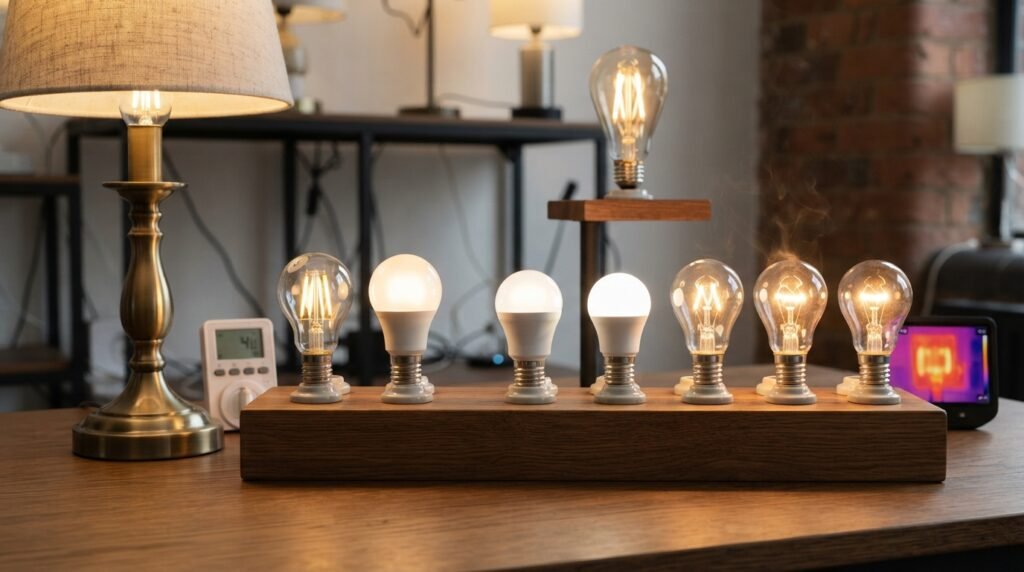
For many everyday applications, an E14 LED bulb is the most practical option.
LED technology generally offers high efficiency and long operating life compared with traditional incandescent lighting, and modern E14 products are available in a wide range of brightness levels, color temperatures and designs. Current E14 product markets include standard LED, filament, smart, decorative and specialty versions.
Advantages of E14 LED Bulbs
- Lower electricity consumption than traditional incandescent bulbs
- Long service life
- Low operating power
- Wide choice of color temperatures
- Available in dimmable versions
- Available in filament styles
- Available in smart versions
- Available in many compact shapes
However, LED does not automatically mean every bulb will work perfectly in every fixture.
You still need to check the product specifications.
E14 LED vs Halogen vs Incandescent
| Feature | LED E14 | Halogen E14 | Incandescent E14 |
|---|---|---|---|
| Energy efficiency | High | Lower | Low |
| Heat generation | Generally lower | High | High |
| Typical lifespan | Long | Shorter | Short |
| Dimmability | Many options | Common | Common |
| Smart versions | Available | No | No |
| Decorative styles | Many | Some | Many |
| Best general choice | Usually | Specialty applications | Traditional appearance |
For everyday household lighting, LED is usually the most practical choice.
Halogen or other specialist technologies can still be appropriate where a fixture specifically requires them, particularly for high-temperature applications.
E14 Bulb Wattage: How Many Watts Do You Need?
One of the most common mistakes is choosing an E14 bulb based only on wattage.
Watts measure electrical power consumption.
They do not directly tell you how much visible light a modern LED bulb produces.
For brightness, look at lumens.
For example, current E14 products demonstrate that relatively low-power LED bulbs can produce hundreds of lumens. Exact performance varies considerably by product, so always use the manufacturer’s stated lumen output rather than assuming every 5W or 6W bulb is equally bright.
Watts vs Lumens
| Measurement | What it tells you |
|---|---|
| Watts | Electrical power used |
| Lumens | Visible light output |
| Kelvin | Light color |
| CRI | How accurately colors appear |
| Voltage | Electrical supply requirement |
This distinction makes choosing an E14 bulb much easier.
How Bright Should an E14 Bulb Be?
The ideal brightness depends on the application.
As a general starting point:
- 200–400 lumens: Accent and atmospheric lighting
- 400–600 lumens: General lamp lighting
- 600–800+ lumens: Brighter task-oriented applications
These are practical starting ranges, not universal rules.
A chandelier with six E14 bulbs may need much less output per bulb than a single E14 lamp being used as the primary light source.
Always consider the number of bulbs in the fixture.
Six 400-lumen bulbs provide approximately 2,400 lumens collectively before accounting for fixture design and light losses.
What Color Temperature Should an E14 Bulb Have?
Color temperature is measured in Kelvin (K).
| Color temperature | Appearance | Common use |
|---|---|---|
| 2200K | Very warm | Decorative/vintage atmosphere |
| 2700K | Warm white | Bedrooms, living rooms |
| 3000K | Soft warm | Kitchens, hallways, general home use |
| 4000K | Neutral white | Work areas and practical lighting |
| 5000K+ | Cool/daylight | Task-oriented environments |
Lower Kelvin values generally produce warmer-looking light, while higher values produce cooler-looking light. E14 products are available across a broad range of color temperatures.
Best E14 Color Temperature for a Bedroom
For a comfortable bedroom atmosphere, 2700K–3000K is usually a sensible starting point.
Best E14 Color Temperature for a Kitchen
For a more functional appearance, 3000K–4000K can work well depending on the fixture and desired atmosphere.
Best E14 Color Temperature for a Chandelier
Warm light around 2200K–2700K is often preferred for decorative chandeliers because it creates a softer, more traditional appearance.
What Is CRI and Why Does It Matter?
CRI stands for Color Rendering Index.
It describes how accurately a light source renders colors compared with a reference light source.
For ordinary household lighting, an E14 LED with CRI 80+ is commonly adequate.
For applications where color accuracy matters, such as:
- Makeup areas
- Art displays
- Photography
- Retail displays
- Design studios
a higher-CRI bulb can be preferable.
Some E14 LED products are available with CRI values above 90 or even 95.
Are E14 Bulbs Dimmable?
Some are, and some are not.
Never assume that an E14 LED bulb is dimmable simply because it is an LED.
The product should specifically state that it is dimmable, and the bulb should be compatible with the installed dimmer.
The same E14 base can be found on both dimmable and non-dimmable products.
Common E14 Dimming Problems
You may experience:
- Flickering
- Buzzing
- Limited dimming range
- Sudden shutoff
- Uneven brightness between bulbs
These problems can result from incompatibility between the LED driver and dimmer.
If a chandelier contains multiple bulbs, using matching bulbs from the same model and specification can also help maintain consistent appearance.
What Voltage Is an E14 Bulb?
This is an important point:
E14 does not define voltage.
The E14 designation describes the physical screw-base system. The actual voltage rating depends on the specific bulb.
E14 products can be sold for different electrical systems, including products intended for approximately 120 V or 220–240 V applications.
Therefore, always check:
- The bulb’s voltage rating.
- The fixture’s electrical rating.
- The requirements of the country or electrical system.
- Whether the bulb is designed for the particular application.
Never choose a bulb based on “E14” alone.
Can You Use an E14 LED Bulb in an Old Lamp?
Usually, an E14 LED can replace an older E14 incandescent bulb if the voltage, physical dimensions, wattage limits and fixture requirements are compatible.
Before replacing it, check:
- E14 base
- Voltage
- Bulb diameter
- Bulb length
- Fixture maximum wattage
- Enclosure restrictions
- Dimming requirements
- Temperature requirements
An LED’s lower electrical wattage does not eliminate the need to verify the fixture’s instructions.
Choosing an E14 Bulb for Different Rooms
Bedroom
Choose:
- 2200K–3000K
- Warm light
- Moderate lumen output
- Dimmable if desired
Living Room
Choose:
- 2700K–3000K
- Warm white
- Decorative candle or filament styles
- Dimmable models for flexible ambience
Kitchen
Choose:
- 3000K–4000K
- Higher lumen output when task lighting is needed
- Good color rendering
Chandelier
Choose:
- Candle or flame-tip shape
- Warm color temperature
- Clear or frosted finish depending on appearance
- Dimmable if the chandelier uses a dimmer
Desk or Reading Lamp
Choose:
- Sufficient lumen output
- Appropriate beam distribution
- 3000K–4000K depending on preference
- High CRI if accurate color perception is important
Appliance
Choose:
- Appliance-specific E14 bulb
- Correct voltage
- Correct temperature rating
- Correct dimensions
Do not substitute an ordinary decorative bulb merely because it has an E14 base.
Clear vs Frosted E14 Bulbs
The bulb finish affects how the light looks.
Clear E14 Bulbs
Clear bulbs are useful when you want:
- Visible LED filaments
- Sparkling chandelier effects
- Vintage styling
- Decorative appearance
Frosted E14 Bulbs
Frosted bulbs generally provide a softer-looking light and can reduce the visual harshness associated with exposed light sources.
For a bedroom or living room, frosted E14 bulbs can be a comfortable choice.
For decorative fixtures where the bulb itself is part of the design, clear filament E14 bulbs may be more attractive.
E14 Filament Bulbs
E14 filament bulbs combine the compact SES base with a vintage-style LED appearance.
They are particularly popular for:
- Chandeliers
- Exposed-bulb lamps
- Decorative pendants
- Restaurants
- Bedrooms
- Vintage interiors
The advantage is that you can get the visual character of traditional filament lighting while using modern LED technology.
Smart E14 Bulbs
Smart E14 bulbs are available with features such as:
- Smartphone control
- Voice control
- Dimming
- Scheduling
- Color adjustment
- RGB lighting
- Automation
They are useful when you want an existing E14 fixture to become part of a smart-lighting system.
However, smart bulbs can be physically larger than conventional E14 bulbs, so check the bulb dimensions before installing one inside a small shade.
How to Choose the Right E14 Bulb
Use this checklist before buying.
Step 1: Confirm the base
Make sure the fixture requires E14/SES.
Step 2: Check voltage
Don’t assume E14 means a particular voltage.
Step 3: Measure available space
Check the maximum bulb diameter and length.
Step 4: Choose brightness
Look at lumens, not just watts.
Step 5: Choose color temperature
Select the Kelvin range according to the room and desired atmosphere.
Step 6: Check dimming
If you have a dimmer, purchase a compatible dimmable bulb.
Step 7: Check the fixture
Confirm the bulb is suitable for:
- Enclosed fixtures
- Outdoor use
- Appliances
- High-temperature environments
- Damp locations
when applicable.
Step 8: Choose the appearance
Select candle, globe, filament, reflector, pygmy or another shape based on the fixture.
Step 9: Consider CRI
Choose a higher CRI when accurate color appearance matters.
Step 10: Compare the complete specification
Don’t choose based solely on the phrase “E14 LED.”
Common E14 Bulb Mistakes to Avoid
Mistake 1: Assuming E14 means 14 mm overall bulb width
It doesn’t.
The 14 mm specification refers to the screw-base diameter.
Mistake 2: Confusing E14 with E12
They are different fittings.
Mistake 3: Confusing E14 with E27
They have substantially different base diameters and are not direct replacements.
Mistake 4: Choosing by watts alone
Watts measure energy consumption. Compare lumens when evaluating brightness.
Mistake 5: Ignoring voltage
The E14 base does not tell you the voltage rating.
Mistake 6: Assuming every E14 LED is dimmable
Always check the product specification.
Mistake 7: Ignoring physical dimensions
A bulb can have the correct E14 base but still be too long or too wide for your fixture.
Mistake 8: Using an ordinary bulb in a specialist appliance
Appliance fixtures can have special operating requirements.
Mistake 9: Mixing bulbs unnecessarily
In chandeliers and multi-bulb fixtures, different bulbs can produce noticeably different colors and brightness levels.
E14 Bulb Troubleshooting
E14 bulb does not fit
Check whether the fixture actually requires E14.
It may use E12, E17, E27, B22 or another fitting.
Never force the bulb.
E14 bulb fits but does not turn on
Check:
- Power supply
- Switch
- Bulb condition
- Socket condition
- Voltage rating
- Fixture compatibility
E14 LED bulb flickers
Possible causes include:
- Incompatible dimmer
- Poor-quality bulb electronics
- Loose connection
- Electrical supply problems
- Compatibility issues with the fixture
If the bulb is dimmable, confirm that the dimmer is compatible with that particular LED.
E14 bulb is too large
The base may be correct while the bulb envelope is not.
Check the manufacturer’s dimensions for both width and length.
E14 bulb gets unusually hot
LED bulbs can become warm during normal operation, but excessive heat may indicate an unsuitable bulb, poor ventilation, an enclosed-fixture limitation, or another compatibility problem.
Follow the bulb and fixture manufacturer’s instructions.
Frequently Asked Questions About E14 Bulbs
What is an E14 bulb?
An E14 bulb is a light bulb with a Small Edison Screw base having a nominal diameter of approximately 14 mm.
What does E14 stand for?
The “E” refers to the Edison screw system, while “14” refers to the approximate diameter of the screw base in millimeters.
Is E14 the same as SES?
Yes. SES means Small Edison Screw, which is the common name used for the E14 fitting.
Is E14 the same as E12?
No. E12 has a nominal 12 mm base while E14 has a nominal 14 mm base. They are different fittings.
Is E14 the same as E27?
No. E14 is approximately 14 mm and E27 is approximately 27 mm. They use different-size screw bases.
Are all E14 bulbs LED?
No. E14 bulbs are available in LED and other lighting technologies.
Are E14 bulbs dimmable?
Some E14 bulbs are dimmable and others are not. Check the specific product specification and make sure the dimmer is compatible.
Are E14 bulbs 220–240V?
Not necessarily. E14 describes the base, not the voltage. Always check the voltage rating of the exact bulb.
What is the brightest E14 bulb?
There is no single brightness level for all E14 bulbs. Compare lumens rather than the E14 designation or wattage alone.
What color E14 bulb is best?
For relaxing residential spaces, 2700K–3000K is a common choice. For more functional lighting, 3000K–4000K may be preferable.
Can I use an E14 bulb in an E27 socket?
Not directly. The screw bases are different sizes. An adapter may be available for some situations, but the complete fixture and bulb specifications still need to be checked.
What is the most common E14 bulb shape?
The candle shape is particularly common in chandeliers and decorative fixtures, although E14 bulbs are also sold as globes, golf balls, pygmy bulbs, reflectors and other shapes.
Can an E14 bulb be used in an oven?
Only if the bulb is specifically rated for the oven’s temperature and operating conditions. Do not assume that an ordinary E14 LED is suitable simply because it fits the socket.
Final Thoughts
An E14 bulb is primarily a small Edison screw fitting with a nominal 14 mm base diameter. Once you understand that, choosing the right bulb becomes much easier.
The key is not to stop at the E14 label.
Before buying, verify the base, voltage, physical dimensions, lumens, color temperature, CRI, dimming capability, fixture restrictions, and intended application.
For most everyday household applications, an E14 LED bulb offers a practical combination of efficiency, long service life and design flexibility. But the best bulb depends on the fixture and the type of light you actually need.
If you remember only one rule, make it this:
Match the E14 base first, then choose the bulb’s brightness, color, shape and features according to your fixture and lighting needs.
Related Post
- Feit Electric Enhance Flame Tip Led Bulb Bpcff60950cafl2 – Complete Specs & Buying Guide!
- Fluorescent Bulbs – Types, Sizes, T5 vs T8 vs T12, Ballasts & LED Replacement Guide!
- Garage Door Opener Light Bulb – Best Bulbs, Replacement Guide, Compatibility & Troubleshooting!
About the Author