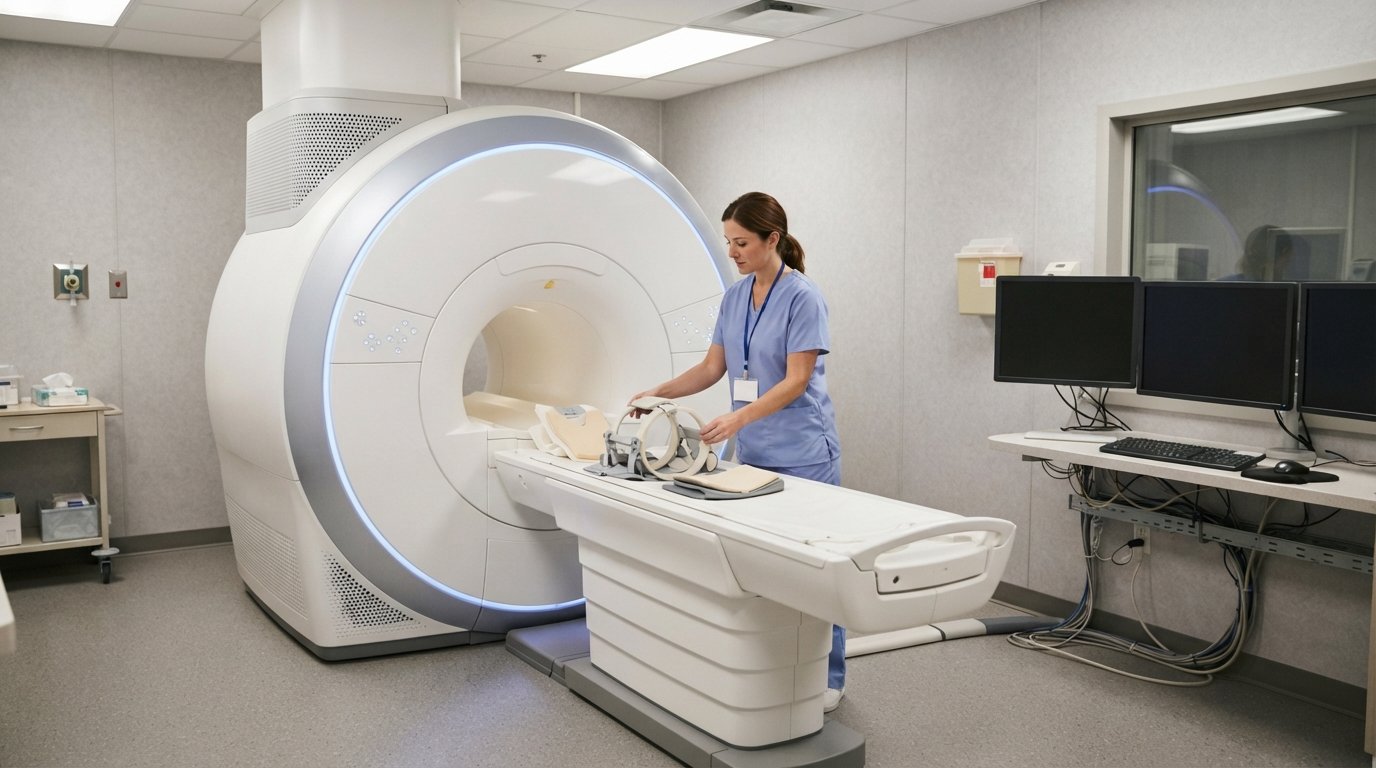
If you are searching for a pic of MRI scanner, you are probably interested in seeing what an MRI machine looks like before an appointment, learning about its parts, or understanding how the scanner works. An MRI scanner is a large medical imaging machine that uses a strong magnetic field and radio waves to create detailed images of structures inside the body.
Unlike an X-ray or CT scanner, an MRI does not use ionizing radiation. The machine usually has a large circular opening, often called the MRI bore, where the patient lies on a movable table during the scan.
This guide explains what an MRI scanner looks like, its main parts, how MRI imaging works, what happens during an MRI scan, and the different types of MRI machines you may see in pictures.
What Does an MRI Scanner Look Like?
A typical MRI scanner looks like a large, rounded or cylindrical machine with a tunnel through the center.
The patient lies on a padded examination table that slowly moves into the opening of the scanner. The circular structure contains the equipment needed to create the magnetic field and collect signals used to produce medical images.
When looking at a pic of MRI scanner, you will usually see:
- A large circular scanner
- A central tunnel or bore
- A motorized patient table
- Head or body positioning equipment
- Coils used during imaging
- A control area outside the scanning room
- A display system for viewing MRI images
The exact appearance varies depending on the manufacturer, model, and type of MRI system.
MRI Scanner Parts and Their Functions
Understanding the main components can make an MRI machine picture much easier to understand.
1. MRI Bore
The MRI bore is the central opening where the patient is positioned during the scan.
The size of the bore can vary between MRI systems. Some newer scanners are designed with wider openings to improve patient comfort.
2. Patient Table
The patient lies on a movable table that slides into the scanner.
The table is carefully positioned so the part of the body being examined is located correctly within the magnetic field.
3. Main Magnet
The magnet is one of the most important components of an MRI machine.
It produces the strong magnetic field required for MRI imaging. This is why MRI facilities have strict rules about metal objects and certain medical devices.
4. Radiofrequency Coils
MRI scanners use specialized radiofrequency coils to transmit and receive signals during imaging.
Different coils can be designed for different parts of the body, such as the head, knee, shoulder, spine, or abdomen.
5. Control System
MRI technologists operate the scanner from a control room located outside the scanning area.
The control system allows the technologist to select imaging sequences, monitor the examination, and communicate with the patient.
How Does an MRI Scanner Work?
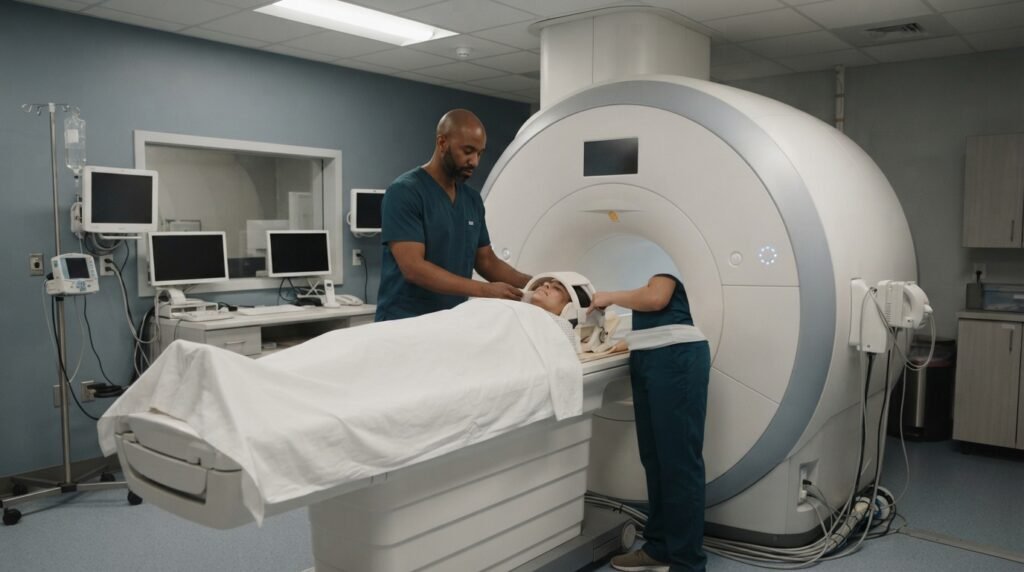
An MRI scanner uses a powerful magnetic field, radiofrequency energy, and computer processing to create detailed images.
The magnetic field influences hydrogen nuclei in the body. Radiofrequency pulses are then used to produce measurable signals. The scanner detects these signals and sophisticated computer systems process them into images.
These images can show differences between various types of soft tissue.
MRI is commonly used to examine structures such as:
- The brain
- Spine
- Muscles
- Ligaments
- Tendons
- Joints
- Abdominal organs
- Pelvic organs
- Blood vessels
- Certain soft-tissue abnormalities
What Is the Difference Between an MRI Scanner and a CT Scanner?
MRI and CT scanners can both create cross-sectional images of the body, but they use different technologies.
| Feature | MRI Scanner | CT Scanner |
|---|---|---|
| Main technology | Magnetic field and radio waves | X-rays |
| Ionizing radiation | No | Yes |
| Soft-tissue detail | Excellent for many applications | Good |
| Typical appearance | Large circular tunnel | Shorter, wider ring |
| Scan time | Often longer | Often faster |
| Noise | Can be loud | Generally quieter |
| Metal screening | Very important | Also relevant |
The appropriate imaging method depends on the medical question, the body part being examined, and the patient’s individual circumstances.
What Is an Open MRI Scanner?
An open MRI scanner is designed with a more open configuration than a traditional enclosed cylindrical MRI machine.
Open MRI systems can be helpful for certain patients who have difficulty with enclosed spaces. However, the exact design, image quality, availability, and suitability vary between systems.
When searching for an open MRI scanner pic, you may notice that the machine does not completely surround the patient in the same way as a conventional closed-bore scanner.
What Is a Wide-Bore MRI Scanner?
A wide-bore MRI scanner has a larger opening than many traditional MRI systems.
The additional space can make the examination more comfortable for some patients.
A wide-bore MRI may still look similar to a conventional MRI machine in photographs, but the bore diameter is larger.
What Does a Brain MRI Scanner Look Like?
During a brain MRI, the patient lies on the scanner table with the head positioned inside a specialized head coil.
A pic of MRI scanner for brain imaging typically shows:
- The MRI machine
- The patient table
- A head coil
- The circular bore
- Positioning equipment
The head coil helps the scanner collect high-quality signals from the brain.
What Does an MRI Machine Look Like From the Inside?
From the patient’s perspective, the inside of an MRI scanner generally appears as a circular tunnel.
The exact interior varies by machine. There may be lighting, ventilation, padding, and communication equipment inside the bore.
The patient normally lies on a flat table while the scanner obtains images.
Some facilities also provide mirrors, music, headphones, or other features designed to make the examination more comfortable.
Is an MRI Scanner Loud?
Yes. MRI scans can be surprisingly loud.
The sounds are produced by rapidly switching magnetic field gradients during different imaging sequences.
Patients may hear:
- Knocking
- Clicking
- Buzzing
- Thumping
- Vibrating sounds
- Repetitive mechanical noises
MRI facilities commonly provide hearing protection such as earplugs or headphones.
What Happens During an MRI Scan?
The exact procedure depends on the type of examination, but the process generally follows several steps.
Step 1: Safety Screening
Before entering the MRI room, the patient is screened for metal objects, implants, medical devices, and other safety considerations.
Step 2: Removing Metal Items
Patients may be asked to remove items such as:
- Jewelry
- Watches
- Keys
- Coins
- Certain clothing accessories
- Electronic devices
The MRI facility will provide specific instructions based on its equipment and safety procedures.
Step 3: Positioning
The patient lies on the MRI table, and the appropriate imaging coil is positioned around the body part being examined.
Step 4: Entering the Scanner
The table moves into the MRI bore.
Step 5: Remaining Still
Patients usually need to remain as still as possible while images are being acquired.
Step 6: Communication With the Technologist
The technologist can communicate with the patient during the examination. MRI systems also generally provide ways for patients to alert staff if they need assistance.
Can You Move During an MRI?
Movement can reduce image quality and may require some images to be repeated.
That is why patients are generally asked to remain still during each imaging sequence.
Breathing instructions may also be provided during certain examinations, particularly when imaging areas affected by breathing motion.
Is an MRI Scanner Safe?
MRI does not use ionizing radiation, but the powerful magnetic field creates important safety considerations.
Patients should provide accurate information about:
- Implanted medical devices
- Metal fragments
- Certain surgical implants
- Previous surgeries
- Other relevant medical information
MRI safety screening is essential because some objects or devices can be affected by the magnetic field.
Always follow the instructions provided by the MRI facility and medical professionals.
Why Do MRI Scanners Have Such Strong Magnets?
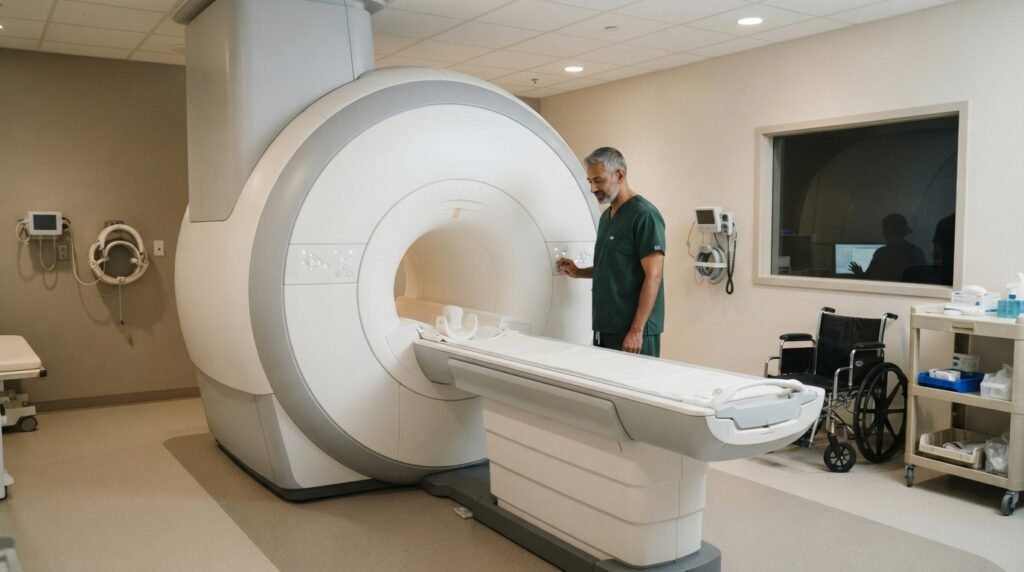
A strong magnetic field is fundamental to MRI imaging.
The magnetic field helps align hydrogen nuclei in the body. Radiofrequency energy and changing magnetic fields are then used to generate signals that can be processed into detailed images.
The strength of an MRI scanner is often described in tesla (T). Common clinical systems include 1.5T and 3T scanners, although other field strengths exist.
What Is an MRI Contrast Scan?
Some MRI examinations use a contrast agent to make certain tissues or structures easier to distinguish.
Contrast is not required for every MRI scan.
Whether contrast is appropriate depends on the type of examination and the clinical question. The medical team will determine whether it is needed and review relevant safety considerations.
MRI Scanner vs. X-Ray Machine
An MRI scanner looks very different from a conventional X-ray machine.
An X-ray system usually consists of a relatively open imaging setup, while an MRI scanner is a large machine with a central bore.
The two technologies also produce images differently:
- MRI: Uses magnetic fields and radiofrequency energy.
- X-ray: Uses X-rays.
- MRI: Particularly useful for many soft-tissue examinations.
- X-ray: Commonly used for bones and other applications.
Doctors choose imaging based on the patient’s condition and the information needed.
How Big Is an MRI Scanner?
MRI scanners are large medical machines that require a dedicated examination room.
The overall dimensions vary by model and facility. The scanner itself occupies significant space, and the MRI suite also requires room for the patient table, equipment, safety systems, and technologist’s control area.
A pic of MRI scanner can help patients understand the general size and appearance before visiting an imaging center.
Why Is an MRI Scanner Room Special?
An MRI scanner room is designed around the strong magnetic field produced by the scanner.
Facilities use controlled access and safety procedures to prevent unsuitable objects from entering the scanning area.
The MRI suite may also have specialized equipment and room construction designed for the scanner’s electromagnetic environment.
Frequently Asked Questions
1. What does an MRI scanner look like?
An MRI scanner typically looks like a large cylindrical or rounded machine with a central tunnel and a movable patient table.
2. Can I see a picture of an MRI scanner before my appointment?
Yes. Medical imaging centers and manufacturers commonly provide photographs of MRI machines. Looking at a pic of MRI scanner can help you understand what the equipment and scanning room may look like.
3. Is an MRI scanner a tunnel?
Many conventional MRI scanners have a tunnel-like bore. However, open and wide-bore MRI systems have different designs.
4. Is an MRI scanner painful?
The MRI scanning process itself is generally noninvasive. However, remaining in one position for an extended period can sometimes be uncomfortable.
5. Why does an MRI scanner make loud noises?
The scanner’s gradient system produces characteristic knocking, buzzing, and other loud sounds during image acquisition.
6. Does an MRI scanner use radiation?
MRI does not use ionizing radiation. It uses a strong magnetic field and radiofrequency energy to generate images.
7. How long does an MRI scan take?
The duration varies depending on the body part, imaging sequences, use of contrast, and other factors. Some examinations take relatively little time, while more complex studies can take longer.
8. What should I bring to an MRI appointment?
Follow the imaging center’s instructions. You will typically need to provide relevant medical information and complete MRI safety screening. The facility will explain what clothing and personal items are appropriate.
Final Thoughts
Searching for a pic of MRI scanner can be a useful first step for anyone who wants to understand what an MRI machine looks like before an examination. Most conventional MRI scanners have a large circular design with a central bore and a movable patient table.
The scanner uses a powerful magnetic field and radiofrequency technology to create detailed images of the body’s internal structures without using ionizing radiation. Different MRI systems, including closed-bore, wide-bore, and open MRI scanners, can have noticeably different appearances. If you are preparing for an MRI appointment, understanding the machine, the scanning process, the sounds, and the safety screening can make the experience feel more familiar. Always follow the specific instructions provided by your healthcare provider and MRI facility.
About the Author