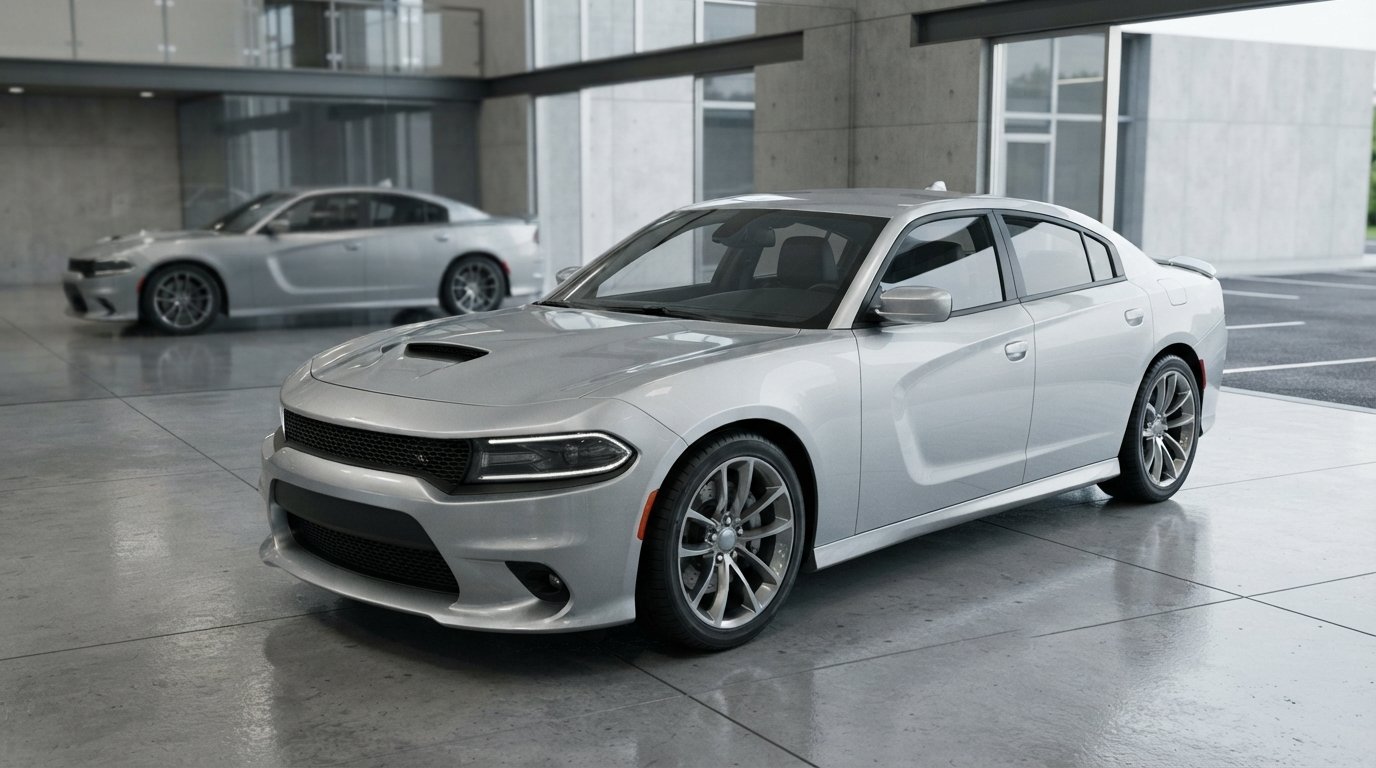
The 2016 Dodge Charger is one of the more unusual full-size sedans from its era. It combines four-door practicality with rear-wheel-drive architecture, available all-wheel drive, multiple V8 options, and the extreme 707-horsepower SRT Hellcat.
For 2016, buyers could choose from a 3.6-liter V6, 5.7-liter HEMI V8, 6.4-liter HEMI V8, or supercharged 6.2-liter HEMI V8. Every version used an eight-speed automatic transmission, while AWD was available on the V6-powered SE and SXT.
Today, the 2016 Dodge Charger is primarily a used-car proposition. That changes the questions buyers should ask. Original MSRP and horsepower are useful, but condition, mileage, service history, accident history, modifications, rust, and recall status can matter just as much.
This guide covers the 2016 Charger from the specifications and trim lineup to performance, fuel economy, safety, reliability considerations, and what to inspect before buying one.
2016 Dodge Charger Overview
The 2016 Charger was a full-size four-door sedan designed to combine everyday usability with muscle-car performance.
Its broad lineup ranged from the V6-powered SE and SXT to the V8-powered R/T, R/T Road & Track, R/T Scat Pack, SRT 392, and SRT Hellcat.
2016 Dodge Charger Quick Facts
| Category | 2016 Dodge Charger |
|---|---|
| Body style | 4-door sedan |
| Seating | 5 |
| Transmission | 8-speed automatic |
| Base engine | 3.6L V6 |
| V8 options | 5.7L, 6.4L, 6.2L supercharged |
| Drivetrain | RWD; AWD available on select V6 models |
| Maximum horsepower | 707 hp |
| Maximum torque | 650 lb-ft |
| Cargo capacity | 16.5 cu. ft. |
| Performance range | V6 commuter to supercharged muscle sedan |
The model’s four engine families give it a much wider performance range than most full-size sedans.
2016 Dodge Charger Engine Options
One of the biggest reasons people continue searching for the 2016 Charger is its engine lineup.
There are four major engines to understand.
3.6-Liter Pentastar V6
The 3.6-liter V6 powers the SE and SXT.
It produces 292 horsepower and 260 lb-ft of torque in standard form. The V6 is available with rear-wheel drive, while AWD versions were offered on the SE and SXT.
For buyers who want a Charger as a daily driver, the V6 provides a balance between performance, practicality, and fuel consumption.
5.7-Liter HEMI V8
The R/T and R/T Road & Track move up to the 5.7-liter HEMI V8.
This engine produces:
- 370 horsepower
- 395 lb-ft of torque
The extra displacement changes the character of the Charger significantly, giving it substantially more V8 performance than the V6 models.
6.4-Liter HEMI V8
The R/T Scat Pack and SRT 392 use the 6.4-liter HEMI V8.
Output reaches:
- 485 horsepower
- 475 lb-ft of torque
Edmunds recorded an R/T Scat Pack reaching 60 mph in 4.6 seconds during its testing.
This engine puts the Charger firmly into high-performance territory while retaining the practicality of a four-door sedan.
6.2-Liter Supercharged HEMI V8
The SRT Hellcat is the top-performance version.
Its supercharged 6.2-liter V8 produces:
- 707 horsepower
- 650 lb-ft of torque
Cars.com lists a starting MSRP of $65,945 for the 2016 SRT Hellcat, while Edmunds recorded a 4.1-second 0-to-60-mph test result.
The Hellcat is therefore a very different proposition from the V6 Charger.
2016 Dodge Charger Trims Explained
The trim lineup can be confusing because several models share engines while adding different equipment and performance hardware.
2016 Dodge Charger SE
The SE sits at the entry point of the lineup.
It uses the 3.6-liter V6 and was available with:
- Rear-wheel drive
- All-wheel drive
Cars.com lists starting MSRPs of $27,995 for the RWD SE and $30,245 for the AWD version.
The SE is aimed more toward buyers who want the Charger body and driving experience without moving into the higher-performance versions.
2016 Dodge Charger SXT
The SXT also uses the 3.6-liter V6.
It was available in both RWD and AWD configurations. Cars.com lists $29,995 as the RWD starting MSRP and $31,995 for AWD.
The SXT adds more comfort and technology equipment than the base SE, making it an important trim for used-car shoppers.
2016 Dodge Charger R/T
The R/T introduces the 5.7-liter HEMI V8.
It produces 370 horsepower and uses rear-wheel drive.
Cars.com lists a $33,895 starting MSRP and 19 mpg combined for the R/T.
2016 Dodge Charger R/T Road & Track
The Road & Track builds on the R/T’s V8 platform with additional performance-oriented equipment and appearance features.
The underlying engine remains the 5.7-liter HEMI.
The factory feature information shows the Road & Track received equipment such as sport-oriented suspension and additional performance-focused features.
2016 Dodge Charger R/T Scat Pack
The Scat Pack uses the 6.4-liter HEMI V8.
Its 485 horsepower makes it substantially more powerful than the R/T.
The Scat Pack also adds serious performance hardware, including Brembo brakes and Bilstein dampers.
2016 Dodge Charger SRT 392
The SRT 392 also uses the 485-horsepower 6.4-liter HEMI.
It adds additional SRT-oriented equipment and features over the standard R/T and provides a more performance-focused package around the same basic 392 engine.
2016 Dodge Charger SRT Hellcat
The Hellcat is the performance flagship.
It combines:
- 6.2-liter supercharged V8
- 707 horsepower
- 650 lb-ft of torque
- 8-speed automatic
- Rear-wheel drive
Cars.com lists a $65,945 starting MSRP for the 2016 model.
2016 Dodge Charger Trim Comparison
| Trim | Engine | Horsepower | Drivetrain |
|---|---|---|---|
| SE | 3.6L V6 | 292 hp | RWD/AWD |
| SXT | 3.6L V6 | 292 hp | RWD/AWD |
| R/T | 5.7L HEMI V8 | 370 hp | RWD |
| R/T Road & Track | 5.7L HEMI V8 | 370 hp | RWD |
| R/T Scat Pack | 6.4L HEMI V8 | 485 hp | RWD |
| SRT 392 | 6.4L HEMI V8 | 485 hp | RWD |
| SRT Hellcat | 6.2L Supercharged HEMI V8 | 707 hp | RWD |
Factory specifications and trim availability are supported by Dodge’s 2016 feature documentation and Cars.com’s trim data.
2016 Dodge Charger AWD vs RWD

AWD is available on the V6-powered SE and SXT.
The V8 performance trims are rear-wheel drive.
Why Choose AWD?
AWD can be useful for drivers who regularly deal with:
- Snow
- Ice
- Wet roads
- Poor traction
- Winter driving
However, AWD does not eliminate the need for appropriate tires and careful driving.
Why Choose RWD?
RWD is central to the Charger experience, particularly for buyers interested in the V8 models.
It is also the drivetrain used by the R/T, Scat Pack, SRT 392, and Hellcat.
2016 Dodge Charger Fuel Economy
Fuel economy depends heavily on the engine and drivetrain.
The V6 models provide the strongest fuel-economy numbers in the lineup.
For example, Edmunds lists the RWD V6 at an EPA-estimated 23 mpg combined, with AWD versions rated at 21 mpg combined. The 5.7-liter R/T is rated at 19 mpg combined, while the 6.4-liter models are rated at 18 mpg combined.
The Hellcat’s EPA estimate is 16 mpg combined, with 13 mpg city and 22 mpg highway.
Actual fuel economy will depend on driving style, traffic, weather, tires, maintenance, and vehicle condition.
How Fast Is the 2016 Dodge Charger?
Performance varies dramatically by trim.
A V6 Charger provides strong everyday acceleration for a full-size sedan, while the V8 models move progressively deeper into performance-car territory.
The R/T Scat Pack produced a 4.6-second 0-to-60-mph time in Edmunds testing. The Hellcat achieved 4.1 seconds in the same source’s testing.
Independent testing can vary because of:
- Tires
- Surface conditions
- Temperature
- Fuel
- Launch technique
- Test equipment
Therefore, published acceleration numbers should be viewed as test results rather than guarantees for every vehicle.
2016 Dodge Charger Interior and Technology
The Charger was not designed purely as a stripped-down muscle car.
Depending on trim and options, buyers could get:
- Uconnect touchscreen
- Bluetooth
- Satellite radio
- Navigation
- Heated seats
- Premium audio
- Rearview camera
- Dual-zone climate control
- Driver-assistance technology
Dodge’s 2016 documentation shows multiple Uconnect configurations, including 5-inch and 8.4-inch systems, while the available 8.4AN system added navigation and other connected features.
2016 Dodge Charger Cargo Space
The Charger offers 16.5 cubic feet of trunk space, according to CARFAX.
That is one of the reasons the Charger appeals to buyers who want performance without giving up four-door practicality.
You get:
- Four doors
- Five-seat capacity
- A usable trunk
- Comfortable highway cruising
- Performance-oriented engine choices
2016 Dodge Charger Safety
The 2016 Charger benefits from standard safety equipment including stability and traction control, antilock brakes, front-seat side-impact airbags, side-curtain airbags, and a driver knee airbag.
Available driver-assistance features included blind-spot monitoring, lane-departure-related technology, and forward collision warning/mitigation depending on configuration.
IIHS Safety Results
IIHS testing for the Charger platform shows:
- Good moderate-overlap front rating
- Good side rating
- Good roof-strength rating
- Good head-restraint/seat rating
- Marginal small-overlap driver-side rating
An optional front crash-prevention system received a Superior rating in IIHS testing.
Remember that crash-test ratings apply to the configurations and test conditions specified by IIHS.
Is the 2016 Dodge Charger Reliable?
Reliability is one of the most important questions when buying a used 2016 Charger.
The answer cannot be determined by the model year alone.
Two 2016 Chargers can have completely different ownership histories.
One might have:
- Complete maintenance records
- Moderate mileage
- No major accidents
- Original drivetrain
- Mostly stock equipment
Another might have:
- Very high mileage
- Poor maintenance
- Previous collision damage
- Heavy modifications
- Multiple owners
- Extensive rust
The second vehicle could be a much greater financial risk even though both carry the same model year.
CARFAX currently reports strong consumer ratings for the 2016 Charger, while its reliability data and other sources should be interpreted alongside the specific vehicle’s condition and history.
2016 Dodge Charger Common Problems and Concerns
A used Charger should be inspected based on its individual condition rather than assuming every car has the same problems.
Potential areas worth checking include:
- Engine noises
- Oil leaks
- Cooling-system condition
- Transmission behavior
- Suspension components
- Brake condition
- Electrical features
- Uconnect operation
- Air conditioning
- Rust
- Accident repairs
- Tire condition
V6 Engine Noise
The 3.6-liter Pentastar V6 deserves particular attention during a used-car inspection.
In the Reddit discussion supplied for this research, one owner specifically warned the prospective buyer to listen for engine ticking and described an experience involving lifter work. That is an individual owner report, not proof that every 2016 Charger has the same issue.
The practical takeaway is to listen carefully to the engine and have a qualified mechanic inspect a high-mileage vehicle before purchase.
Transmission Behavior
The 2016 Charger uses an eight-speed automatic transmission throughout the lineup.
During a test drive, watch for:
- Harsh engagement
- Unusual slipping
- Delayed shifts
- Abnormal noises
- Warning lights
- Rough behavior when cold or warm
A transmission problem can be expensive, so unusual behavior should not be ignored.
Rust
Rust is especially important on vehicles that have spent years in areas with road salt.
The Reddit buying discussion is a good example: one commenter specifically warned about frame rust in snow-and-salt environments.
Inspect:
- Underbody
- Rocker panels
- Wheel arches
- Suspension mounting areas
- Brake lines
- Subframes
- Door bottoms
- Trunk areas
Is a 2016 Dodge Charger With High Mileage Worth Buying?
Mileage alone should not determine the purchase.
A 2016 Charger with 140,000-plus miles and excellent maintenance history may deserve more consideration than a poorly maintained example with substantially fewer miles.
The supplied Reddit discussion illustrates this perfectly. The buyer was considering a 144,000-mile SXT AWD and had negotiated the price down, but commenters emphasized the potential cost of repairs and the importance of the car’s condition.
What Matters More Than the Odometer?
Look at:
- Maintenance records
- Number of owners
- Accident history
- Rust
- Engine condition
- Transmission condition
- Suspension
- Cooling system
- Tires
- Brakes
- Warning lights
- Modifications
High mileage should increase the importance of a professional inspection.
What Should You Check Before Buying a Used 2016 Dodge Charger?
A pre-purchase inspection can prevent expensive surprises.
Check the Vehicle History
Look for:
- Accident records
- Title problems
- Previous ownership
- Service history
- Mileage consistency
- Fleet or commercial use
Inspect the Engine
Look for:
- Unusual ticking
- Knocking
- Excessive smoke
- Fluid leaks
- Rough idle
- Warning lights
- Cooling problems
Test the Transmission
Drive the car both slowly and at highway speeds.
Pay attention to:
- Shift quality
- Engagement
- Delayed response
- Unusual noises
- Warning messages
Inspect the Suspension
Listen for:
- Clunks
- Knocks
- Squeaks
- Uneven tire wear
Also inspect the tires because uneven wear can reveal alignment or suspension issues.
Check the Electronics
Test:
- Touchscreen
- Bluetooth
- Audio
- Backup camera
- Power windows
- Door locks
- Climate controls
- Heated seats
- Steering-wheel controls
- Instrument cluster
Inspect for Modifications
A heavily modified Charger deserves additional scrutiny.
Look for:
- Aftermarket tuning
- Modified exhaust
- Suspension changes
- Non-factory wiring
- Engine modifications
- Oversized wheels
- Drag-oriented modifications
A modified vehicle is not automatically bad, but you should understand exactly what was changed and how the work was performed.
What About a Former Police 2016 Dodge Charger?
The 2016 Charger was also offered in police configurations, according to vehicle trim databases.
A former police vehicle can have a very different ownership history from a privately owned Charger.
Before buying one, investigate:
- Idle hours
- Mileage
- Service records
- Suspension condition
- Brake wear
- Interior wear
- Wiring modifications
- Electrical equipment removal
- Accident history
The vehicle’s actual condition matters more than the badge or previous use alone.
2016 Dodge Charger Recalls
Recall status should always be checked using the vehicle identification number before buying a used vehicle.
Cars.com’s current recall database lists six NHTSA recall results associated with the 2016 Charger data.
Recall applicability can depend on the specific vehicle, equipment, and VIN.
Why VIN Verification Matters
Do not rely only on a generic online list.
The VIN can determine whether a specific vehicle is affected and whether a recall repair has already been completed.
If a recall remains outstanding, contact an authorized dealer or use the appropriate official recall process to determine the next step.
2016 Dodge Charger Maintenance Considerations
A used Charger should be maintained according to its specific engine and configuration.
Important areas include:
- Engine oil
- Filters
- Spark plugs
- Cooling system
- Brake fluid
- Transmission service
- Tires
- Brake pads and rotors
- Battery
- Suspension components
Performance trims can also have higher consumable costs.
A Scat Pack or Hellcat with aggressive driving history may have substantially different tire and brake wear from a gently driven V6.
2016 Dodge Charger vs. Charger SXT AWD
The SXT AWD is an especially interesting used-car configuration.
It combines:
- 3.6-liter V6
- 292 horsepower
- All-wheel drive
- Four doors
- Five seats
- Charger styling
- Eight-speed automatic
Cars.com lists the 2016 SXT AWD at 21 mpg combined when new.
For someone who wants the Charger platform without stepping into V8 fuel consumption and performance-car running costs, this configuration deserves consideration.
2016 Dodge Charger V6 vs. V8
The right engine depends on how the vehicle will be used.
V6
The V6 makes sense for buyers prioritizing:
- Daily driving
- Fuel economy
- AWD availability
- Lower performance-car running costs
- Practical transportation
5.7 HEMI
The 5.7-liter V8 is aimed at drivers who want:
- More power
- V8 sound
- Strong acceleration
- Traditional muscle-car character
6.4 HEMI
The 6.4-liter is for buyers seeking considerably stronger performance.
It produces 485 horsepower and is found in the R/T Scat Pack and SRT 392.
6.2 Supercharged HEMI
The Hellcat is in another performance category entirely.
Its 707-horsepower supercharged V8 makes it one of the most extreme factory versions of the Charger.
How Much Does a Used 2016 Dodge Charger Cost?
There is no single current used price for every 2016 Charger.
Value varies significantly according to:
- Trim
- Mileage
- Condition
- Location
- Accident history
- Service history
- Modifications
- Drivetrain
- Engine
- Ownership history
CARFAX currently displays an average price figure of $15,692 for the 2016 Charger, but individual listings can differ considerably.
For an actual purchase, compare several comparable vehicles rather than using one average number as the target price.
What Makes the 2016 Dodge Charger Different?
The biggest attraction is its combination of practicality and performance.
Many performance cars sacrifice:
- Rear-seat space
- Trunk space
- Four-door access
- Everyday usability
The Charger retains those features while offering engines ranging from a 292-hp V6 to a 707-hp supercharged V8.
That broad range is why the model can appeal to both daily drivers and performance enthusiasts.
2016 Dodge Charger Used-Buying Checklist
Before buying one, check these items:
- Verify the VIN
- Check the vehicle history
- Confirm recall status
- Review maintenance records
- Inspect for rust
- Check for accident repairs
- Listen for unusual engine noise
- Test the transmission
- Check suspension components
- Inspect tires
- Inspect brakes
- Test the air conditioning
- Test Uconnect and electronics
- Check warning lights
- Inspect for modifications
- Confirm AWD/RWD configuration
- Arrange a professional pre-purchase inspection
Frequently Asked Questions
1. Is the 2016 Dodge Charger a good car?
The 2016 Charger offers a broad range of engines, practical four-door space, available AWD, and several powerful V8 configurations. For a used example, however, the specific vehicle’s condition and maintenance history are critical.
2. How much horsepower does a 2016 Dodge Charger have?
Horsepower ranges from 292 hp in the 3.6-liter V6 to 707 hp in the SRT Hellcat. The 5.7-liter HEMI produces 370 hp, while the 6.4-liter HEMI produces 485 hp.
3. Does the 2016 Dodge Charger have AWD?
Yes. AWD was available on the V6-powered SE and SXT. The V8 performance models use rear-wheel drive.
4. What engine is in the 2016 Dodge Charger SXT?
The SXT uses the 3.6-liter Pentastar V6 producing 292 horsepower in standard configuration.
5. What engine is in the 2016 Dodge Charger R/T?
The R/T uses a 5.7-liter HEMI V8 producing 370 horsepower and 395 lb-ft of torque.
6. How much horsepower does the 2016 Charger Scat Pack have?
The R/T Scat Pack uses the 6.4-liter HEMI V8 with 485 horsepower and 475 lb-ft of torque.
7. How much horsepower does the 2016 Charger Hellcat have?
The SRT Hellcat produces 707 horsepower and 650 lb-ft of torque from its supercharged 6.2-liter HEMI V8.
8. What transmission does the 2016 Dodge Charger use?
The 2016 Charger lineup uses an eight-speed automatic transmission.
9. Is the 2016 Dodge Charger good for daily driving?
The V6 versions can function as practical daily drivers because they combine four-door space, a sizable trunk, and relatively stronger fuel economy than the V8 models. Higher-performance versions can also be daily driven, but their fuel, tire, and maintenance requirements can be greater.
10. Is 144,000 miles too much for a 2016 Dodge Charger?
Not necessarily. Mileage should be evaluated alongside maintenance history, mechanical condition, rust, accident history, and upcoming repair needs. A high-mileage Charger should receive a thorough inspection before purchase.
11. Does the 2016 Dodge Charger have recalls?
Yes. Cars.com’s current NHTSA-based database lists six recall results associated with the model. Check the specific VIN for applicable and completed recalls.
12. How much trunk space does the 2016 Charger have?
The Charger has approximately 16.5 cubic feet of trunk space.
13. Is the 2016 Dodge Charger a muscle car?
The Charger is a four-door full-size sedan, but its rear-wheel-drive layout and available HEMI V8 engines give it many characteristics traditionally associated with American muscle cars.
Final Thoughts on the 2016 Dodge Charger
The 2016 Dodge Charger stands out because it covers an unusually wide range of needs.
The 3.6-liter V6 models provide the more practical side of the lineup, with AWD available on the SE and SXT. The 5.7-liter R/T brings traditional HEMI V8 performance, while the 6.4-liter Scat Pack and SRT 392 move into serious performance territory. At the top sits the 707-horsepower SRT Hellcat.
For today’s used-car buyer, however, the trim badge is only part of the equation.
A well-maintained 2016 Charger with documented service history can be a very different proposition from a neglected, heavily modified, accident-damaged, or rust-prone example.
That is why the smartest way to evaluate a 2016 Dodge Charger is to combine the factory specifications with the actual condition of the individual vehicle.
Check the VIN, review the history, inspect the engine and transmission, look underneath the car, verify recalls, test the electronics, and get a professional inspection when possible.
The result is a much more useful buying decision than simply choosing a Charger based on horsepower, mileage, or price alone.
Related Post
- Emporia Classic Level 2 Ev Charger – Complete Guide, Specs, Installation & Classic vs Pro!
- Everstart Maxx Battery Charger – Complete Guide, Setup, Charging & Troubleshooting!
- Evyve Charging Station – Complete Guide to EV Chargers, Prices, App, Locations & How to Charge!
About the Author