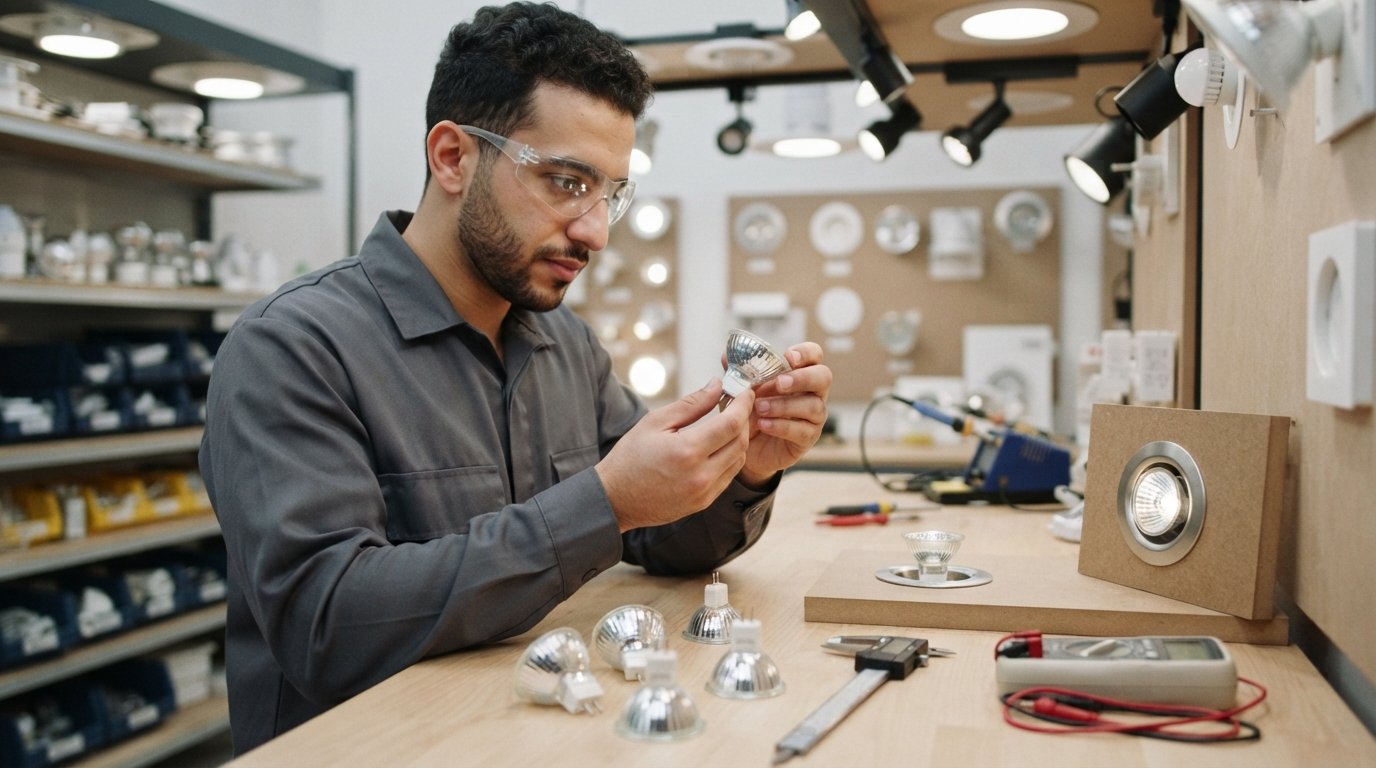
An MR16 bulb is a compact reflector-style light bulb commonly used for accent lighting, display lighting, track lights, recessed fixtures, landscape lighting, and other applications where focused illumination is needed.
The term MR16 refers primarily to the bulb’s physical size and reflector style. MR stands for multifaceted reflector, while 16 indicates the bulb’s diameter in eighths of an inch. An MR16 bulb is therefore approximately 2 inches (50 mm) in diameter.
MR16 bulbs are available in different technologies, including halogen and LED. They can also have different voltages, base types, beam angles, color temperatures, and brightness levels.
This guide explains what an MR16 bulb is, its size, voltage, wattage, lumens, base types, LED and halogen versions, applications, compatibility, installation, troubleshooting, and how to choose the right MR16 light bulb.
What Is an MR16 Bulb?
An MR16 light bulb is a small reflector bulb designed to produce directional or focused light.
Unlike traditional omnidirectional bulbs, MR16 bulbs use a reflector to direct light toward a specific area.
They are commonly used for:
- Accent lighting
- Track lighting
- Recessed lighting
- Display cases
- Cabinet lighting
- Landscape lighting
- Art lighting
- Retail displays
- Architectural lighting
The MR16 format is particularly useful when you want to highlight a specific object or area rather than illuminate an entire room evenly.
What Does MR16 Mean?
MR means multifaceted reflector.
The number 16 refers to the reflector diameter in units of one-eighth of an inch.
Therefore:
16 × 1/8 inch = 2 inches
An MR16 bulb is approximately:
2 inches / 50 mm in diameter
The MR16 designation describes the bulb’s reflector size and shape, but it does not automatically specify voltage, wattage, base, or whether the bulb is LED or halogen.
How Big Is an MR16 Bulb?
An MR16 bulb has a nominal diameter of approximately 2 inches (50 mm).
Its overall length can vary depending on the specific bulb design and manufacturer.
This compact size makes MR16 bulbs suitable for fixtures where space is limited.
Before purchasing a replacement, compare the dimensions of the old bulb with the fixture’s available space.
MR16 Bulb Base Types
One of the most important things to check when replacing an MR16 bulb is its base.
A common MR16 base is:
GU5.3
GU5.3 bulbs have two small pins that fit into a compatible socket.
However, MR16 should not be treated as a universal base designation. Some reflector bulbs with similar dimensions can use different bases.
Always check the original bulb, fixture specifications, or socket before purchasing a replacement.
MR16 GU5.3 Bulb
The MR16 GU5.3 bulb is one of the most common MR16 configurations.
The GU5.3 base typically uses two pins spaced approximately 5.3 mm apart.
These bulbs are commonly found in:
- Recessed lights
- Track lights
- Display fixtures
- Landscape lighting
- Accent lighting
If your fixture specifically requires GU5.3, make sure the replacement bulb has the same base.
MR16 Bulb Voltage
MR16 bulbs are available in different voltage configurations.
A very common version is:
12V MR16
These bulbs are frequently used with a transformer or compatible power supply.
However, some MR16-style bulbs can be designed for other voltage systems.
Therefore, never choose an MR16 bulb based solely on its appearance. Check the required voltage of your fixture.
What Voltage Is an MR16 Bulb?
Many MR16 bulbs are designed for 12-volt systems, especially GU5.3 versions used in low-voltage lighting.
However, voltage can vary by product.
For this reason, check:
- Existing bulb label
- Fixture label
- Transformer output
- Manufacturer specifications
Using the wrong voltage can cause poor performance, overheating, premature failure, or damage to the lighting system.
Does an MR16 Bulb Need a Transformer?
A 12V MR16 bulb generally requires a suitable transformer or power supply when connected to standard mains voltage.
For example, a fixture supplied by household mains may use a transformer to reduce the voltage to the level required by the MR16 bulb.
When replacing a halogen MR16 with an LED MR16, transformer compatibility becomes particularly important.
Some older electronic transformers have a minimum load requirement that an LED bulb may not meet.
MR16 LED Bulb
An MR16 LED bulb uses light-emitting diode technology rather than a halogen filament.
LED MR16 bulbs are popular because they generally provide:
- Lower energy consumption
- Longer operating life
- Lower heat output than halogen
- Multiple color-temperature options
- Various beam angles
- Different brightness levels
However, compatibility with the fixture’s transformer and dimmer should be checked before replacing a halogen MR16 with an LED model.
MR16 Halogen Bulb
An MR16 halogen bulb uses a tungsten filament and halogen gas.
Halogen MR16 bulbs are known for:
- Warm light
- Excellent color rendering
- Instant illumination
- Smooth dimming
- Focused light
The main disadvantage is heat.
Halogen MR16 bulbs can become extremely hot during operation, so proper fixture compatibility and ventilation are important.
MR16 LED vs Halogen
The choice between MR16 LED and halogen depends on your priorities.
| Feature | MR16 LED | MR16 Halogen |
|---|---|---|
| Energy consumption | Lower | Higher |
| Heat output | Generally lower | High |
| Lifespan | Generally longer | Shorter |
| Color options | Many | Typically warm |
| Dimming | Depends on model | Usually excellent |
| Instant-on | Yes | Yes |
| Transformer compatibility | Must be checked | Generally straightforward in matching systems |
For everyday energy-efficient lighting, LED is usually the practical choice.
For traditional warm light and predictable dimming, halogen can still have advantages.
MR16 Bulb Wattage
MR16 bulbs are available in different wattages.
Common halogen versions include ratings such as:
- 20W
- 35W
- 50W
LED MR16 bulbs can produce similar brightness using substantially less electrical power.
For example, an LED MR16 may use only a fraction of the wattage of a comparable halogen bulb.
However, wattage is not a direct measurement of brightness.
MR16 Bulb Lumens
Lumens measure the amount of visible light produced by a bulb.
When comparing an MR16 LED with a halogen bulb, use lumens rather than wattage alone.
A lower-wattage LED can produce similar or greater brightness than a higher-wattage halogen bulb.
When selecting an MR16 bulb, consider:
- Lumens
- Beam angle
- Color temperature
- Fixture position
- Intended application
MR16 Beam Angle
Beam angle determines how widely the bulb distributes light.
Common beam categories include:
- Narrow spot
- Spot
- Narrow flood
- Flood
- Wide flood
A narrow beam is useful for highlighting a specific object.
A wider beam is better for illuminating a larger area.
For example:
Narrow beam: artwork or architectural details
Medium beam: accent lighting
Wide beam: general area illumination
MR16 Bulb Color Temperature
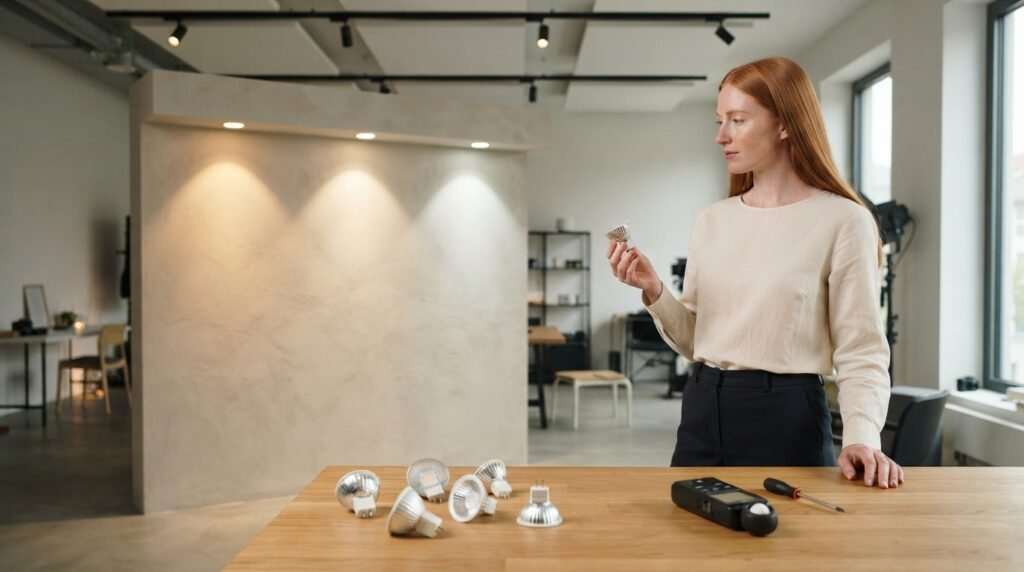
MR16 bulbs are available in different color temperatures.
Common choices include:
- 2700K: Warm white
- 3000K: Warm/soft white
- 4000K: Neutral white
- 5000K: Daylight-style appearance
A 2700K or 3000K MR16 is often suitable for residential accent lighting.
Higher color temperatures can be useful in workspaces, retail environments, or applications where a cooler appearance is preferred.
MR16 Bulb Color Rendering
Color Rendering Index (CRI) describes how accurately a light source reveals colors compared with a reference light source.
A higher CRI is generally desirable for:
- Artwork
- Retail displays
- Museums
- Photography
- Interior design
- Decorative objects
If accurate color appearance matters, look for an MR16 LED with a high CRI rating.
Where Are MR16 Bulbs Used?
MR16 bulbs are extremely versatile.
Recessed Lighting
Their compact size and directional beam make them suitable for recessed accent fixtures.
Track Lighting
MR16 bulbs can provide focused illumination along a track.
Landscape Lighting
Low-voltage MR16 bulbs are widely used in outdoor landscape fixtures.
They can highlight:
- Trees
- Plants
- Paths
- Walls
- Architectural features
For outdoor installations, make sure the entire fixture and bulb are appropriately rated for the environment.
Display Cabinets
MR16 bulbs can highlight products, collectibles, artwork, and other objects.
Kitchen Lighting
They can be used under cabinets or in other accent-lighting applications when the fixture is designed for them.
MR16 Bulbs for Landscape Lighting
Low-voltage MR16 bulbs are popular in landscape lighting because many outdoor lighting systems operate at around 12 volts.
Applications include:
- Pathway accents
- Garden lighting
- Tree uplighting
- Wall washing
- Architectural lighting
- Patio lighting
Outdoor fixtures should be rated for the conditions in which they are installed.
Can You Replace a Halogen MR16 With LED?
In many cases, yes.
However, you need to verify several compatibility factors:
- Voltage
- Base type
- Physical dimensions
- Transformer compatibility
- Dimmer compatibility
- Fixture temperature
- Minimum load requirements
If the existing system uses a 12V electronic transformer, an LED MR16 may not always work correctly with it.
Possible symptoms include:
- Flickering
- Buzzing
- Failure to turn on
- Intermittent operation
- Reduced lifespan
A compatible LED driver or transformer may solve the issue.
Why Is My MR16 LED Bulb Flickering?
Flickering is a common issue when installing an LED MR16 in an older low-voltage system.
Potential causes include:
Incompatible Transformer
The transformer may require a minimum electrical load that the LED does not provide.
Incompatible Dimmer
The dimmer may not be designed for LED loads.
Poor Connection
Loose wiring or socket contacts can interrupt power.
Incorrect Voltage
The bulb and power supply may not match.
Defective Bulb
A faulty LED bulb can also cause flickering.
Why Does My MR16 Bulb Keep Burning Out?
Repeated MR16 failures can have several causes.
Possible reasons include:
- Excessive heat
- Incorrect voltage
- Poor-quality bulbs
- Loose connections
- Transformer problems
- Incompatible fixtures
- Frequent switching
Halogen MR16 bulbs are particularly sensitive to heat.
If a bulb repeatedly fails, replacing the bulb alone may not solve the underlying problem.
Why Is My MR16 LED Bulb Not Working?
If a new MR16 LED does not illuminate, check:
- Is the base correct?
- Is the voltage correct?
- Is the transformer compatible?
- Is the socket making proper contact?
- Is the dimmer compatible?
- Does the bulb work in another compatible fixture?
If multiple bulbs fail in the same fixture, investigate the power supply, transformer, socket, or wiring.
How to Install an MR16 Bulb
Installation varies by fixture, but the general process is:
Step 1: Turn Off the Power
Switch off the fixture and disconnect power where appropriate.
Allow a recently used halogen bulb to cool completely.
Step 2: Remove the Existing Bulb
Remove the old bulb according to the fixture’s socket design.
Do not force it.
Step 3: Check the Replacement
Confirm that the replacement has the correct:
- MR16 size
- Base
- Voltage
- Wattage
- Physical dimensions
Step 4: Install the New Bulb
Insert the pins or base into the socket correctly.
Step 5: Restore Power
Turn the fixture back on and check operation.
For electrical work involving fixed wiring or uncertain connections, use a qualified electrician.
Can You Touch an MR16 Halogen Bulb?
It is best to avoid touching the glass of a halogen bulb with bare fingers.
Oils from your skin can contaminate the glass surface and potentially create uneven heating.
If you accidentally touch a halogen capsule, follow the manufacturer’s cleaning instructions before operating it.
How Long Does an MR16 Bulb Last?
Lifespan depends heavily on the technology and product.
Generally:
- Halogen MR16: shorter operating life
- LED MR16: significantly longer operating life
LED models can provide many times the operating life of traditional halogen bulbs.
Actual lifespan depends on operating temperature, voltage stability, usage patterns, and product quality.
Are MR16 LED Bulbs Energy Efficient?
Yes.
MR16 LED bulbs generally use substantially less electricity than comparable halogen MR16 bulbs.
For a lighting system with many MR16 fixtures, changing from halogen to LED can significantly reduce electricity consumption.
The reduction in energy use can be particularly noticeable when lights operate for several hours every day.
Are MR16 Bulbs Dimmable?
Some MR16 bulbs are dimmable, while others are not.
Always check the product specifications.
For LED MR16 bulbs, you should verify compatibility with the specific dimmer and transformer.
A bulb labeled “dimmable” does not necessarily mean it will work with every dimmer.
MR16 vs GU10
MR16 and GU10 are often confused.
The key differences include the base and typical voltage configuration.
| Feature | MR16 GU5.3 | GU10 |
| Typical base | GU5.3 | GU10 |
| Pins | Two-pin | Twist-lock pins |
| Common voltage | 12V | Often mains voltage |
| Diameter | About 50 mm | About 50 mm |
| Shape | Reflector | Reflector |
Although they can look similar, MR16 GU5.3 and GU10 are not automatically interchangeable.
Always match the bulb to the socket and voltage.
MR16 vs MR11
MR11 is smaller than MR16.
Typical nominal diameters are:
- MR11: approximately 1⅜ inches / 35 mm
- MR16: approximately 2 inches / 50 mm
They should not be treated as interchangeable unless the fixture specifically supports both.
How to Choose the Right MR16 Bulb
Before buying an MR16 replacement, check these specifications:
1. Size
Confirm that the bulb fits the fixture.
2. Base
Check whether you need GU5.3 or another base.
3. Voltage
Verify the required voltage, especially for low-voltage fixtures.
4. Brightness
Compare lumens rather than wattage alone.
5. Beam Angle
Choose spot, narrow flood, or wide flood based on the application.
6. Color Temperature
Choose warm, neutral, or daylight-style light.
7. CRI
Select a higher CRI if accurate color reproduction is important.
8. Dimming
Confirm compatibility with your dimmer.
9. Transformer
For low-voltage LED MR16s, verify transformer compatibility.
Frequently Asked Questions
1. What is an MR16 bulb?
An MR16 bulb is a small multifaceted reflector light bulb with a nominal diameter of approximately 2 inches or 50 mm.
2. What does MR16 stand for?
MR stands for multifaceted reflector, while 16 refers to the nominal diameter in eighths of an inch.
3. Is an MR16 bulb 12V?
Many MR16 bulbs, particularly GU5.3 models, are designed for 12V systems, but you should always verify the bulb’s specifications.
4. What base does an MR16 bulb use?
A common MR16 base is GU5.3, which uses two pins. However, the MR16 designation itself describes the reflector format, not a universal base.
5. Is MR16 the same as GU5.3?
No. MR16 describes the bulb’s reflector size and style, while GU5.3 describes a particular base configuration.
6. Is MR16 the same as GU10?
No. MR16 GU5.3 and GU10 bulbs generally use different bases and voltage configurations.
7. Can I replace an MR16 halogen with LED?
Often yes, but you must check voltage, base, transformer, dimmer, dimensions, and fixture compatibility.
8. Why is my MR16 LED flickering?
An incompatible transformer, dimmer, poor electrical connection, incorrect voltage, or defective bulb can cause flickering.
9. How many watts is an MR16 bulb?
MR16 bulbs come in various wattages. Traditional halogen versions commonly include 20W, 35W, and 50W models, while LED versions generally use much less power.
10. How bright is an MR16 bulb?
Brightness varies by model. Compare the bulb’s lumen rating rather than relying only on wattage.
11. Are MR16 bulbs good for recessed lighting?
Yes. Their compact size and directional illumination make them useful for recessed accent and spotlighting applications.
12. Are MR16 bulbs good for outdoor lighting?
Low-voltage MR16 bulbs are commonly used in landscape lighting, provided the bulb and fixture are rated appropriately for the outdoor environment.
13. Are MR16 LED bulbs better than halogen?
For many applications, LED MR16 bulbs offer lower energy consumption, longer lifespan, and lower heat generation. Halogen may still be preferred for traditional light quality and certain dimming applications.
14. Do MR16 LED bulbs need a transformer?
A 12V MR16 LED requires an appropriate 12V power supply. Whether you can use the existing transformer depends on its design and compatibility with LED loads.
15. Why does my MR16 bulb get hot?
Halogen MR16 bulbs generate significant heat. LED MR16 bulbs generally produce less heat, although they still generate heat that must be managed by the fixture.
Final Thoughts
The MR16 bulb is a compact and versatile reflector light source used for accent lighting, recessed fixtures, track lighting, display lighting, and landscape applications. Its approximately 2-inch (50 mm) diameter makes it useful in compact fixtures where focused illumination is required. When choosing an MR16 replacement, don’t look at the size alone. Check the base, voltage, wattage, lumens, beam angle, color temperature, CRI, dimming capability, and transformer compatibility.
For many users, an MR16 LED bulb is an efficient replacement for a traditional halogen model. However, low-voltage systems require special attention to the transformer or driver, and not every LED MR16 will work correctly with an older power supply. Understanding these specifications will help you select the correct MR16 light bulb, avoid compatibility problems, improve lighting performance, and get the desired brightness and appearance from your fixture.
Related Post
- Sylvania Bulb Finder – Complete Guide to Finding the Right Sylvania Light Bulb!
- T12 Bulbs – Complete Guide to Sizes, Wattage, Types, Replacement, and Compatibility!
- Tanning Bed Bulbs – Complete Guide to Types, Wattage, Replacement, and Safety!
About the Author