A tungsten bulb filament is the thin wire inside a traditional incandescent light bulb that produces light when electricity passes through it. The electrical current heats the filament to an extremely high temperature, causing it to glow and emit visible light.
Tungsten became the preferred filament material because it combines several unusual properties: an exceptionally high melting point, useful strength at high temperature, relatively low vapor pressure, and the ability to be manufactured into extremely fine wire. Tungsten can therefore operate at temperatures high enough to produce bright visible light without immediately melting.
But the story is more interesting than simply saying “tungsten has a high melting point.”
The shape of the filament, the gas inside the bulb, the way tungsten wire is manufactured, and the way the metal behaves as it heats all contribute to how an incandescent lamp works.
What Is a Tungsten Bulb Filament?
A tungsten bulb filament is a very thin piece of tungsten wire used as the light-producing element in an incandescent lamp.
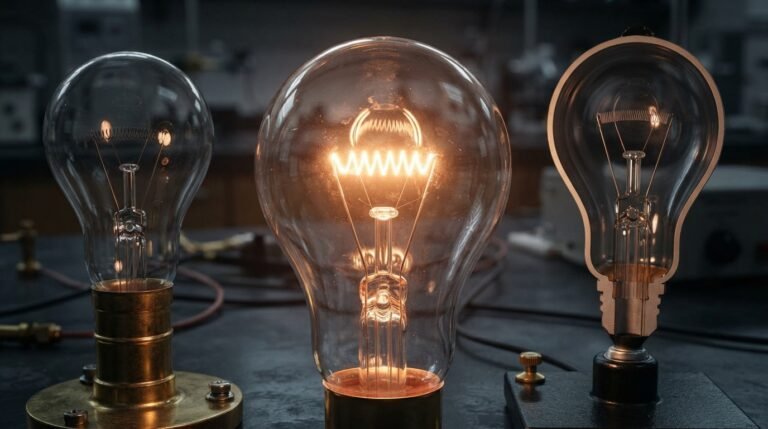
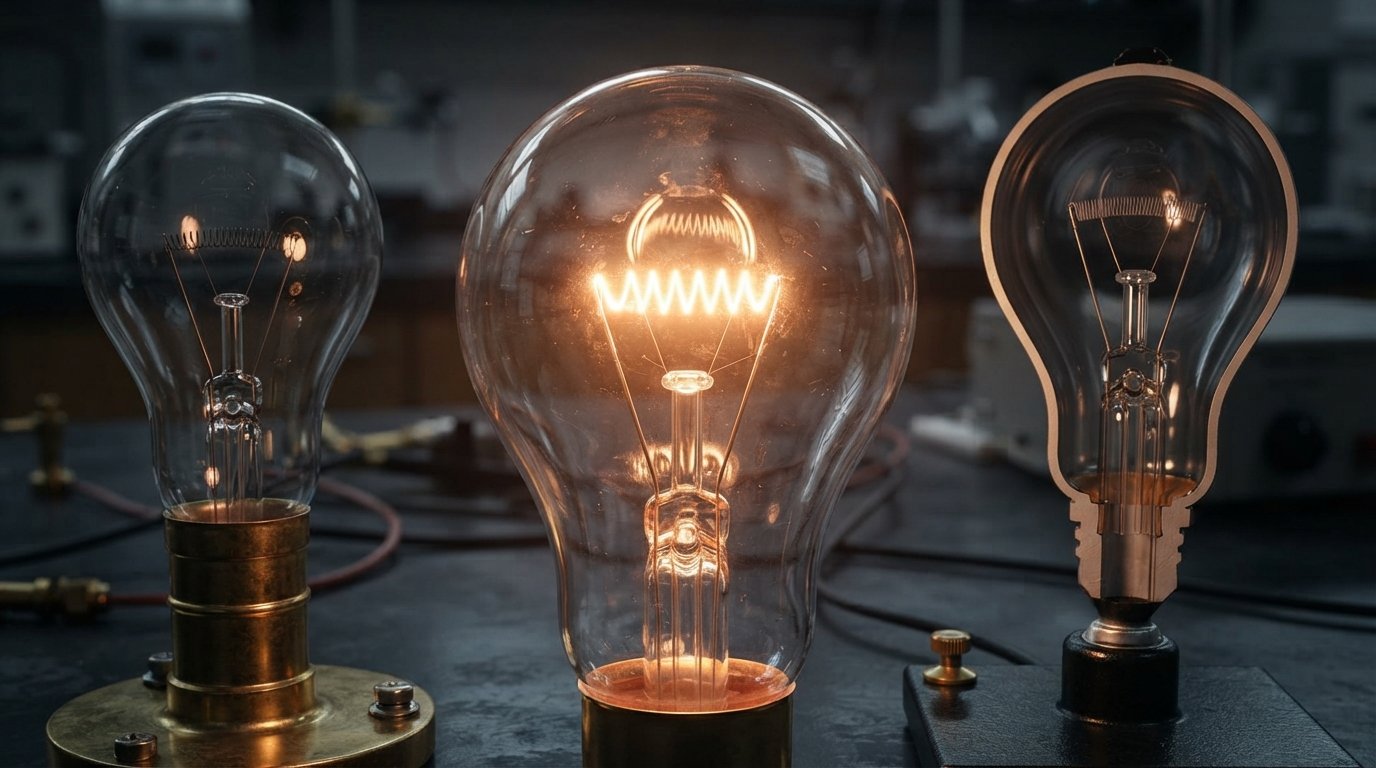
When the bulb is switched on, electrical current flows through the filament. Because the wire has electrical resistance, electrical energy is converted into heat. The filament becomes extremely hot and begins emitting thermal radiation, including visible wavelengths.
This process is called incandescence.
A simplified sequence is:
Electricity → electrical resistance → heat → extremely high temperature → thermal radiation → visible light
The filament is normally enclosed inside a sealed glass envelope containing either a vacuum or a carefully selected gas atmosphere. The enclosure protects the hot tungsten from oxygen and also affects how quickly tungsten evaporates and how much heat is lost from the filament.
Why Is Tungsten Used for Bulb Filaments?
The short answer is that tungsten can survive the extreme temperatures required for incandescent lighting better than most practical metals.
An incandescent filament needs to become extremely hot to produce useful visible light. If the material melted or evaporated rapidly at those temperatures, the bulb would have a very short life.
Tungsten has a melting point of approximately 3,414°C (6,177°F) according to the Royal Society of Chemistry. It is the metal with the highest melting point, giving it an important advantage in high-temperature applications.
However, its suitability comes from a combination of properties rather than one number.
1. Extremely high melting point
The filament must operate at a temperature where it emits significant visible radiation.
Many metals would melt before reaching a useful incandescent temperature. Tungsten provides a much larger temperature range in which the filament can remain solid.
This is one of the fundamental reasons tungsten became so important to incandescent lighting.
2. Relatively low vapor pressure
Tungsten can still lose atoms from its surface when extremely hot, even though it remains solid.
This gradual loss of material is one reason incandescent filaments eventually become thinner and fail.
Tungsten’s relatively low vapor pressure helps slow this process compared with many alternative materials. Research on incandescent lamp materials has specifically identified low vapor pressure as an important requirement for filament materials.
3. Strength at high temperature
A filament is incredibly thin, so it cannot simply be a soft piece of wire.
It has to support its own shape while being heated repeatedly to extreme temperatures. Tungsten’s mechanical properties make it suitable for this demanding environment.
4. It can be manufactured into extremely fine wire
Pure tungsten is notoriously difficult to work with. Historically, this was one of the biggest obstacles to using it commercially.
William D. Coolidge and other researchers developed techniques that transformed tungsten powder into ductile wire that could be drawn into extremely small diameters. By 1910, Coolidge’s process could produce kilometers of very fine tungsten filament.
5. It produces a useful incandescent spectrum
As the filament becomes hotter, its thermal radiation shifts toward shorter wavelengths, producing more visible light.
That is why a heated metal can progress visually from a dull red glow toward orange, yellow, and eventually a much whiter appearance as its temperature increases.
How Does a Tungsten Filament Produce Light?
The filament does not produce light through a chemical reaction like a flame.
Instead, it produces light through thermal radiation.
When electricity passes through the thin tungsten wire, the filament heats because of its electrical resistance. At sufficiently high temperature, the tungsten emits electromagnetic radiation across a broad range of wavelengths.
Some of that radiation is visible to human eyes.
A significant portion is outside the visible range, particularly in the infrared. This is one of the major reasons conventional incandescent bulbs are much less energy efficient than modern LED lighting. Cambridge’s tungsten-filament study guide notes that a large majority of the electrical input in incandescent lamps is ultimately emitted as infrared heat rather than useful visible light.
How Hot Does a Tungsten Bulb Filament Get?
A tungsten filament commonly operates at several thousand degrees Celsius, depending on the lamp design, voltage, filament geometry, and operating conditions.
The exact temperature is not identical for every incandescent bulb.
The important point is that the filament becomes hot enough to emit substantial visible radiation while remaining below tungsten’s melting point.
This is the fundamental balancing act of incandescent lighting:
Hot enough to glow brightly, but not so hot that the filament rapidly melts or fails.
Why Doesn’t the Tungsten Filament Melt?
Tungsten actually does get close to its extreme thermal limits during operation.
The reason it does not simply turn into a liquid is that the operating temperature of the filament remains below tungsten’s melting point.
The Royal Society of Chemistry gives tungsten’s melting point as about 3,414°C. Cambridge’s materials-science material explains that incandescent filaments operate at temperatures approaching the extreme thermal limits of the material.
However, “doesn’t melt” does not mean “doesn’t lose material.”
Tungsten atoms can gradually leave the filament surface at high temperature. Over time, this causes parts of the wire to become thinner.
Eventually, the thinnest section becomes a weak point and the filament breaks.
Why Is the Bulb Filled With Argon or Another Gas?
Early incandescent bulbs used vacuum envelopes to keep oxygen away from the hot filament.
A vacuum prevents oxidation, but it also allows tungsten atoms to evaporate relatively easily from the hot wire.
Modern incandescent lamps can instead use an inert gas such as argon, often with other gases depending on the lamp design.
The gas performs two important jobs:
- It prevents oxygen from reacting with the hot tungsten.
- It reduces the rate at which tungsten leaves the filament.
The gas must be selected carefully because it can also increase heat transfer away from the filament.
This creates another engineering compromise: the gas should protect the filament without removing too much heat.
Why Is the Tungsten Filament Coiled?
If you looked closely at an incandescent bulb, you might notice that the filament is not usually a straight wire.
It is commonly wound into a coil, and some designs use a coiled-coil arrangement.
There are several advantages.
More wire in a compact space
A long piece of fine tungsten wire can be packed into a relatively small bulb by winding it into a coil.
Better thermal behavior
Coiling changes how the filament exchanges heat with its surroundings. Cambridge’s materials-science study guide notes that filament coiling can reduce certain gas-convection effects and allow the filament to maintain a high operating temperature.
High operating temperature
Maintaining a high filament temperature is important because increasing temperature shifts thermal radiation toward the visible part of the spectrum.
This helps an incandescent lamp produce more useful visible light.
Does Tungsten Have High Electrical Resistance?
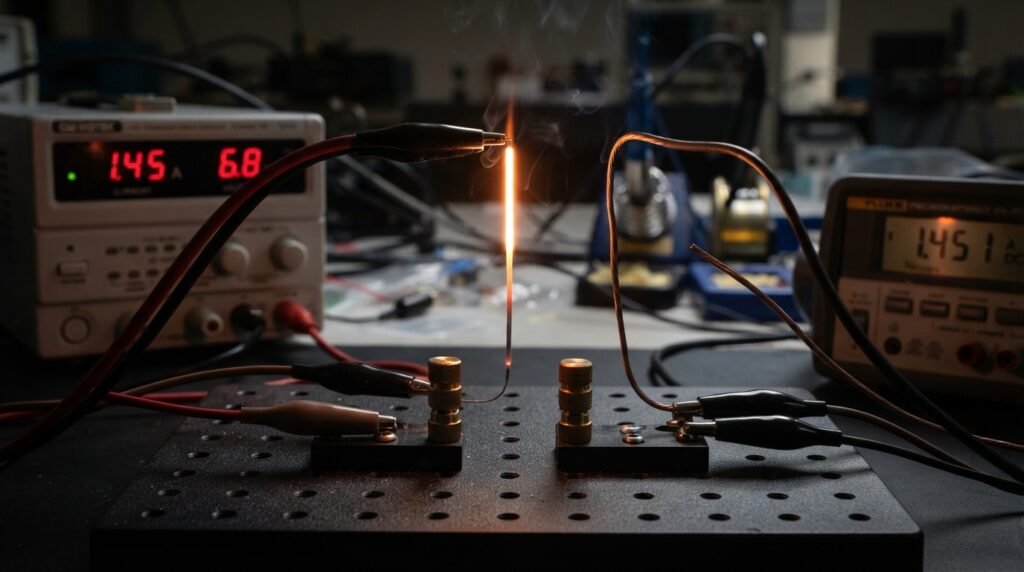
Tungsten has electrical resistivity that is useful for filament construction, but it is misleading to say that high resistivity alone is the reason tungsten is chosen.
The overall resistance of a filament depends on both the material and its geometry.
Engineers can change resistance by changing:
- Wire length
- Wire diameter
- Cross-sectional area
- Filament shape
- Operating temperature
The more important material challenge is finding a material that can survive the temperature required for incandescent light.
This is why the common explanation that tungsten is simply selected because it has “high resistance” is incomplete. The physics discussion surrounding tungsten filaments makes this distinction particularly clear.
Tungsten vs. Carbon Filament
Before tungsten became dominant, incandescent lamps used carbon and other materials.
Carbon filaments helped make practical electric lighting possible, but tungsten eventually offered important performance advantages.
| Feature | Carbon Filament | Tungsten Filament |
|---|---|---|
| High-temperature performance | Good for early lamps | Excellent |
| Operating temperature potential | Lower | Higher |
| Brightness potential | Lower | Higher |
| Filament material | Carbon | Tungsten |
| Historical use | Early incandescent lamps | Later standard |
| Mechanical characteristics | Different from tungsten | Strong but challenging to manufacture |
| Modern use | Mostly decorative/historical | Incandescent and decorative applications |
Historical sources document the transition from carbon to tungsten during the early twentieth century. The National Museum of American History notes that GE began replacing carbon filaments with tungsten in the 1910s, while American Scientist describes the technological work required to make ductile tungsten practical.
How Did Tungsten Replace Carbon?
The move from carbon to tungsten was not simply a matter of discovering a better material.
Manufacturers first had to solve the difficult problem of turning tungsten into a sufficiently fine, durable filament.
Early tungsten was extremely hard and brittle. It could not easily be processed using conventional metalworking techniques.
William D. Coolidge’s work at General Electric was especially important. He developed methods involving tungsten powder, sintering, mechanical working, and wire drawing to produce ductile tungsten filament.
By the early twentieth century, tungsten filament lamps were becoming commercially important, and tungsten eventually displaced carbon as the dominant incandescent filament material.
How Is a Tungsten Filament Made?
Modern tungsten filament production is based on sophisticated materials processing.
A simplified process includes:
1. Tungsten ore processing
Commercial tungsten is obtained from ores including wolframite and scheelite.
2. Producing tungsten powder
The tungsten compounds are chemically processed and reduced to produce tungsten powder.
3. Compacting
The powder is pressed into a dense form.
4. Sintering
The compacted tungsten is heated below its melting point to produce a strong, dense bar.
5. Working the tungsten
The bar can be mechanically processed through techniques such as swaging and rolling.
6. Wire drawing
The tungsten is progressively drawn through dies to reduce its diameter and create very fine wire.
The Cambridge technical material describes tungsten filament production as a powder-metallurgy process involving compaction, sintering, swaging, and wire drawing.
This manufacturing challenge is one of the most interesting parts of tungsten’s history: the material had excellent properties for a filament, but it was exceptionally difficult to turn into one.
What Did William Coolidge Contribute to Tungsten Filaments?
William D. Coolidge played a major role in developing practical ductile tungsten for incandescent lamps.
American Scientist’s historical account describes how Coolidge initially struggled to shape tungsten and eventually developed a process involving tungsten powder, sintering, heating, and repeated mechanical reduction. His work made fine tungsten wire suitable for mass-produced lamps.
The history is important because it shows that finding the right material is only half the problem.
A material can have excellent theoretical properties and still be nearly useless commercially if engineers cannot manufacture it reliably.
Why Does a Tungsten Filament Eventually Burn Out?
A tungsten filament usually does not fail because it suddenly melts into a liquid.
Instead, several processes gradually weaken it.
Tungsten evaporation
At very high temperatures, tungsten atoms leave the filament surface.
The wire becomes thinner over time.
Uneven thinning
The filament does not necessarily lose material uniformly. Some areas can become thinner than others.
A thinner region has higher electrical resistance per unit length and can become hotter.
That creates a dangerous feedback process:
Thinner section → higher local heating → higher temperature → faster material loss → even thinner section
Eventually, the filament breaks.
Switching stress
A cold tungsten filament has a much lower electrical resistance than it does when hot.
When an incandescent bulb is switched on, a brief surge of current can therefore occur. Physics education resources identify this initial inrush current as an important source of stress on tungsten filaments.
This helps explain why a bulb that has worked for months may fail immediately when switched on.
Why Does the Inside of an Old Bulb Turn Dark?
The darkening is associated with material leaving the hot filament and depositing on cooler parts of the bulb envelope.
In older vacuum-style incandescent lamps, tungsten evaporation could produce noticeable blackening.
Gas-filled lamps reduce this problem by slowing filament evaporation.
Halogen lamps take the concept further by using a halogen cycle that helps return evaporated tungsten toward the filament instead of allowing as much material to accumulate on the glass.
What Is a Halogen Tungsten Filament?
A halogen lamp is still an incandescent lamp that uses a tungsten filament.
The difference is the environment surrounding the filament.
A small amount of a halogen-containing gas is used to support a chemical cycle that helps control tungsten deposition on the bulb envelope.
This allows halogen lamps to operate the tungsten filament at relatively high temperatures while maintaining useful lamp life.
The basic light-producing principle remains the same:
Electrical energy → tungsten heating → thermal radiation → visible light
Are Tungsten Filament Bulbs Still Used?
Yes, although traditional incandescent lighting has been displaced by more efficient technologies in many applications and markets.
Tungsten filament lamps still appear in:
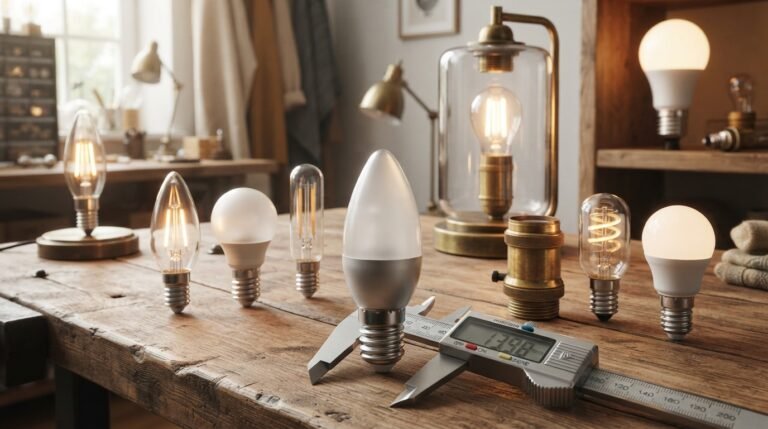
- Vintage-style lighting
- Edison-style decorative bulbs
- Specialty lamps
- Certain appliance and equipment applications
- Historical reproductions
- Lighting where the appearance of a glowing filament is desired
Modern decorative bulbs may intentionally expose or stylize the filament because the filament itself is part of the visual design.
For example, commercially sold vintage-style E26 tungsten filament lamps are still available for decorative lighting applications.
Why Do People Like Vintage Tungsten Filament Bulbs?
The appeal is not necessarily efficiency.
It is often the appearance.
A visible tungsten filament produces a warm, continuous glow that is visually different from the light produced by an LED.
Vintage-style bulbs commonly emphasize:
- Warm color
- Visible filament shape
- Amber-tinted glass
- Retro appearance
- Decorative glass designs
- Edison-inspired styling
That is why tungsten filament technology remains relevant even though LEDs are generally much more energy efficient.
Are Tungsten Filament Bulbs Energy Efficient?
Traditional incandescent tungsten bulbs are not highly energy efficient compared with modern LEDs.
The reason is fundamental to the technology.
The filament has to become extremely hot to produce visible light, but thermal radiation produces a large amount of infrared energy as well.
In other words, a substantial portion of the electrical energy ends up as heat rather than visible illumination.
LEDs produce light through a fundamentally different mechanism and can achieve substantially higher luminous efficacy.
So tungsten remains excellent for demonstrating incandescent physics and for certain aesthetic applications, but it is generally not the best choice when maximum energy efficiency is the primary goal.
Why Is Tungsten Better Than Most Other Metals?
The important point is that tungsten offers a combination of properties.
A useful filament material must:
- Survive extremely high temperatures.
- Avoid rapid evaporation.
- Maintain mechanical integrity.
- Be manufacturable as very fine wire.
- Produce useful visible radiation when heated.
- Work inside a controlled atmosphere.
- Provide practical service life.
Tungsten performs this combination exceptionally well.
Other materials may outperform tungsten in one individual property, but that does not necessarily make them better overall filament materials. Research into incandescent lamps has found that even materials with higher melting points may fail to meet other requirements, particularly those involving vapor pressure and practical filament behavior.
Frequently Asked Questions About Tungsten Bulb Filaments
What is a tungsten bulb filament?
A tungsten bulb filament is a thin tungsten wire inside an incandescent lamp. Electrical current heats the wire until it becomes hot enough to emit visible thermal radiation.
Why is tungsten used in light bulb filaments?
Tungsten is used because it has an exceptionally high melting point, relatively low vapor pressure, good high-temperature strength, and can be manufactured into very fine wire.
What temperature does a tungsten filament reach?
Depending on the lamp design, a tungsten filament can reach several thousand degrees Celsius. The operating temperature is high enough to generate visible light while remaining below tungsten’s melting point.
Why doesn’t a tungsten filament melt?
Tungsten’s melting point is extremely high—about 3,414°C according to the Royal Society of Chemistry. The filament operates below that temperature, although it still slowly loses tungsten atoms through evaporation.
Why does tungsten evaporate if it doesn’t melt?
Melting and evaporation are different processes. A solid material can lose atoms from its surface at high temperature without first becoming a liquid. Over time, this causes a tungsten filament to become thinner.
Why is argon used in incandescent bulbs?
Argon is chemically inert under normal lamp conditions, so it does not readily react with the hot tungsten. The gas also slows tungsten evaporation compared with a simple vacuum.
Why is the tungsten wire coiled?
Coiling allows a relatively long length of fine wire to fit inside a compact bulb and changes the filament’s heat-transfer behavior. Coiled and coiled-coil designs help maintain the high temperature needed for useful incandescent light.
Did Edison invent the tungsten filament?
Not exactly. Edison is strongly associated with practical incandescent lighting and early carbon filaments, but tungsten filament development involved several researchers. Sándor Just and Franjo Hanaman patented an early tungsten filament lamp in 1904, while William D. Coolidge later made major contributions to practical ductile tungsten wire production.
Is a tungsten filament the same as an Edison filament?
Not necessarily. “Edison bulb” commonly refers to the vintage decorative appearance and filament style. Historical Edison-era lamps used carbon and later tungsten filaments, while modern Edison-style bulbs can reproduce the appearance using different technologies.
Why does a tungsten bulb eventually stop working?
The filament gradually loses tungsten through evaporation. Uneven thinning creates weak and hotter sections, and eventually the wire breaks. Electrical stress during startup can also contribute to failure.
Final Thoughts
The tungsten bulb filament is a deceptively simple piece of technology.
It is essentially a very thin wire, yet it has to survive an extraordinary environment. Electricity heats the filament to several thousand degrees, where it produces light through thermal radiation. Tungsten works because it combines an exceptionally high melting point with relatively low vapor pressure, high-temperature strength, and the ability to be manufactured into extremely fine wire.
The history is equally important. Early incandescent lamps used materials such as carbon, but the development of practical tungsten wire transformed incandescent lighting. William Coolidge’s work showed that solving the manufacturing problem was just as important as identifying tungsten’s impressive physical properties.
Although LEDs have largely replaced traditional incandescent bulbs where energy efficiency matters, tungsten filament technology remains important in vintage lighting, decorative lamps, scientific demonstrations, and the history of electrical engineering.
Ultimately, the tungsten filament succeeded because it achieved something remarkably difficult: it could become hot enough to glow brightly without immediately destroying itself.
Related Post
- Enema Bulb – Complete Guide to Types, Uses, Sizes, Cleaning & Safety!
- Feit Electric Enhance Flame Tip Led Bulb Bpcff60950cafl2 – Complete Specs & Buying Guide!
- Fluorescent Bulbs – Types, Sizes, T5 vs T8 vs T12, Ballasts & LED Replacement Guide!
About the Author