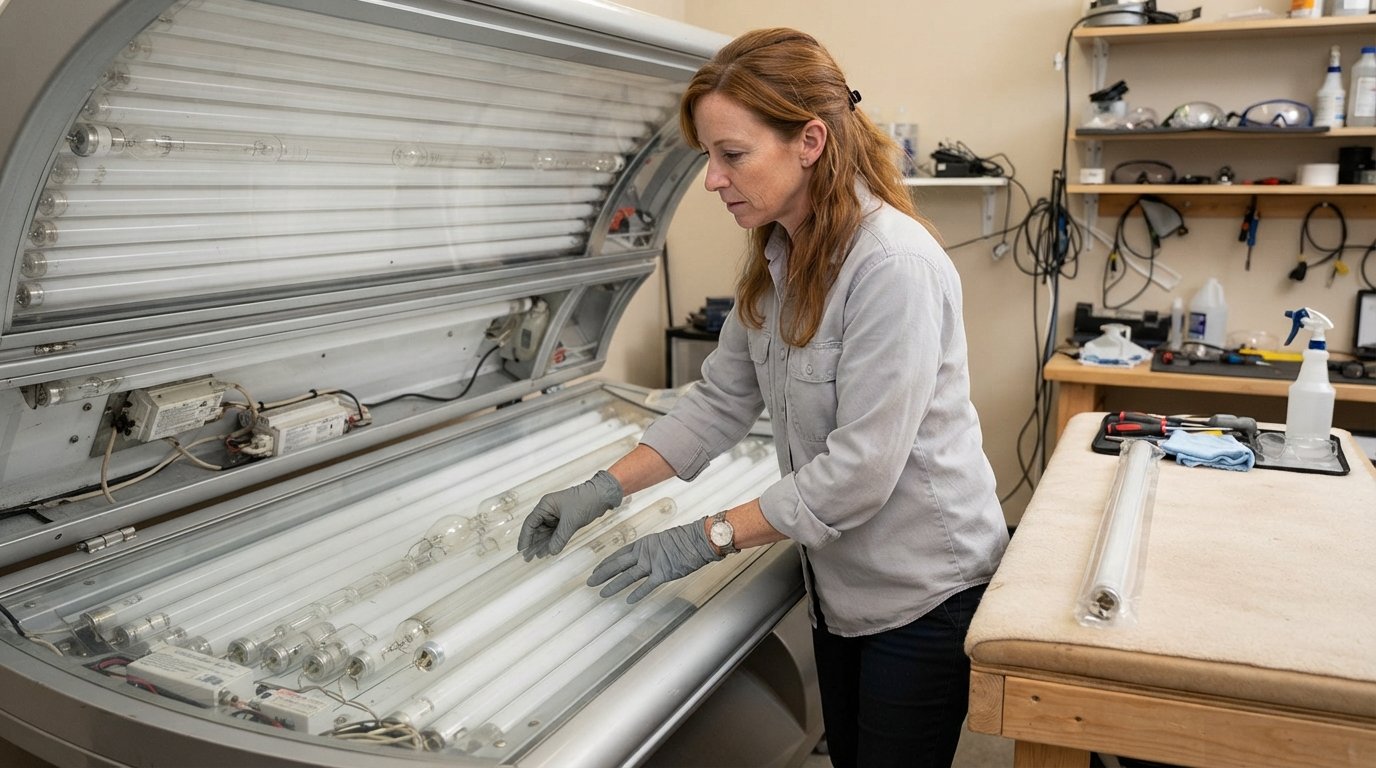
Tanning bed bulbs are the light-producing components inside tanning beds and tanning booths that generate ultraviolet (UV) radiation. Choosing the correct tanning bed lamp is important because different beds are designed for specific lamp types, lengths, wattages, and electrical specifications.
Whether you need tanning bed replacement bulbs, want to understand tanning lamp wattage, or are trying to determine why your tanning bed bulbs are not working properly, this guide covers the essential information you need.
Important: Tanning beds expose the skin to UV radiation, which can cause sunburn, premature skin aging, eye injury, and skin cancer. No tanning bed or bulb can make indoor tanning risk-free. Always follow the equipment manufacturer’s instructions and applicable safety guidance.
What Are Tanning Bed Bulbs?
Tanning bed bulbs are specialized fluorescent or other UV-emitting lamps designed for tanning equipment. Unlike ordinary household light bulbs, tanning lamps are engineered to produce specific amounts and types of ultraviolet radiation.
A tanning bed typically contains multiple lamps positioned beneath or around the user. The lamps work together to produce UV exposure over a designated area.
Tanning bed lamps can vary in:
- Length
- Diameter
- Wattage
- UV output
- Electrical characteristics
- Manufacturer
- Intended tanning-equipment application
Because of these differences, you should never assume that any UV lamp will work in every tanning bed.
How Do Tanning Bed Bulbs Work?
Many traditional tanning beds use fluorescent-style UV lamps.
When electricity passes through the lamp, it produces ultraviolet radiation. The lamp is designed to emit particular wavelengths that interact with the skin.
The UV spectrum is generally divided into:
- UVA
- UVB
- UVC
Commercial tanning lamps are primarily associated with UVA and UVB radiation. UVC is not the intended tanning component.
The exact UV spectrum depends on the lamp design and manufacturer.
What Is the Difference Between Tanning Bed Bulbs and Regular Light Bulbs?
A regular household bulb is designed primarily to produce visible light.
A tanning lamp, by contrast, is specifically engineered to emit UV radiation.
| Feature | Tanning Bed Bulb | Regular Household Bulb |
|---|---|---|
| Primary purpose | UV exposure | Visible illumination |
| UV output | Designed for UV emission | Generally minimized |
| Common technology | Specialized UV lamp | LED, incandescent, fluorescent, etc. |
| Application | Tanning equipment | Household fixtures |
| Replacement | Must match equipment specifications | Usually easier to match |
A tanning lamp should only be used in equipment designed for that specific type of lamp.
What Types of Tanning Bed Bulbs Are Available?
There are different categories of tanning lamps and replacement bulbs.
Low-Pressure Tanning Lamps
Many traditional tanning beds use low-pressure fluorescent lamps.
These lamps can be manufactured with different UV characteristics and wattages.
High-Pressure Tanning Lamps
High-pressure tanning systems use different lamp technology and often have different requirements from conventional fluorescent tanning beds.
They should not be treated as interchangeable with standard low-pressure lamps.
Facial Tanning Lamps
Some tanning equipment contains dedicated facial lamps designed for specific sections of the unit.
These lamps may have different specifications from the main body lamps.
Replacement Tanning Lamps
Replacement lamps are manufactured to match particular tanning equipment specifications.
The correct replacement depends on the original lamp and tanning-bed model.
What Does Tanning Bed Bulb Wattage Mean?
Tanning bed bulb wattage describes the electrical power the lamp is designed to consume under specified operating conditions.
Common tanning lamp wattages vary by equipment.
You may encounter lamps around:
- 20W
- 25W
- 32W
- 40W
- 80W
- Other specialized ratings
The correct wattage depends on the tanning bed.
A higher wattage does not automatically mean a better or safer tanning lamp. Installing an incorrect wattage can create electrical, thermal, and equipment problems.
Always use the lamp specification recommended by the equipment manufacturer.
Why Does Tanning Bed Bulb Wattage Matter?
The tanning bed’s electrical system is designed around particular lamp specifications.
Using an incorrect bulb can affect:
- Ballast operation
- Electrical load
- Heat production
- Lamp performance
- Equipment lifespan
- UV exposure
For this reason, replacing a lamp should involve matching the manufacturer’s specified replacement rather than simply choosing the highest-wattage lamp available.
How Long Do Tanning Bed Bulbs Last?
The useful life of tanning bed bulbs depends on the lamp type, equipment, usage, operating conditions, and manufacturer’s specifications.
A lamp can continue to illuminate while its UV output has declined.
This is important because visible light does not necessarily tell you how effectively a UV tanning lamp is performing.
Many manufacturers provide a recommended lamp replacement interval based on operating hours.
Always follow the lamp and tanning-bed manufacturer’s maintenance recommendations.
How Do You Know When Tanning Bed Bulbs Need Replacing?
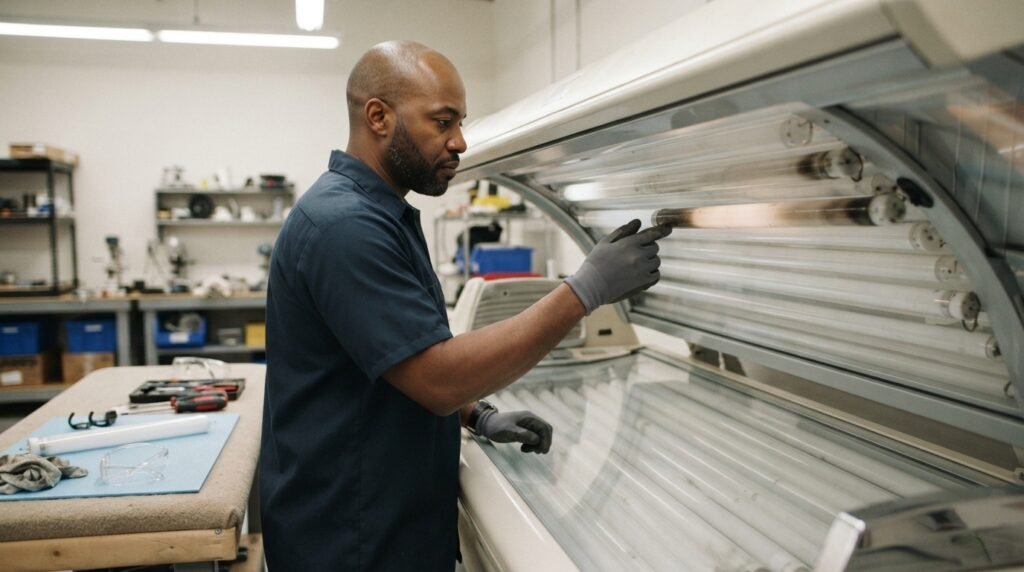
Several signs can indicate that tanning lamps require attention.
Reduced Lamp Output
The bulbs may appear to operate normally while producing less UV output than when new.
Darkened Lamp Ends
Discoloration or darkening near the ends can occur as fluorescent lamps age.
Flickering
Flickering may indicate an aging lamp, ballast issue, starter problem, or electrical fault.
Lamps Not Turning On
A lamp that fails to illuminate may be defective, improperly seated, or affected by another component.
Uneven Performance
If some lamps appear noticeably different from others, the system may require inspection.
Do not rely solely on visual appearance to determine UV output.
Should You Replace All Tanning Bed Bulbs at Once?
Whether you should replace every lamp depends on the equipment manufacturer’s recommendations and the condition of the existing lamps.
Replacing lamps as a complete set can provide more consistent performance because lamps installed at the same time tend to have similar operating hours.
However, some systems may permit individual replacement.
Follow the maintenance instructions for your particular tanning equipment.
How to Choose the Correct Tanning Bed Replacement Bulbs
Finding the correct tanning bed replacement bulbs requires more than matching the physical length.
Check the following specifications:
1. Tanning Bed Model
Find the manufacturer’s model number.
2. Existing Lamp Information
Read the markings printed on the original lamp.
3. Lamp Length
Measure or verify the specified lamp length.
4. Wattage
Match the manufacturer’s required wattage.
5. Lamp Type
Determine whether the equipment uses the appropriate low-pressure, high-pressure, facial, or other lamp type.
6. Electrical Specifications
Check the required electrical characteristics and ballast compatibility.
7. Manufacturer Recommendations
Use the equipment manufacturer’s approved replacement specification whenever possible.
Can You Use Any Tanning Bed Bulb?
No.
Tanning lamps are not universally interchangeable.
Even if two lamps look similar, they may differ in:
- Wattage
- Length
- Electrical characteristics
- UV output
- Lamp construction
- Ballast compatibility
Using the wrong lamp can result in poor performance or equipment damage.
What Are Tanning Bed Bulb Sizes?
Tanning bed lamps are available in different lengths and diameters.
The correct size depends on the tanning equipment.
Common lamp lengths can include approximately:
- 5 feet
- 6 feet
- Other specialized dimensions
However, you should not choose a replacement based on approximate length alone.
Check the exact lamp designation and equipment specifications.
What Is a Tanning Bed Ballast?
A ballast is an electrical component used with many fluorescent tanning lamps.
It helps regulate the electrical current supplied to the lamp.
The ballast and lamp must be compatible.
If a tanning bed has flickering lamps, lamps that do not start, or other electrical problems, the issue may involve the ballast rather than the bulbs themselves.
Why Are My Tanning Bed Bulbs Flickering?
Flickering can have several causes.
Possible causes include:
- Aging lamps
- Faulty ballast
- Loose electrical connections
- Starter problems
- Incorrect lamp specifications
- Electrical issues
Replacing a lamp may not solve the problem if the underlying issue is electrical.
Because tanning equipment involves high electrical voltage and UV exposure, electrical repairs should be performed by appropriately qualified personnel.
Why Are Some Tanning Bed Bulbs Not Turning On?
If one or more lamps fail to illuminate, possible causes include:
- Failed lamp
- Poor electrical connection
- Ballast problem
- Starter issue
- Damaged socket
- Incorrect replacement lamp
Do not repeatedly operate equipment with suspected electrical faults.
Disconnect the equipment according to the manufacturer’s procedures and have it inspected if necessary.
Can LED Bulbs Replace Tanning Bed Bulbs?
Generally, ordinary LED bulbs are not direct replacements for tanning lamps.
A standard LED light bulb is designed to produce visible light, while tanning lamps are specifically designed for UV output.
A tanning bed’s electrical system, lamp holders, ballast, and other components are designed for specific lamp technology.
Do not install ordinary LED bulbs in tanning equipment unless the entire system has been specifically designed and approved for such a conversion.
How Much Do Tanning Bed Bulbs Cost?
The cost of tanning bed bulbs varies considerably.
Pricing can depend on:
- Lamp type
- Brand
- Length
- Wattage
- UV characteristics
- Quantity purchased
- Replacement vs. original equipment parts
Buying a complete set can cost considerably more than replacing a single lamp.
When comparing prices, make sure you are comparing compatible lamps rather than simply choosing the cheapest option.
Are Used Tanning Bed Bulbs Worth Buying?
Used UV lamps can be difficult to evaluate because visible appearance does not necessarily reveal remaining UV output.
A used lamp may look functional but have already accumulated substantial operating hours.
For consistent equipment performance, new lamps from a reputable supplier are generally easier to evaluate than unknown used lamps.
How Should Tanning Bed Bulbs Be Handled?
Tanning lamps should be handled carefully.
For fluorescent-style lamps:
- Follow the manufacturer’s installation instructions.
- Avoid striking or dropping the lamp.
- Handle lamps carefully to prevent breakage.
- Keep replacement lamps protected until installation.
- Dispose of old lamps according to applicable local requirements.
Some fluorescent lamps contain small amounts of mercury, so broken or discarded lamps may require special handling.
Are Tanning Bed Bulbs Dangerous?
Yes. Tanning lamps are specifically designed to emit UV radiation, and exposure can harm the skin and eyes.
Potential risks associated with UV exposure include:
- Sunburn
- Premature skin aging
- Eye injury
- Skin damage
- Increased skin-cancer risk
The risk does not disappear simply because the UV source is an indoor tanning lamp.
Do Tanning Bed Bulbs Cause Skin Cancer?
UV radiation from tanning equipment can damage DNA in skin cells.
Exposure to artificial UV radiation from indoor tanning devices is associated with an increased risk of skin cancer, including melanoma and other skin cancers.
There is no tanning-bed bulb that makes UV tanning completely safe.
If your goal is cosmetic tanning, UV-free alternatives such as sunless tanning products can provide color without exposing the skin to tanning-bed UV radiation.
Tanning Bed Bulbs and Eye Protection
UV radiation can also damage the eyes.
When using tanning equipment, follow the equipment manufacturer’s requirements for appropriate protective eyewear.
Ordinary sunglasses are not necessarily adequate protection.
Never look directly at tanning lamps without appropriate protection.
How to Replace Tanning Bed Bulbs
Replacing tanning lamps should be done according to the manufacturer’s instructions.
A general process may involve:
- Turn off and disconnect the tanning equipment.
- Allow lamps and equipment to cool.
- Follow the manufacturer’s access instructions.
- Remove protective covers as directed.
- Carefully remove the old lamp.
- Install the specified replacement lamp.
- Reinstall all protective components.
- Verify that the equipment operates according to the manufacturer’s instructions.
If you are not familiar with the electrical and mechanical requirements of the equipment, have the work performed by a qualified technician.
Why Proper Tanning Bed Bulb Replacement Matters
Installing the correct lamp helps ensure that the equipment operates within its designed specifications.
An incorrect replacement can affect:
- Lamp performance
- Electrical components
- Heat management
- UV output
- Equipment reliability
For commercial tanning businesses, following the manufacturer’s maintenance schedule is particularly important.
Tanning Bed Bulbs vs. Sunlight
Both sunlight and tanning equipment can expose the skin to UV radiation.
A tanning bed provides an artificial UV source in a controlled environment, but controlled exposure does not mean risk-free exposure.
The safest approach is to minimize unnecessary UV exposure and use appropriate protection.
How to Maintain Tanning Bed Bulbs
Proper maintenance can help maintain equipment performance.
Keep the Equipment Clean
Follow the manufacturer’s cleaning procedures for acrylic surfaces and surrounding components.
Inspect Lamps Regularly
Look for visible damage, darkening, or other abnormalities.
Monitor Operating Hours
If the manufacturer provides a lamp-hour replacement recommendation, keep track of usage.
Check the Electrical System
Have electrical components inspected when there are signs of malfunction.
Follow Manufacturer Instructions
The manufacturer’s service documentation should take priority over generic maintenance advice.
Frequently Asked Questions
1. What are tanning bed bulbs?
Tanning bed bulbs are specialized UV-emitting lamps designed for use in tanning beds and tanning equipment.
2. How long do tanning bed bulbs last?
Their useful life depends on the lamp design, equipment, operating conditions, and manufacturer’s specified replacement interval. UV output can decline even while the lamp still produces visible light.
3. What wattage are tanning bed bulbs?
Tanning lamps are available in different wattages. The correct wattage depends on the specific tanning bed and its electrical system.
4. Can I use regular light bulbs in a tanning bed?
No. Ordinary household bulbs are not designed to provide the specialized UV output required by tanning equipment.
5. Can LED bulbs replace tanning bed bulbs?
Ordinary LED bulbs are not direct replacements for UV tanning lamps. Any conversion should only be performed when specifically designed and approved for the equipment.
6. How do I know which tanning bed replacement bulbs to buy?
Check the tanning bed model, original lamp markings, length, wattage, lamp type, electrical specifications, and manufacturer recommendations.
7. Why are my tanning bed bulbs flickering?
Flickering can be caused by aging lamps, ballast problems, electrical connections, starters, or incorrect lamp specifications.
8. Should all tanning bed bulbs be replaced together?
It depends on the equipment and maintenance recommendations. Replacing lamps as a set can provide more consistent performance when the existing lamps have similar operating hours.
9. Are tanning bed bulbs safe?
Tanning lamps emit UV radiation, which can damage skin and eyes and increase skin-cancer risk. Indoor tanning is not risk-free.
10. Can tanning bed bulbs burn your skin?
Yes. UV exposure from tanning equipment can cause sunburn and other forms of skin damage.
Final Thoughts
Tanning bed bulbs are specialized UV lamps that must be matched carefully to the tanning equipment in which they are installed. Factors such as lamp type, length, wattage, electrical compatibility, and manufacturer specifications all matter when choosing tanning bed replacement bulbs. If a lamp needs replacement, don’t select a bulb simply because it looks similar or has a higher wattage. Check the tanning bed’s model information and use the manufacturer’s recommended lamp specification.
Most importantly, remember that tanning lamps produce ultraviolet radiation. Indoor tanning carries health risks, including skin damage, premature aging, eye injury, and increased skin-cancer risk. For cosmetic tanning without UV exposure, consider safer non-UV alternatives such as sunless tanning products.
About the Author